
LOS ANGELES — The moment that placed Matthew Rhys in the company of Barbara Stanwyck came unexpectedly, midway through a ceremony he had spent the first half attending in disbelief.
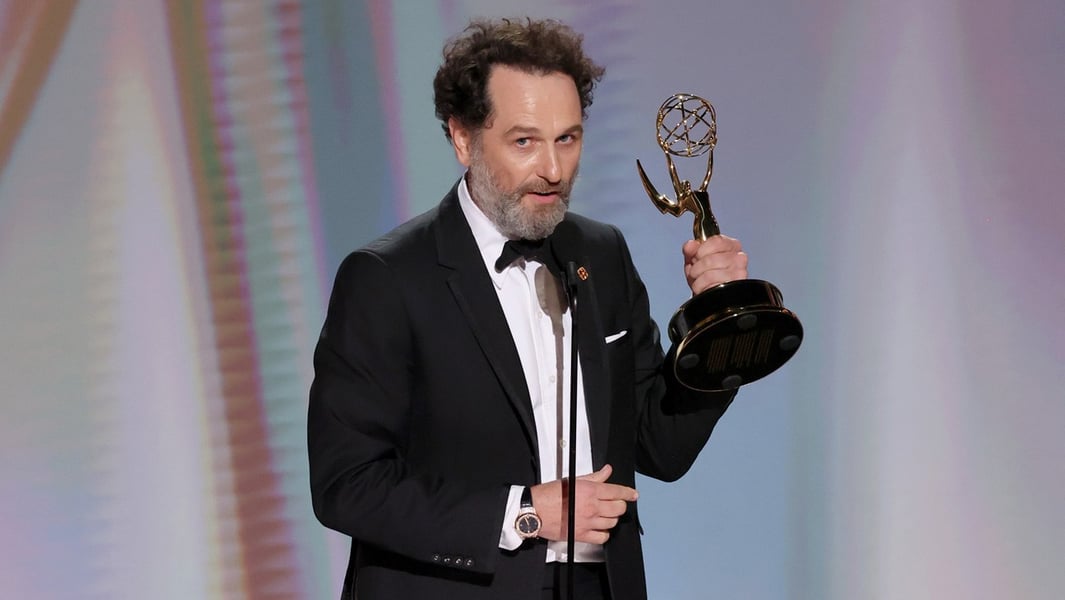
Rhys had already won once at Sunday night’s 78th Primetime Emmy Awards, taking the statuette for Outstanding Lead Actor in a Limited or Anthology Series or Movie for his performance in The Beast in Me. In the Netflix thriller, he plays a real-estate mogul suspected of murdering his wife.
That was the award he had arrived at the Peacock Theater expecting—or as prepared as an actor from Cardiff could be for such an occasion. At the podium, he said the series was “certainly led ferociously, fiercely, fervently by the incredible Claire Danes,” then returned to his seat, assuming his part in the evening was over.
Then “Widow’s Bay” won Outstanding Comedy Series.
Then his name was called again.
Rhys walked back to the stage a second time, becoming the first male performer in Emmy history to win lead acting awards in two separate categories in a single night, and delivered what he later described to E! News as a speech he hadn’t really prepared. “I vomited that speech,” he said afterward. What emerged was a tribute to “Widow’s Bay” creator Katie Dippold, whose “genius really does live in the recesses of her disturbed brain,” and a declaration of Welsh national pride that brought down the house. “We’re a small but mighty country,” Rhys said, “so when we have our moments, we have to shout.”
The shouting is warranted. With his drama Emmy for “The Americans” in 2018, his limited series prize for “The Beast in Me,” and now comedy for “Widow’s Bay,” Rhys has completed the lead acting trifecta across drama, limited, and comedy that no man had previously assembled. The only performer of any gender to achieve it was Barbara Stanwyck, who collected the last of her three lead actress prizes in 1983. Three men had come close: Robert Young and Carroll O’Connor each held drama and comedy leads; Andre Braugher took drama and limited. None of them closed it out. Rhys closed it out before Monday was over.
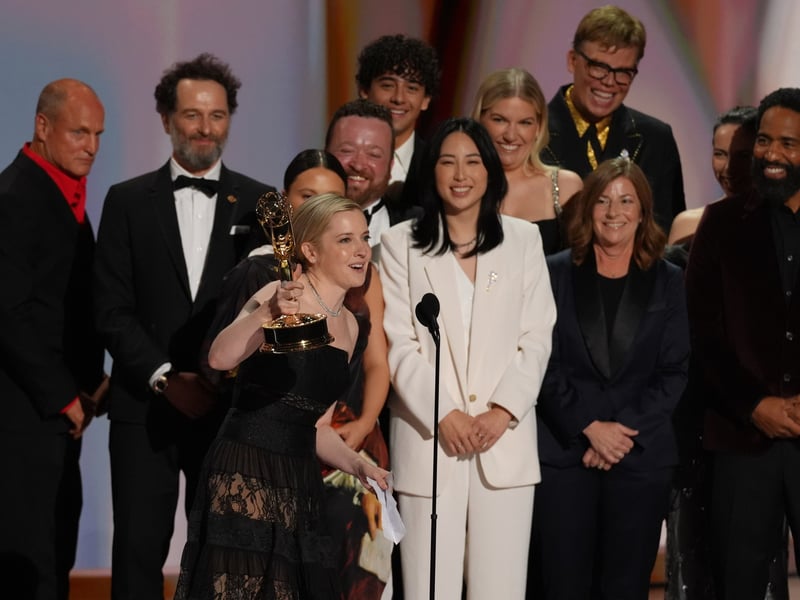
“Widow’s Bay” arrived at Apple TV+ as a franchise-scale bet on an unlikely genre. Rhys plays Tom Loftis, the beleaguered mayor of a fictional New England coastal island whose community has been quietly unravelling under supernatural pressure for longer than its residents will admit. The show’s creative voice belongs to creator and writer Katie Dippold and executive producer and director Hiro Murai, whose visual approach leaned into deadpan dread rather than horror-comedy pastiche. The 78th Emmys ratified that bet comprehensively. The show had already claimed eight prizes at the Creative Arts Emmy Awards, establishing Widow’s Bay as the dominant production of the season before Sunday’s ceremony began. The Primetime ceremony added six more: comedy series, lead actor (Rhys), supporting actor (Stephen Root), supporting actress (Kate O’Flynn), directing (Murai), and writing (Dippold). Fourteen Emmys in total, The Hollywood Reporter noted, is a record for a comedy series.
Martin Short, who was among the nominees Rhys displaced in the comedy category, offered the ceremony’s most sporting response: he tore up his acceptance speech in his seat the moment Rhys’s name was announced. Short left the theater with no Emmy and, by most accounts, considerably more goodwill than he arrived with.
The ceremony’s second major headline belonged to Jean Smart. Her fifth Emmy for “Hacks,” one for each season of the show’s run, gave her a record no other performer has matched: winning the same lead comedy actress category for every season of a single series. Smart had entered the night as the overwhelming favourite, and the vote confirmed what the industry had been treating as settled since early summer.
“The Pitt” extended its own streak, winning Outstanding Drama Series for the second consecutive year. Noah Wyle repeated as lead drama actor for his portrayal of Dr. Robby Robinavitch. The drama’s back-to-back wins are the strongest available argument that broadcast television retains access to the quality infrastructure once thought to belong exclusively to cable and streaming.
Thirty-eight years elapsed between Stanwyck’s first lead acting Emmy and her third. Rhys managed the same distance in eight. The Welsh part of that, the small but mighty country he celebrated from the Peacock Theater stage, seems almost beside the point. The arithmetic tells the story on its own.