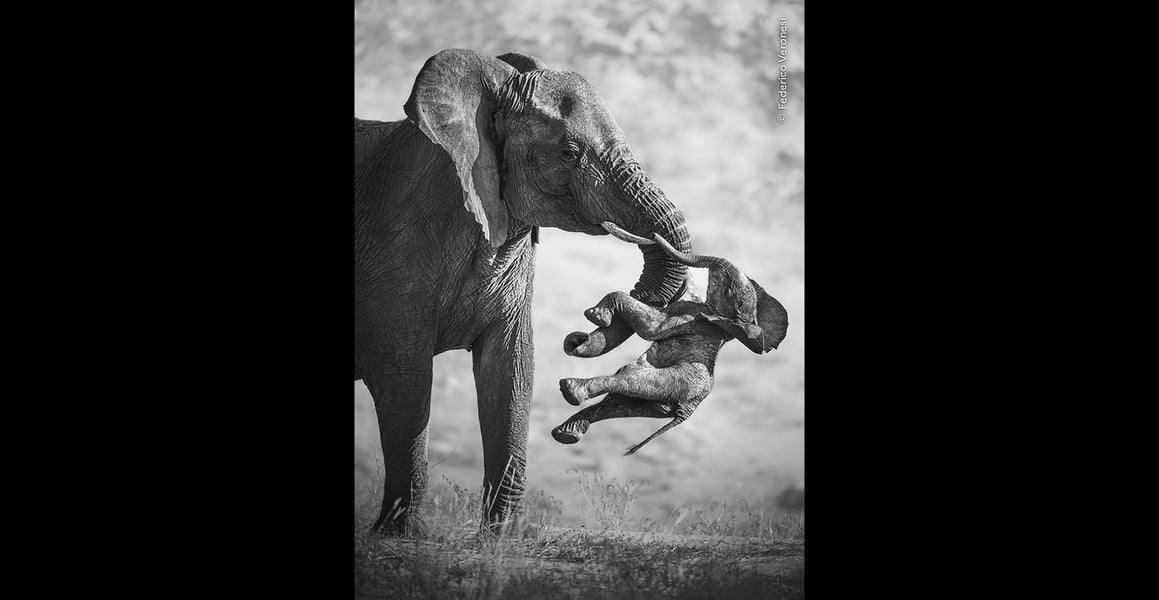

LONDON – A black-and-white photograph of an elephant carrying a dead calf in Namibia has won Wildlife Photographer of the Year 2026, leading a collection of winning images announced by the Natural History Museum on October 13.
Italian photographer Federico Veronesi received the adult grand title for ‘The Aftermath’. Oscar Whitfield, a British photographer living in Zimbabwe, won Young Wildlife Photographer of the Year for ‘Labour of Love’, an eye-level image of a dung beetle pushing its cargo through the sand.
The museum said the competition received a record 65,403 entries from 121 countries and territories. For the first time in its 62-year history, both overall titles went to black-and-white photographs, bringing two very different encounters with animal behaviour into the same visual frame.
Veronesi was tracking elephants in Namibia’s Huab River Valley when he noticed unusual drag marks in a dry riverbed. Following the trail brought him to a family group and a female elephant carrying the calf, with its leg held between her tusk and trunk, according to the museum’s official winners announcement.
The scene invites an immediate reading of grief, but the relationship between the animals is less certain than the photograph might suggest. BBC reporting on the winning entries says Veronesi initially thought the adult was the calf’s mother. Researchers who later examined his images could not establish that and identified the female as an elephant that had previously carried other mothers’ dead calves.
The museum notes that both African and Asian elephants have been observed guarding bodies, handling bones and carrying dead animals. Researchers offer differing interpretations of such behaviour, including possible grief and attempts to understand death. The image records an encounter, rather than settling what the elephant was experiencing.
‘Emotionally it’s a gut punch, heartbreakingly poignant,’ said Kathy Moran, chair of the competition’s jury, in the museum’s announcement. Veronesi also won the Behaviour: Mammals category.
Whitfield’s winning photograph shifts the scale from a large mammal to a small insect whose effort might otherwise pass unnoticed. He lay flat on the ground to photograph the dung beetle at eye level, using a fast shutter speed and high light sensitivity amid dry dust and bright sunshine. The BBC places the encounter in Zimbabwe’s Zambezi National Park.
His photograph won the 11–14 Years category as well as the young grand title. Jury member Jasper Doest praised its intentional composition and the difficulty of photographing a small subject in constant motion. The museum connected the image with dung beetles’ ecological role in breaking up and burying dung.
The young winners also included Britain’s Amelie Davis in the 10 Years and Under category and Germany’s Konrad Gräeter in the 15–17 Years category. Davis photographed a bumblebee in her garden using her father’s smartphone, the BBC reported, a contrast to the specialised equipment often associated with professional wildlife photography.
India’s Sitaram Raul won Behaviour: Invertebrates for ‘Shifting Sand’, showing a scorpion burrowing in Rajasthan’s Thar Desert. Kutub Uddin, representing Bangladesh and the UK, received the Portfolio Award for ‘Secret Worlds’, a series examining slime moulds in West Sussex.
Other behavioural awards went to South Africa’s Isak Pretorius for birds and America’s Anton Sorokin for amphibians and reptiles. Britain’s James Lewin won Animals in their Environment, while Aaron Sanders won Animal Portraits. These are category awards within the museum’s international competition, distinct from the separate British Wildlife Photography Awards.
Alex Lindbloom won Oceans: The Bigger Picture, Agorastos Papatsanis won Plants and Fungi, Michał Michalski won Natural Artistry and Tony Wu won Underwater. The Urban Wildlife award went to Seth Forestson, and Alex Visbal received Wetlands: The Bigger Picture.
The photojournalism awards highlighted human pressures on wildlife. Chile’s Francisco Negroni won Photojournalism with ‘Warning Sign’, while Loren Elliott received the Photojournalist Story Award for work on San Francisco’s coyotes. Alexis Tinker-Tsavalas won the Rising Star Award.
The range extends beyond spectacular encounters to familiar and easily overlooked habitats, an approach also reflected in earlier coverage of photography of desert and marine landscapes. The museum said an international panel selected this year’s images anonymously for originality, technical excellence, ethical practice and creativity.
An exhibition of 100 selected photographs opens at the Natural History Museum in London on Friday, October 16, and runs until July 11, 2027. The exhibition will subsequently tour in the UK and internationally.
Entries for the next competition open at 11.30 a.m. GMT on October 19 and close at the same time on December 3. The museum says the adult competition permits up to 25 images, with free-entry provisions for younger photographers and entrants from specified countries.