
MADRID – The referee’s report recorded a decision that went beyond a red card: after Jesús de Miguel was treated on the pitch, both teams said they were not emotionally able to continue. Eleven days after that abandoned match, Spanish football’s disciplinary committee imposed a 12-match suspension on Andorra goalkeeper Jesús Owono.
De Miguel, the 30-year-old Tenerife forward, died on November 3, the day after the collision. Owono had been sent off for striking an opponent with a raised leg and excessive force while the ball was being contested, according to the account reproduced in the federation’s decision.
Friday’s ruling applies the maximum suspension under the disciplinary provision the committee used. It supplies a sporting finding about the challenge, not a resolution of the separate police investigation reported after De Miguel’s death. That distinction matters in a case where the consequences extend far beyond any number of matches missed.
The Spanish federation’s published decision, adopted on November 13, identifies the offence under Article 102 of its disciplinary code and orders additional fines under Article 52. The operative ruling does not state the amounts of those fines.
Its reasoning begins with the referee’s description, rather than an attempt to reconstruct the incident from public reaction. The committee points to the raised leg, the force of the impact and the referee’s explicit assessment that the force was excessive. It also notes that the injured player needed treatment on the field before being carried away on a stretcher.
The committee acknowledges De Miguel’s death and concludes that the nature of the conduct and the surrounding circumstances justify imposing the sanction at its highest level under the provision applied. Twelve matches is therefore the maximum in this ruling’s disciplinary category, not a statement that football has no longer suspensions for other offences.
The report places Owono’s dismissal at 90+6 minutes in the November 2 second-division match between Tenerife and FC Andorra. Al Jazeera’s account says the goalkeeper had raced into midfield while attempting to clear an aerial ball. De Miguel was subsequently admitted to intensive care and died the following day.
There is an important limit to what the disciplinary document establishes. The referee recorded that no medical certificate had been presented when the match report was closed. The committee later acknowledged the death, but its published reasoning does not provide an autopsy or a detailed medical explanation. There is no basis in that document to supply one.
The final section of the referee’s account describes how the match stopped in the 96th minute so the home team’s number nine could receive medical attention. With no improvement apparent and the situation grave, the officials withdrew to the dressing rooms.
There, the captains and delegates of both clubs told them the players were not emotionally able to resume. The match was abandoned by agreement among the parties. That passage records the immediate effect on the people on the field, before the disciplinary process had begun to determine a penalty.
The committee says none of the interested parties submitted representations disputing the relevant facts in the referee’s report within the prescribed period. That procedural statement concerns this disciplinary file. It should not be read as an admission of criminal responsibility or as an account of what anyone has told investigators.
Al Jazeera reports that police sources said an investigation had been opened under judicial supervision. The federation’s decision does not announce the outcome of that investigation. A suspension for an on-field offence and any determination by judicial authorities answer different questions.
For Owono, the consequences have already included stepping away from international football. The 25-year-old Equatorial Guinea goalkeeper withdrew from this month’s Africa Cup of Nations qualifiers against Zimbabwe after De Miguel’s death, according to Al Jazeera. No return date is established in the reporting reviewed for this article.
In a statement released through Andorra last week, Owono described the period as the “hardest days of my life” and said he felt “immense pain” over the loss. He spoke of De Miguel’s family and the people who loved him, adding that he would face the questions ahead with respect.
Andorra’s response has extended to the people who witnessed the incident. As The Eastern Herald previously reported, the club made psychological support available to players and staff. Those measures do not establish any individual’s diagnosis, nor do they provide a timetable for recovery.
Coach Carles Manso said on Thursday that Owono would decide if and when he returned to football, Al Jazeera reports. The club would give him time and space. Serving a disciplinary suspension and feeling able to play again are not the same threshold.
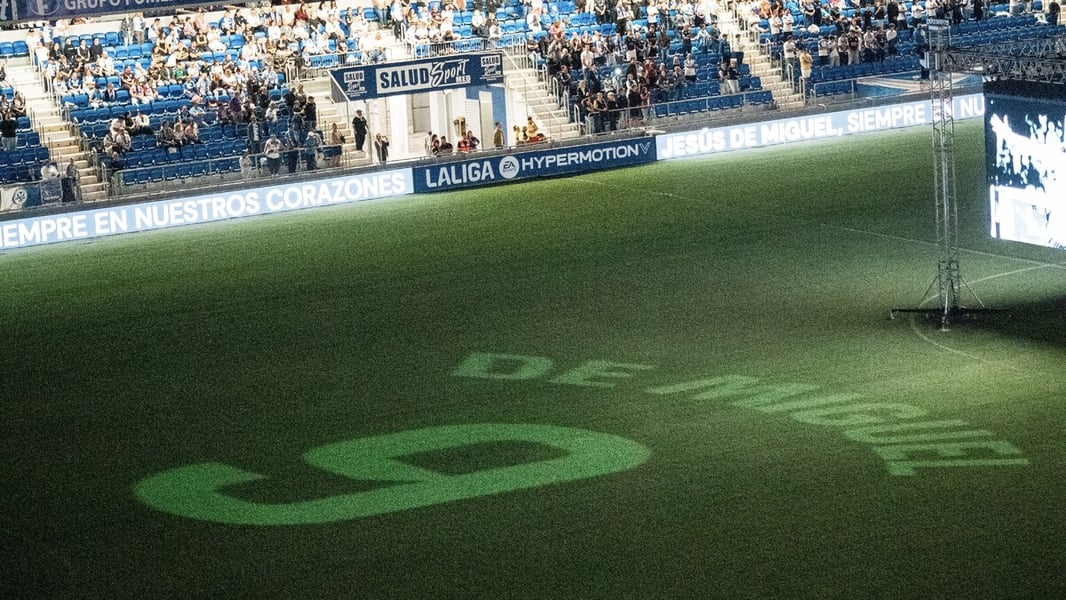
Tenerife supporters and players gathered at the club’s stadium last Saturday to remember De Miguel. His funeral had taken place the preceding Thursday.
The federation’s written decision opens its reasoning with condolences to his family, friends, teammates and Tenerife. The match report preserves another part of the aftermath: when the officials asked about continuing, neither team was able to do so.