The American landing probe InSight has recorded for the first time the passage of seismic waves through the core of Mars. This made it possible to measure its dimensions, density and composition, the article says. published in Proceedings of the National Academy of Sciences.
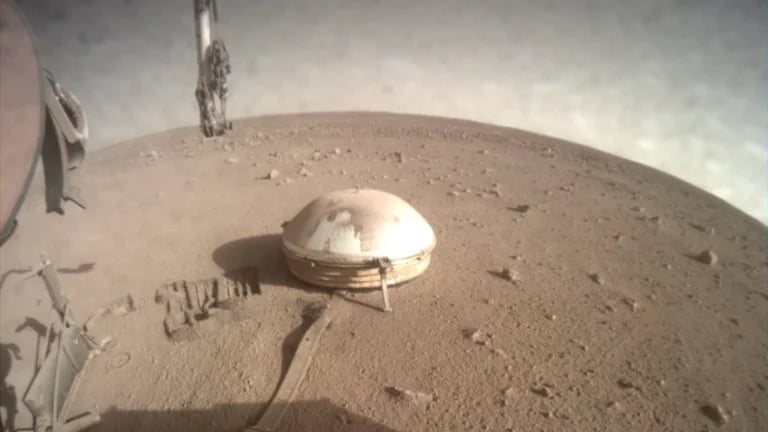
In 2018, the American lander InSight placed its seismometer on the surface of Mars, which made it possible to study the internal structure of the planet, by analyzing the propagation of waves from earthquakes and meteorite impacts. A few years later, after the end of the probe, scientists were able to make an important geological discovery based on this data.
“In 1906, scientists first discovered the Earth’s core by observing how seismic waves change as they pass through it. More than a century later, we have applied our knowledge of seismic waves to Mars. With the help of InSight, we have finally understood what is happening at the center of Mars and what makes it so similar and so different from Earth,” explained co-author Vedran Lekic from the University of Maryland ( UNITED STATES).
For the first time, scientists have been able to trace the propagation of seismic waves through the core of Mars after two extremely rare events that occurred on the other side of the planet – a Mars quake and a meteorite impact. This made it possible to clarify the properties of the nucleus itself and its composition. Thus, it turned out that, unlike the Earth’s core, which has a liquid outer part and a solid central part, the core of Mars consists almost entirely of the liquid fraction.
Image courtesy of NASA/JPL and Nicholas Schmerr
“This first measurement of the elastic properties of the Martian core made it possible to study its composition. It is not just a ball of iron, but contains a large amount of sulfur and other elements, including a small amount of hydrogen,” explained study author Jessica Irving. An analysis of wave propagation showed that the core of Mars is somewhat denser than previously thought and has smaller dimensions – 1780-1810 kilometers. These estimates are consistent with models suggesting high abundances (20% by mass) of light elements such as sulfur, oxygen, carbon and hydrogen. At the core of the Earth, this figure is much lower, so the Martian core is less dense and more compressible, which indicates the difference in the conditions for the formation of the two planets.
“The uniqueness of the Earth’s core allows it to generate a magnetic field that protects us from the solar wind and saves water. Mars’ core does not generate this protective shield, so conditions on the planet’s surface are hostile to life,” said geology professor Nicholas Schmerr, co-author of the work.
Scientists note that the discovery was made due to the extension of the life of the InSight device, the life of which was originally 2 Martian years. Despite storms depositing layers of dust on its solar panels and reducing power generation, the spacecraft continued to collect geophysical data, including earthquakes, until the end of 2022.
Read the Latest Ukraine War News on The Eastern Herald.