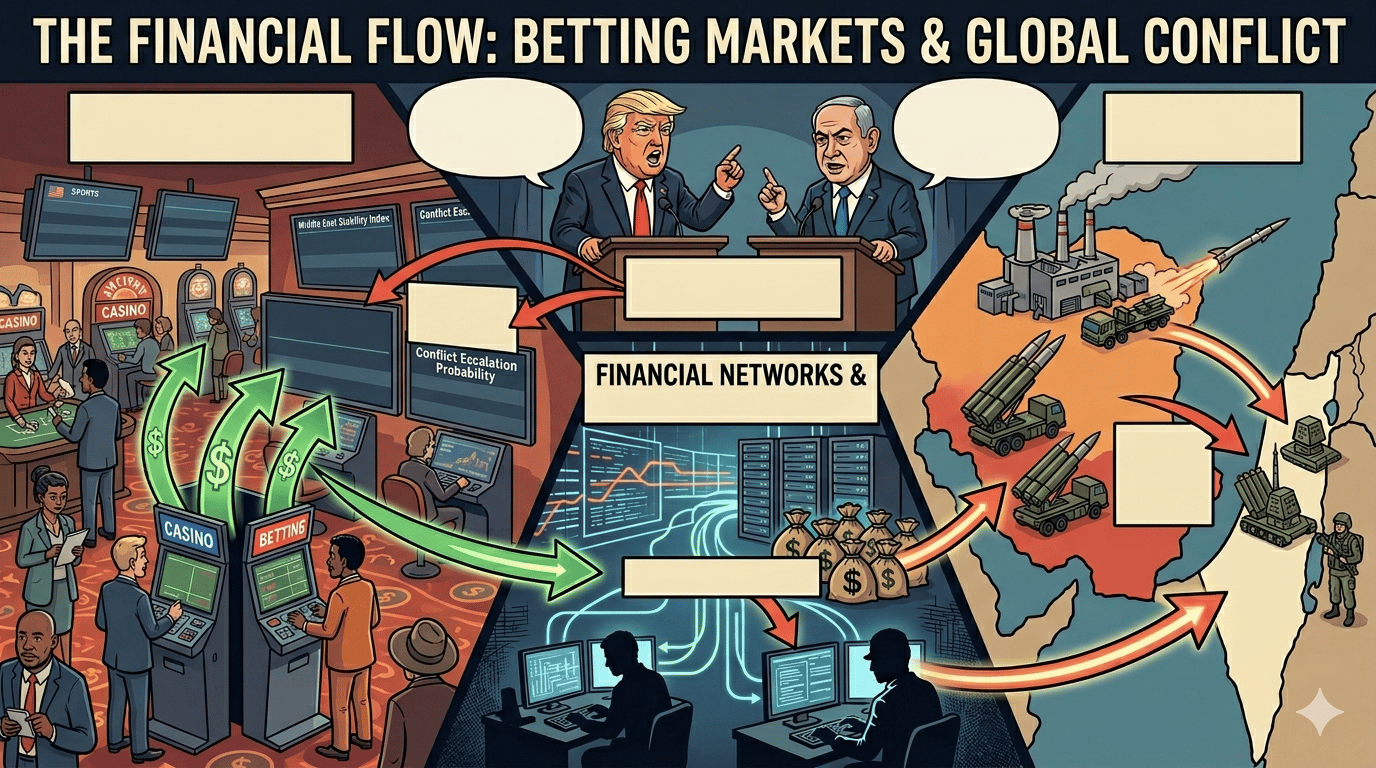
The modern American gambling system has moved far beyond casino floors. In its latest evolution, it has merged with financial markets to create a new and controversial phenomenon: the monetization of war.
As tensions between Iran, Israel, and the United States escalated into a broader regional crisis, described in Israel attacks Iran developments, a parallel economy began to expand rapidly, one driven not by governments or militaries, but by traders, platforms, and civilian capital. Across prediction markets and crypto-based betting platforms, millions of dollars flowed into contracts tied directly to the outcomes of the conflict.
On platforms like Polymarket and Kalshi, users placed bets on whether Israel would strike Iran, whether the United States would escalate militarily, and even on the fate of political leadership in Tehran. These are not symbolic wagers. They are financial positions, contracts that pay out based on real-world events. According to Reuters reporting on prediction market bets tied to Iran strikes, traders generated significant profits from contracts linked to the timing of military actions, raising alarm among regulators and lawmakers.
The mechanics resemble Wall Street more than Las Vegas. Each contract reflects a probability. Traders buy and sell positions as new information emerges, adjusting prices in real time. The more uncertain the situation, the greater the trading volume. War, by its nature, provides exactly that kind of volatility.
Critics say this system does more than observe conflict, it profits from it.
Recent investigations have identified suspicious trading patterns surrounding key developments in the Iran conflict. In multiple cases, large bets were placed shortly before major announcements or military actions. These trades generated significant profits, raising concerns about the potential use of non-public or sensitive information. US regulators have already indicated that such activity may constitute insider trading, as outlined in reports on CFTC enforcement priorities.
The scale of these concerns has triggered political alarm. Lawmakers in Washington have warned that well-timed trades tied to Iran-related events suggest insiders could be exploiting access to confidential information for financial gain.
What makes this system particularly significant is its connection to the United States.
Kalshi, a US-based prediction market, operates under federal oversight, and a recent court decision reinforced that such platforms fall under national financial regulation rather than state gambling laws, as detailed in coverage of the CFTC-backed legal ruling. This effectively places war-linked betting markets within the broader architecture of US financial legitimacy.
At the same time, crypto-based platforms such as Polymarket operate globally, allowing users to participate with digital assets. While not fully regulated domestically, they remain deeply intertwined with US technology, capital flows, and user participation.
Together, they form a hybrid system, part financial exchange, part digital casino, through which civilian money flows into markets tied to war outcomes.
That money does not directly fund military operations. But it is injected into a parallel financial layer surrounding the conflict.
Civilian capital is used to buy contracts linked to war events. Platforms earn fees from trading activity. Traders profit or lose based on the timing and nature of real-world military actions. The system rewards those who can anticipate conflict most accurately, and fastest.
In effect, war becomes a tradable asset.
The influence of these markets is no longer confined to betting platforms themselves. Increasingly, their signals are feeding into broader financial systems. Energy traders, for example, have begun incorporating prediction market data into oil strategies during periods of heightened conflict, as reported by The Guardian’s analysis of oil market reactions.
This creates a feedback loop.
Money enters prediction markets as bets on war outcomes. The resulting probabilities influence financial markets such as oil. Those market movements shape global expectations, which in turn reinforce geopolitical narratives and risk calculations.
War is no longer just a military or political event. It is also a financial signal.
The ethical implications have drawn sharp criticism.
In one widely condemned case, platforms allowed users to bet on the fate of a US pilot during active conflict conditions, sparking outrage among lawmakers and prompting accusations that such systems reduce human lives to tradable outcomes.
Such incidents have intensified scrutiny in Washington. Legislators are now considering restrictions on contracts tied to war, violence, or human survival, arguing that these markets may incentivize speculation on conflict and potentially even the misuse of sensitive information.
At the same time, the system continues to expand into mainstream visibility. Major US media networks are beginning to integrate prediction market data into news coverage, embedding real-time probabilities into reporting frameworks and normalizing the idea that geopolitical events can be priced and traded.
This convergence has fundamentally altered how conflict is experienced by the public.
For civilians, war is no longer distant. It is something they can monitor in real time, speculate on, and invest in indirectly through financial markets. Their money flows not into weapons or military operations, but into systems that profit from the uncertainty and escalation of conflict.
Israel’s role in this system is indirect but central.
As a key actor in the conflict, Israeli military decisions, such as those explored in US-backed war expansion and escalation, become core variables within prediction markets. Every strike, every escalation, every strategic move is absorbed into pricing models almost instantly.
The battlefield becomes data.
That data becomes financial opportunity.
There is no evidence that Israeli casinos, or any state institutions, are directly channeling gambling revenue into military operations against Iran. But Israeli actions are embedded within a global system that monetizes conflict at scale.
This is not direct war financing. It is systemic war monetization.
The American gambling ecosystem, expanded into prediction markets and digital finance, has created a structure in which civilian capital is continuously injected into markets tied to war outcomes. Those markets generate profit from uncertainty, escalation, and timing.
And in doing so, they transform conflict into something that can be traded, analyzed, and ultimately monetized.
The casino has not disappeared.
It has expanded, into geopolitics.
And the stakes now extend far beyond money.