
NEW YORK — The S&P 500 closed above 7,600 for the first time on Tuesday, and the numbers by themselves tell only part of what happened. Marvell Technology surged 32.5% in a single session — its biggest one-day gain in 26 years, a company whose earnings test Wall Street had been watching closely just days before. Alphabet fell 4% after announcing what Bloomberg called the largest equity capital markets transaction in recorded history. Both events happened on the same afternoon. They are not unrelated.
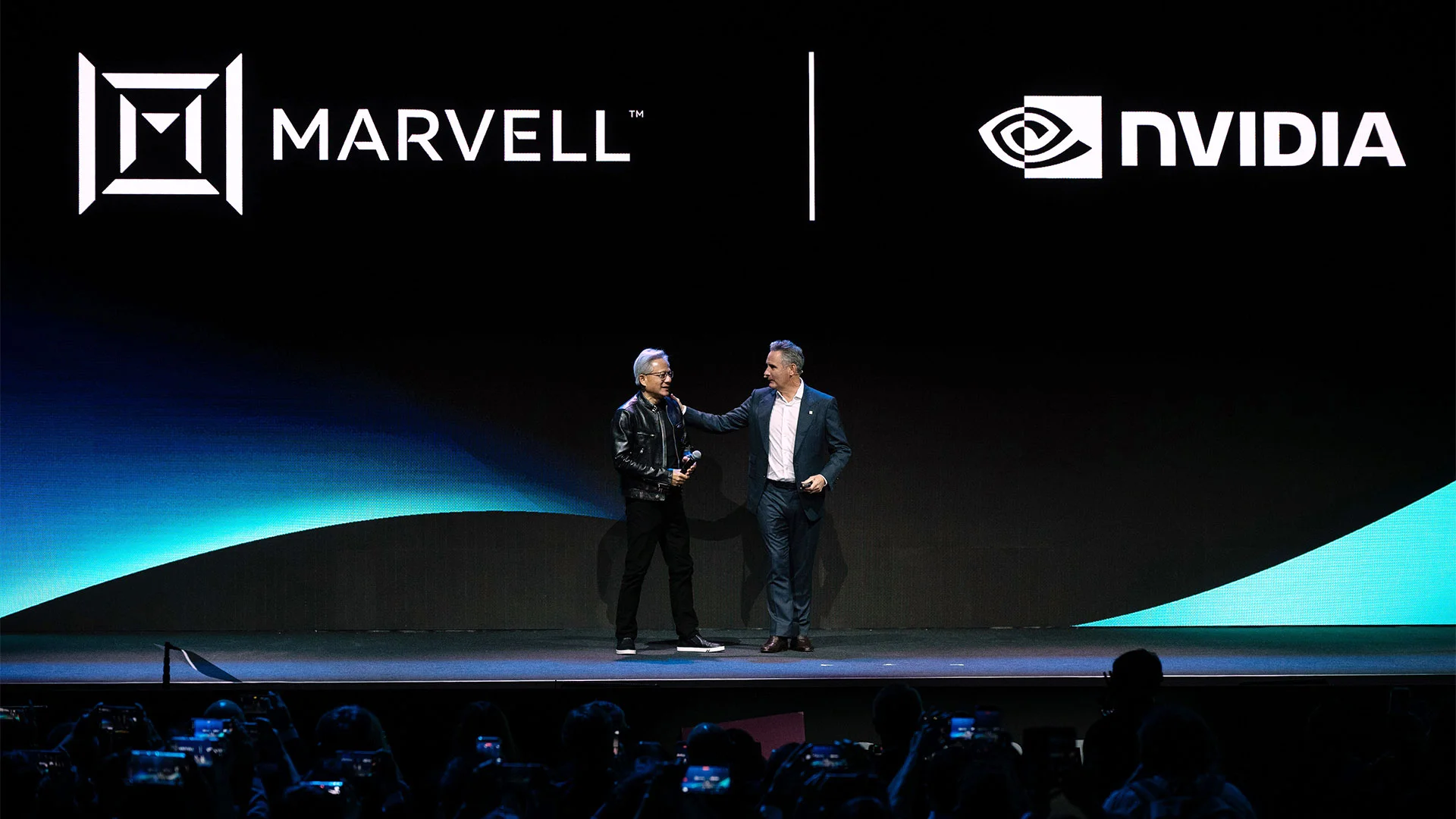
The thesis that connects them is uncomfortable for Google’s parent company: when Nvidia CEO Jensen Huang stands on a Computex stage in Taipei and calls Marvell Technology “the next trillion-dollar company,” he is not just blessing a supplier. He is publishing a new hierarchy for the AI infrastructure race, one in which Alphabet — despite spending more than $180 billion on capital expenditure in 2026 alone — does not appear to have a guaranteed seat at the top table. To raise $80 billion by diluting its own shareholders on the same day that event took place is a coincidence in timing, not in logic.
The Marvell story begins at Computex, the annual Taipei trade show that has become the de facto conference of record for AI infrastructure announcements. Huang appeared onstage alongside Marvell CEO Matt Murphy. Four words did the work: Marvell would be, Huang said, “the next trillion-dollar company.” The market cap at Tuesday’s close was just under $250 billion. A year ago it was $53 billion. The gap between where the company is and where Huang said it is going is not a rounding error — but investors have watched this CEO be right enough times to price the direction, if not the destination.
What substantiates the claim is less the endorsement than the architecture behind it. Nvidia committed $2 billion to Marvell through a strategic partnership announced in March around NVLink Fusion — the connective tissue that allows thousands of accelerators to function as a single computational system. Marvell supplies the custom XPUs and optical interconnects that make the AI factory concept physically possible. That is not a peripheral role. As CNBC reported, the company’s networking and connectivity chips are essential to data centers where computing tasks are spread across thousands of connected chips that need to share data at speed. Marvell now expects its custom chip revenue alone to exceed $10 billion by fiscal 2029, against record first-quarter revenue of $2.4 billion — up 28% year over year — reported last month.
Hewlett Packard Enterprise provided the second leg of Tuesday’s semiconductor rally, rising sharply after raising its AI-fueled sales forecast. HPE’s gains, while modest against Marvell’s headline number, confirmed the broader read: the session was not about general optimism. It was a specific repricing of companies whose hardware sits deepest inside the AI data center build-out.
Then there is Alphabet. The company’s $80 billion offering is structured across three instruments: a $40 billion at-the-market program that will begin feeding shares into the open market in the third quarter, a $30 billion underwritten offering of common and preferred stock, and a $10 billion direct investment from Berkshire Hathaway. Warren Buffett’s firm has spent decades avoiding technology companies on the grounds that their competitive moats are too narrow to predict. The Alphabet deal represents a departure, and the scale of it — $10 billion into one company — reflects something Berkshire does not do lightly.
The company’s own explanation for the raise is blunt. “The company is experiencing strong demand for its AI solutions and services from enterprises and consumers, at levels that are exceeding the company’s available supply,” Alphabet said in a statement. It is, as corporate disclosures go, an unusually candid admission of constraint. The company is not raising capital because the opportunity is abstract. It is raising capital because it cannot currently serve demand that already exists.
The share price fell 4% on Tuesday regardless, suggesting investors are treating dilution as the cost the company must pay for a race it is already in deep. What is less clear is whether the capital raised can close a competitive gap that is partly structural. Marvell and Nvidia are not building AI compute for themselves. They supply the physical substrate that hyperscalers like Google — and Microsoft, Amazon, and Meta — are buying to train models and serve enterprise customers. The suppliers are, in some configurations, setting the pace of the buyers.
For the broader market, the session produced cleaner numbers than the narrative beneath them might suggest. The S&P 500 advanced 0.13% to close at 7,609.78, marking nine consecutive days of gains — the longest winning run since May 2025, in the same period that saw Micron cross the $1 trillion threshold on the AI memory trade. The Dow Jones Industrial Average added 228 points, or 0.45%, to a record 51,307.79. The Nasdaq barely moved, up 0.03%, held back by Alphabet’s drag even as chipmakers surged. A gauge of semiconductor stocks rose nearly 6% on the session.
Oil prices ticked higher, with WTI crude settling at $93.51 per barrel, as uncertainty around US-Iran peace negotiations continued to keep a floor under energy markets. The situation in the Strait of Hormuz remains a live variable — one that, if it resolves, could complicate the inflation picture that the Federal Reserve is watching with particular attention. The most important data release of the month, by most analyst assessments, remains a week away.
What Tuesday produced is a clearer version of the AI trade’s internal logic: the companies building the physical infrastructure of artificial intelligence — the chips, the interconnects, the data center fabric — are being valued on their proximity to Nvidia’s ecosystem. The companies consuming that infrastructure to build applications and services are being valued on their ability to close the gap between demand and supply. Marvell’s 33% gain and Alphabet’s $80 billion bet are the same sentence read from opposite ends.