
ROME — Three consecutive months of rising food costs. That is what the United Nations food agency recorded in July, as wheat prices surged on Russian strikes targeting Ukrainian port infrastructure and heatwaves scorched harvests from the American Plains to southern Europe, pushing the global food price index to its highest level in nearly three years.
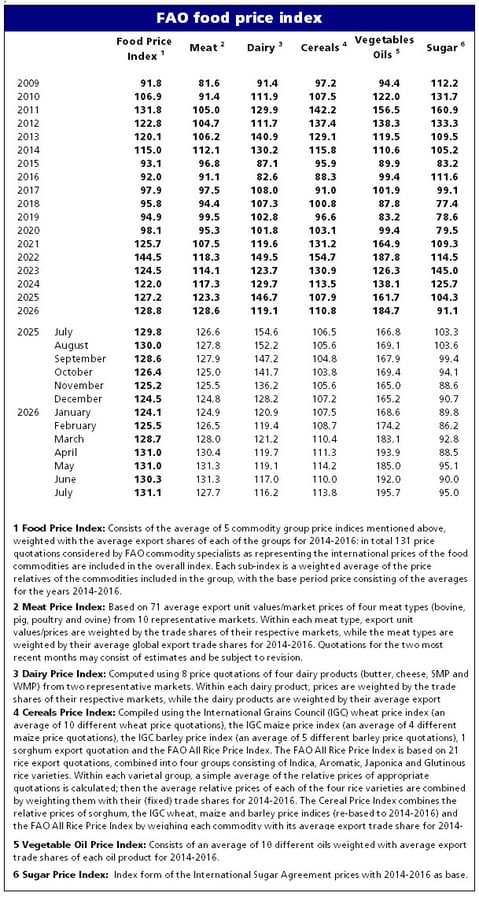
The UN Food and Agriculture Organization’s food price index climbed to 131.1 points last month, a gain of 0.6 percent from June and the highest reading since January 2023. A 5.8 percent surge in wheat prices drove the advance, as fresh Russian strikes on the Odessa port corridor disrupted a critical export route and drought conditions cut into crops from Kansas to the Po Valley in northern Italy.
“The world could be entering another period of food inflation as conflicts involving Iran and Ukraine combine with adverse climatic conditions to reduce agricultural output,” Máximo Torero Cullen, FAO’s chief economist, said in a note accompanying Thursday’s release.
The advance extended across the commodity basket. Maize climbed 3.6 percent in July, compounding pressure on livestock and poultry producers that depend on the grain as feed. Vegetable oils rose 2.0 percent to their highest since June 2022, driven by tighter palm oil inventories in Indonesia. Sugar advanced 5.6 percent. Meat fell 2.8 percent and dairy slid 0.7 percent, partial offsets that kept the overall reading from climbing further.
The FAO index tracks monthly price changes in five commodity groups (cereals, vegetable oils, dairy, meat, and sugar) across international markets. It does not measure retail prices directly, though economists at the IMF and World Bank have found that its movements tend to lead supermarket prices by six to nine months. For low-income food-importing nations, where governments allocate a substantial share of foreign exchange reserves to basic staples, the July uptick deepens a troubling calculation. The Wall Street Journal reported Thursday that the reading raised fresh concerns among food security economists about the pace of the reversal from two years of declining prices.
Moscow launched its latest wave of strikes against Ukrainian port infrastructure in late July, hitting cargo ships and facilities south of Odessa, according to Russia’s Defense Ministry. Ukraine ranks among the world’s top five wheat exporters, and any disruption to its logistics network moves prices quickly on the Chicago Board of Trade. The most recent Odessa port strikes in the final week of July intensified supply anxieties that grain traders had been tracking since early summer.
The United Nations has warned this month that food insecurity affects 733 million people, a figure widely expected to rise if Black Sea grain corridors remain contested. Russia’s position as a subsidized grain supplier for parts of Africa and the Middle East has complicated the geopolitical picture; Russia’s food supply pledges to Africa have tied Moscow’s agricultural role to diplomatic positioning in ways that frustrate Western-led food security initiatives.
Whether July’s spike firms into a sustained price trend depends on decisions well beyond the reach of commodity markets. A ceasefire over the Black Sea export corridor could ease wheat prices almost immediately, as diplomatic arrangements in 2022 and 2023 demonstrated. Heatwaves continuing to roll across the U.S. Plains and southern Europe risk depressing autumn wheat planting and pushing the pressure into the 2027 crop year.
FAO’s latest assessment will factor into negotiations at a UN food security summit scheduled later this year in Rome, where delegates from more than 150 countries are expected to weigh emergency grain reserves, trade rules, and long-term investment in climate-resilient agriculture. The summit was planned before July’s reading; the numbers have sharpened its agenda.
FAO analysts also flagged a secondary pressure point: possible reactivation of sanctions on Iranian petrochemicals, which supply roughly 30 percent of the fertilizers used across South Asia and the Middle East. A tightening in that market could raise input costs for the spring 2027 growing season even if battlefield dynamics in Ukraine ease. That risk compounds what fertilizer supply chain stress from the Hormuz crisis earlier this year had already set in motion.
Private commodity analysts in Chicago and Rotterdam were more measured. Global wheat stockpiles remain above the stocks-to-use ratio that historically triggers panic buying, suggesting July’s data reflects a market under stress rather than one in crisis. What markets are watching most closely now is whether the next U.S. crop progress report, due within days, confirms the damage that weather models have been flagging.
Forecasters at Maxar Technologies flagged continued heat and dryness across the U.S. Plains through the end of August, a pattern that could damage late-season corn yields and compress the window for winter wheat planting. FAO’s fuller supply and demand assessment is expected in September, along with projections for the Southern Hemisphere winter wheat crop, which traders say will determine whether July was a warning shot or the opening note of a new inflationary cycle.
The report arrives as central banks in the United States and Europe focus inflation scrutiny on services rather than food costs, but grocery prices carry political consequences that reach well beyond monetary policy frameworks. Rising food expenses helped defeat incumbent governments across the Americas and South Asia in elections over the past two years. Officials in Cairo, Jakarta, and Nairobi are watching July’s numbers with attention that policymakers in Washington and Brussels have yet to fully match.