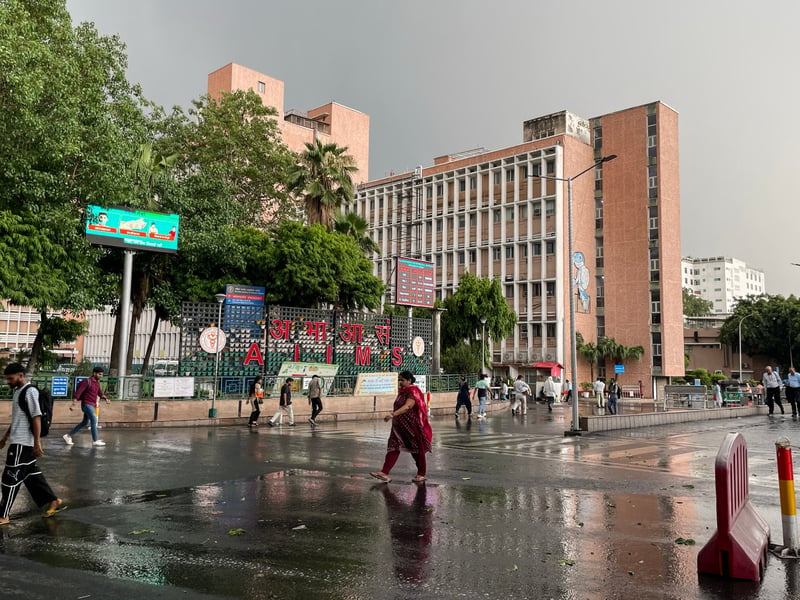

CHENNAI — At the Apollo Hospitals campus on Greams Road, the new oncology wing that opened in April has been running at above 80% occupancy since its third week. That pace of filling tracks with what the company delivered in its financial results for Q1 FY27 — and with the broader story of an Indian private hospital sector that is charging more per patient, treating them faster, and generating more cash than at any point in its history.
Apollo reported consolidated revenue of approximately Rs 5,370 crore for the quarter ending June 30, up 16.4% year-on-year, with EBITDA margins expanding 80 basis points to 13.2% and profit after tax near Rs 380 crore. The Apollo Pharmacy division — which the company has been disclosing separately for two years — contributed nearly 25% of group revenue and grew 22% year-on-year as the network expanded into tier-2 cities.
| Company | Revenue (Rs cr) | YoY Growth | EBITDA Margin | PAT (Rs cr) | |||||
|---|---|---|---|---|---|---|---|---|---|
| Apollo Hospitals | 5,370 | 16.4% | 13.2% | ~380 | |||||
| Max Healthcare | 1,820 | 19.3% | 26.2% | ~350 | |||||
| Fortis Healthcare | 1,940 | 18.1% | 16.8% | — | |||||
| Narayana Hrudayalaya | 1,280 | 14.8% | 18.4% | — | |||||
| Source: BSE/NSE filings, company Q1 FY27 earnings reports. | |||||||||
Fortis Healthcare reported Rs 1,940 crore in revenue for Q1 FY27, up 18.1% year-on-year. The IHH Healthcare-backed company has been running a hospital rationalisation programme since FY25 — closing underperforming facilities and concentrating specialist capacity — and the strategy showed in its margin line. Average revenue per occupied bed for Fortis’s flagship Delhi NCR cluster reached Rs 2.14 crore annualised, up 9% from Q1 FY26. Operating margins came in at 16.8%, the highest in five years, partly because the company no longer carries the drag of three hospitals it exited in FY26.
Max Healthcare Institute reported revenue of Rs 1,820 crore for Q1 FY27, up 19.3% year-on-year, and PAT of approximately Rs 350 crore. Max’s North India concentration — virtually all its hospitals are in Delhi NCR, Lucknow, and Patna — is simultaneously its competitive advantage and its geographic constraint. The NCR medical tourism segment showed particular strength: international patient revenue grew 27% year-on-year as medical visa issuances from the Middle East and East Africa picked up substantially. EBITDA margin at 26.2% remains the highest in the listed hospital sector, a function of premium case mix and the company’s deliberate avoidance of low-acuity beds.
Narayana Hrudayalaya delivered Rs 1,280 crore in revenue for Q1 FY27, up 14.8% year-on-year. The company’s Cayman Islands facility continues to punch above its weight: the health city in Grand Cayman generated roughly Rs 275 crore in revenue during the quarter, up 31% year-on-year, as American and Caribbean patients sought cardiac and orthopaedic procedures at costs well below what US hospitals charge. Consolidated EBITDA margin came in at 18.4%.
The sector’s common denominator in Q1 FY27 is a structural shift in what patients are producing for the income statement. Average length of stay contracted by roughly half a day to 3.4 days across the four companies, while ARPOB rose between 8% and 12% across the cohort. The combination — shorter stays, higher per-bed revenue — reflects two concurrent trends: more day-care and short-stay procedures as laparoscopic and robotic surgery techniques displace open procedures, and a broader shift of the patient mix toward more complex cases carrying higher billing. Apollo’s robotic surgery programme, which now covers more than 30 Da Vinci Surgical Systems across its network, is explicitly designed to capture that premium procedure segment.
The medical devices supply chain has become an increasingly important variable for margin forecasting. Several implant categories — knee replacements, cardiac stents, hip prosthetics — had their prices capped by the National Pharmaceutical Pricing Authority in prior years. The sector has been managing around those caps partly by shifting toward premium-tier implants in categories that remain unregulated, and partly by increasing the share of procedures that are primarily surgeon-fee-driven rather than device-intensive.
The foreign direct investment angle that circulated heavily in the first half of 2026 did not produce a definitive outcome in Q1. Several listed chains attracted interest from Middle Eastern sovereign wealth funds and US-based healthcare private equity, drawn by India’s combination of cost competitiveness and a patient population growing rapidly into complex-care demand. Apollo’s promoter family has been specific about not wanting dilution of control. Max Healthcare’s KKR stake, dating to 2019, creates an overhang question about exit timing that management has not fully addressed publicly. These conversations are shaping capital allocation priorities at each company without yet resolving into disclosed transactions.
The National Medical Commission’s developing accreditation framework for private hospitals — modelled partly on Joint Commission International standards — is a slow-moving policy variable that could increase compliance costs for all four companies over FY27-28. Hospital management teams have publicly endorsed the framework in principle while the specifics of mandatory scope, staffing ratios, and infrastructure requirements remain unsettled. The eventual outcome will affect the sector’s cost structure in ways not yet visible in quarterly earnings.
What Q1 FY27 does not resolve is whether the sector’s ARPOB growth is tracking an expanding base of patients or a shrinking one paying more. The top-tier hospital chains are overwhelmingly concentrated in six to eight cities, and their billing reflects the tastes of a relatively small urban, insured, or wealthy-enough-to-pay patient population. Expansion into tier-2 cities is real — Max opened in Patna, Narayana operates in Mysuru — but those facilities have not yet matured to margin-accretive scale. The headline results continue to tell the story of the top of India’s patient pyramid rather than of its healthcare system as a whole.