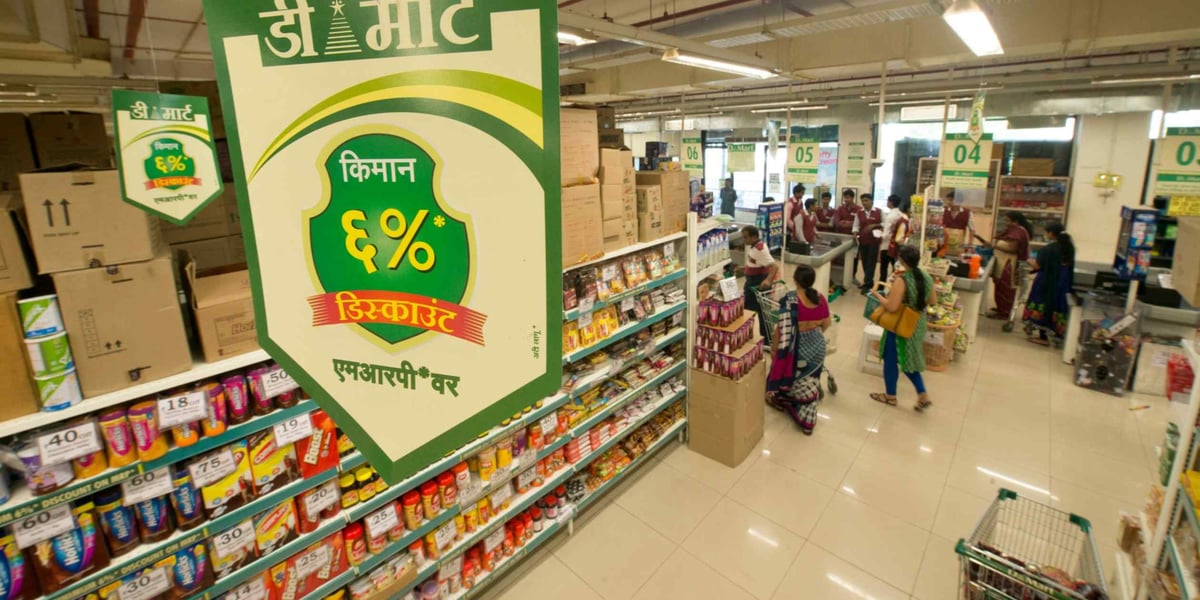

MUMBAI — The number that defines Avenue Supermarts is not its headline revenue — it is the revenue per square foot. In Q1 FY27, DMart delivered roughly Rs 35,000 in revenue per square foot of retail space, a figure that no other listed Indian retailer has come close to replicating in a decade of trying. That density of throughput is what the market pays for when it assigns DMart a valuation premium over its peers, and in Q1 FY27, it held.
Avenue Supermarts reported consolidated revenue of approximately Rs 14,800 crore for the April to June quarter, up 16% year-on-year. EBITDA margins compressed slightly to about 8.1% from 8.5% a year earlier — a function of accelerated store expansion dragging on mature-store economics — but PAT came in near Rs 740 crore, up 12%. The company added seven new stores during the quarter, taking its total count to approximately 378. Each new store in a new geography takes two to three years to reach the throughput density of a mature DMart location, which is the structural reason margins trail revenue growth in expansion phases.
| Company | Q1 FY27 Revenue (Rs Cr) | YoY Growth | PAT (Rs Cr) | EBITDA Margin | |||||
|---|---|---|---|---|---|---|---|---|---|
| Avenue Supermarts (DMart) | ~14,800 | +16% | ~740 | ~8.1% | |||||
| Jubilant FoodWorks (Domino’s) | ~1,680 | +8% | ~85 | ~18.2% | |||||
| Westlife Foodworld (McDonald’s W&S) | ~680 | +5% | ~18 | ~14.5% | |||||
| Devyani International (KFC/Pizza Hut) | ~920 | +11% | ~32 | ~16.8% | |||||
| Sapphire Foods (KFC/Pizza Hut South) | ~560 | +7% | ~14 | ~15.2% | |||||
| Source: BSE/NSE filings, company Q1 FY27 earnings reports. | |||||||||
The QSR picture was more complicated. Jubilant FoodWorks, the master franchisee for Domino’s in India, posted revenue of approximately Rs 1,680 crore in Q1 FY27, up 8%, but same-store sales growth was in the low single digits — the fourth consecutive quarter of subdued SSSG. The EBITDA margin held at roughly 18.2%, supported by delivery order economics and Domino’s strong delivery infrastructure, but the underlying traffic story was not clean. Jubilant has been opening stores at pace — its outlet count crossed 2,100 during Q1 FY27 — and new stores dilute SSSG by definition while simultaneously pressuring existing-store coverage areas. Whether the SSSG compression is structural or cyclical is the question that FY27 will begin to settle.
Westlife Foodworld, the McDonald’s franchisee for West and South India, reported the most cautious quarter among the listed QSR operators. Revenue of approximately Rs 680 crore, up just 5%, with PAT near Rs 18 crore — thin margins reflecting both menu-mix headwinds and higher royalty structures under the McDonald’s master franchise agreement. Westlife’s average check has been rising as the company pushes premium burgers and beverages, but transaction volumes have not kept pace. The tension between premiumisation-led check growth and transaction volume weakness is the central problem for the company through FY27.
Devyani International, which operates KFC and Pizza Hut across large parts of India, posted a stronger quarter at Rs 920 crore revenue, up 11%, with margins near 16.8%. KFC’s chicken-led menu has proven relatively more resilient in a traffic-constrained environment — the average KFC order travels at a higher price point than Domino’s pizza in comparable tier-2 cities, and Devyani’s footprint in those markets has grown systematically. The company’s store count exceeded 1,400 outlets during Q1 FY27.
The demand environment across both retail and QSR reflects the same underlying tension in urban India: organised consumption is growing, but not uniformly. DMart’s grocery-led format benefits from staples demand, which does not compress the way discretionary QSR visits do when household budgets tighten. When fuel costs and EMI obligations rise, the first spending to be cut is eating out, not essential grocery. The QSR chains have been navigating this reality since Q3 FY26, and Q1 FY27 offered no definitive evidence that the cycle had turned.
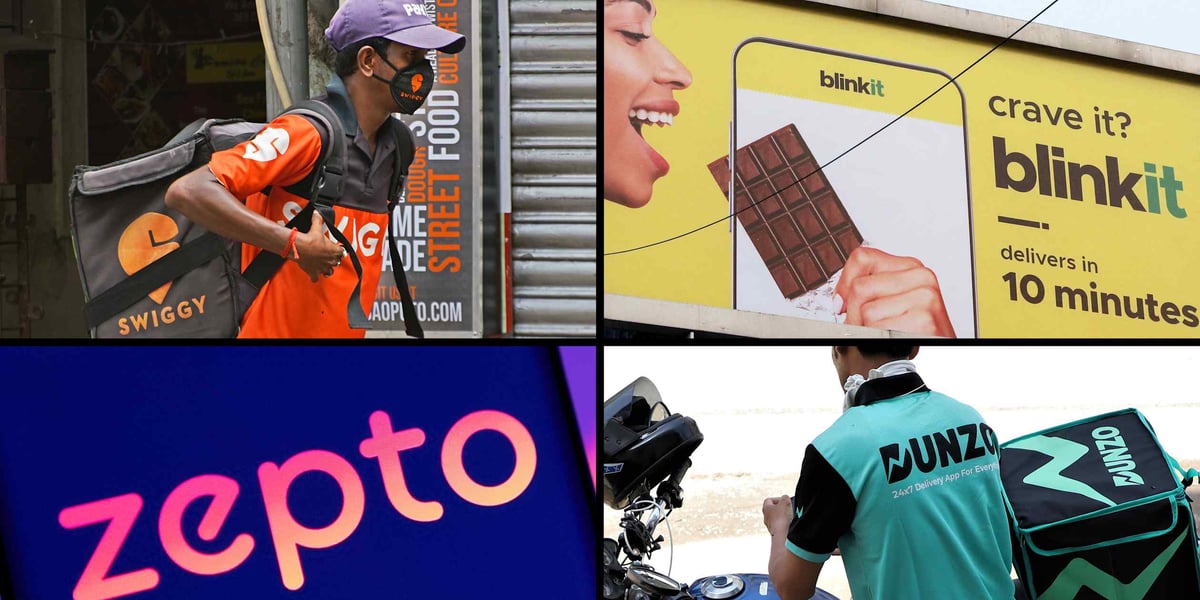
The quick-commerce dimension is the one structural shift that every QSR operator is grappling with but few are articulating publicly. Swiggy Instamart, Blinkit, and Zepto have made 10-to-15-minute grocery delivery a mass-market behaviour in India’s top 20 cities. That shift has not displaced QSR directly — you cannot get a Domino’s pizza delivered in 12 minutes from a dark store — but it has changed the occasion. The impulse dinner that would have been a Domino’s order is increasingly a quick-commerce grocery order assembled into a home-cooked meal. The QSR response, building more dark kitchens and extending delivery radius, addresses throughput but not the occasion shift.
DMart’s long-term positioning question is different. The company’s entire model is predicated on store ownership — DMart buys or leases the real estate for its stores rather than renting short-term — which gives it structural cost advantages over competitors but constrains the pace at which it can expand. In a quick-commerce world, the question is whether high-throughput physical retail retains its premium or whether the DMart real-estate model faces diminishing returns as grocery delivery penetrates the core DMart customer base. The company’s own DMart Ready app, its e-commerce grocery arm, has scaled modestly but has not replicated the economics of its physical stores. Management has been consistent in saying physical retail remains the core; the market, so far, has agreed.