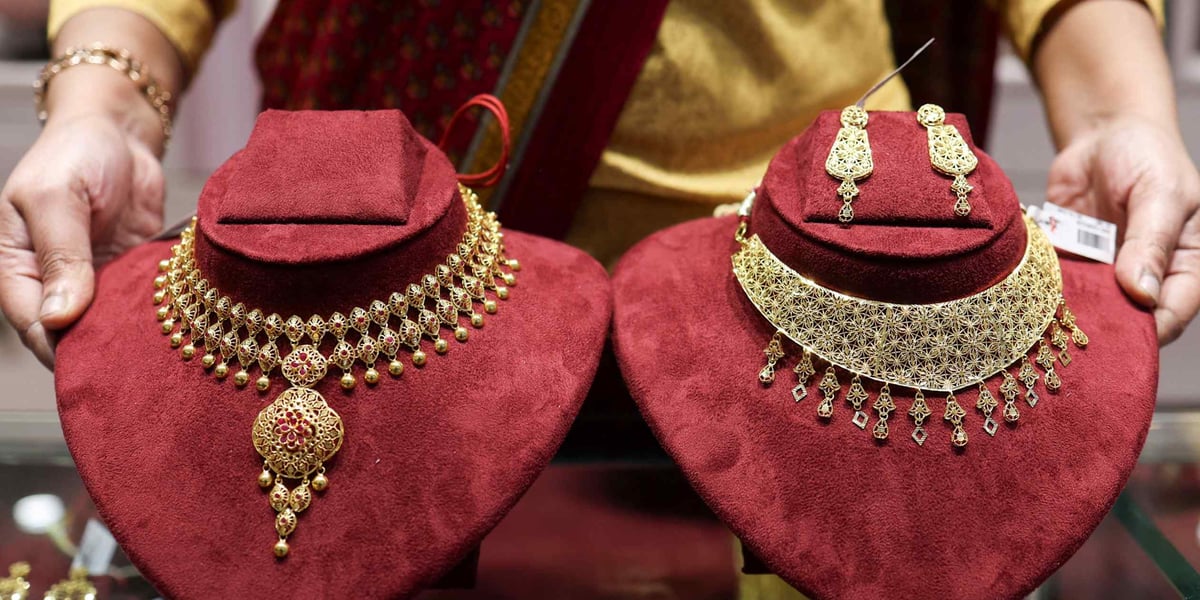

MUMBAI — Gold did what it always does when the world turns nervous: it rose. At Rs 72,000 to Rs 76,000 per 10 grams through the April-June quarter, the metal delivered a revenue tailwind to every organised jeweller in India. But tailwinds, as Titan Company’s Q1 FY27 results made clear, are not distributed equally. The Tata Group company emerged from the quarter with wider margins and stronger volume growth than its peers, widening a structural gap that has been building for three years.
Titan’s jewellery division — which houses Tanishq, Mia, and CaratLane — posted revenue of Rs 12,200 crore in Q1 FY27, up 18% year on year. The growth was broad: studded jewellery share, where margins run 10 to 12 percentage points above plain gold, held at 34% of the jewellery mix, a key metric the company guards carefully. EBIT margin for the division came in at 12.2%, steady against the year-ago quarter despite gold price volatility that typically compresses near-term profitability.
What Titan has that its rivals cannot quickly replicate is inventory management. The company hedges its gold exposure systematically, which means a sharp price move in the quarter affects revenue recognition but does not destroy operating margins the way it can for jewellers carrying unhedged physical stock. That discipline, built over a decade, is increasingly visible in the numbers.
Kalyan Jewellers told a different story — not a bad one, but a more complicated one. Revenue for the quarter reached Rs 5,900 crore, up 28% year on year, the highest growth rate in the peer group. The number, however, requires context. Kalyan has been expanding its Candere online platform and its FOCO (franchise-owned, company-operated) store network aggressively across Tier 2 and Tier 3 cities. The revenue line is inflated by new store ramp-ups; the EBITDA margin of 6.8% is where the costs of that expansion show up.
Management guided that the FOCO model will turn margin-accretive at the store level within 18 months, a projection analysts at Nuvama and Kotak have modelled favourably. The question is execution speed. Kalyan opened 22 new FOCO stores in Q1 FY27, taking the total to over 240 across the country. If the ramp cadence holds, the margin thesis is coherent. If it slips, the revenue growth will look expensive.
| Company | Q1 FY27 Revenue (Rs Cr) | YoY Growth | EBITDA Margin | ||||||
|---|---|---|---|---|---|---|---|---|---|
| Titan Company (Jewellery) | 12,200 | +18% | 12.2% | ||||||
| Kalyan Jewellers | 5,900 | +28% | 6.8% | ||||||
| Senco Gold | 1,380 | +22% | 7.4% | ||||||
| Malabar Gold and Diamonds | ~9,000 (est.) | ~20% | N/A (unlisted) | ||||||
| Source: BSE/NSE filings, company Q1 FY27 earnings reports. | |||||||||
Senco Gold, the Kolkata-headquartered jeweller with a strong East India franchise, delivered Rs 1,380 crore in revenue, up 22%. The company’s EBITDA margin of 7.4% was the strongest showing among the smaller listed peers, reflecting Senco’s tighter geographic concentration — a model that sacrifices national scale for operational density. The World Gold Council’s data on Indian consumer demand provided context: rural gold demand in eastern India, Senco’s primary market, was up 17% in the quarter, driven partly by a robust rabi crop harvest and partly by deferred wedding purchases from the prior quarter’s price surge.
The broader sector dynamic is straightforward: when gold prices rise fast, consumers who were planning to buy hold off, waiting for a correction that does not always come. When prices stabilise at a higher level, pent-up demand releases. That pattern played out cleanly in Q1 FY27 — after gold touched Rs 76,000 in April and then settled around Rs 72,000 to Rs 73,000 through May and June, volumes recovered into the June wedding season.
Malabar Gold and Diamonds, which remains unlisted and does not report quarterly earnings publicly, is estimated by analysts to have crossed Rs 9,000 crore in quarterly revenue based on its store expansion and the sector-wide tailwind. The company’s aggressive international expansion — it now operates stores in eight countries — makes it a competitive pressure on Titan’s premium positioning in the Gulf diaspora market, though domestically the two companies occupy different price tiers.
What the sector does not yet know is how the second half of FY27 will treat it. The Indian government’s 2024 decision to reduce the customs duty on gold imports from 15% to 6% compressed the grey market and shifted buying toward organized retail — a structural positive that will continue to accrue to listed jewellers. But with gold prices near all-time highs globally, the upside surprise in the next two quarters requires either continued safe-haven demand or a domestic wedding season that runs ahead of estimates.
Titan’s watch and wearables segment added Rs 1,100 crore in the quarter, up 9%, a number overshadowed by the jewellery business but important because it demonstrates the company’s ability to sustain a diversified consumer products identity. CaratLane, its online-first jewellery arm, crossed Rs 800 crore in quarterly revenue for the first time, with 60% of transactions originating on mobile — a metric that matters as younger urban consumers enter the gold-buying demographic earlier than their parents did.
For investors watching this sector, the Q1 FY27 results confirmed what the last two years of data have been building toward: Titan is in a different competitive position than any other organised jeweller in India, and the distance is widening rather than narrowing. Kalyan’s expansion strategy is the most credible challenge, but it is an 18- to 24-month thesis. Senco is executing well within its geography. The unlisted competition from Malabar is real but not measurable on a quarterly basis.
What the gold price does next will matter less to Titan than to any of its rivals. That, for now, is the summary of the sector.