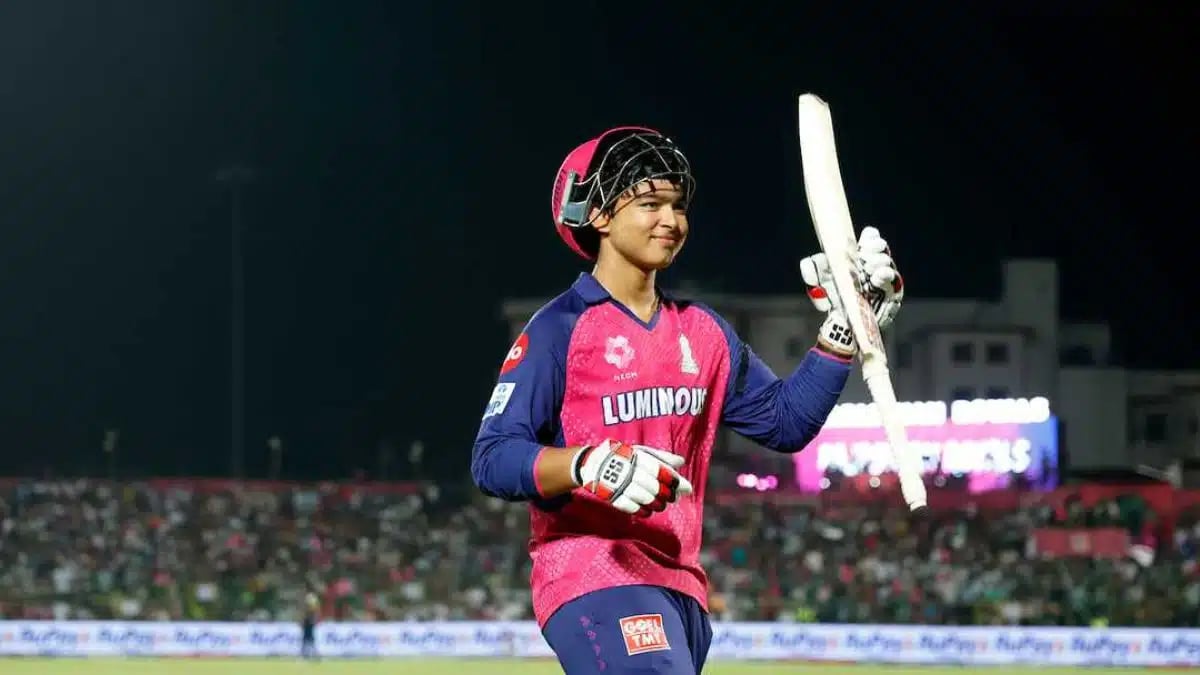
The noise inside Hyderabad’s Rajiv Gandhi International Stadium had barely settled when the moment arrived, abrupt, unexpected, and almost jarring in its simplicity. A single delivery, a misjudged stroke, and the 15-year-old who had spent weeks dismantling bowling attacks walked back without scoring.
For Vaibhav Suryavanshi, the Indian Premier League had, until then, unfolded like a script written for prodigies. But on Sunday night, it paused, if only briefly, to remind him, and perhaps Indian cricket at large, that even the most extraordinary rises are not immune to interruption.
Suryavanshi’s dismissal for a golden duck came at the hands of a debutant, Praful Hinge, whose opening over would go on to reshape the match entirely. Hinge removed three batters in his first over, including Suryavanshi, a feat unprecedented in the league’s history.
It was not just a wicket. It was a moment that punctured momentum.
A Meteoric Rise Interrupted
In the days leading up to the match, Suryavanshi had become one of the defining stories of IPL 2026. At just 15, he had amassed rapid runs, including a blistering 78 off 26 balls, and had carved out a reputation for fearless hitting against some of the world’s most accomplished bowlers.
He had already taken on Jasprit Bumrah with an audacity that seemed to ignore conventional hierarchies of age and experience.
The numbers, striking as they were, told only part of the story. His presence at the crease had begun to alter field placements, bowling strategies, and the tempo of matches. Rajasthan Royals, the franchise that invested early in his promise, had built portions of their batting approach around his aggression.
Yet, as quickly as the narrative had elevated him, the game introduced resistance.
On that first ball against Hyderabad, Suryavanshi attempted to assert control. Instead, the ball found a fielder, and with it, a rare silence followed.
The Match That Shifted the Frame
The broader contest tilted decisively after that moment. Hyderabad, posting a formidable total, capitalized on early breakthroughs to dismantle Rajasthan’s chase, eventually securing a commanding 57-run victory.
Hinge’s spell, 4 for 34, did more than win a match; it introduced a new subplot to the season. His stated intention to dismiss Suryavanshi with the first ball underscored how quickly the teenager had become a target for opponents.
For Rajasthan, the defeat marked their first setback after a strong run. For Suryavanshi, it marked something subtler: the beginning of a recalibration within Rajasthan Royals’ campaign, reflecting the volatility of an Rajasthan Royals’ campaign built on aggressive batting.
Between Brilliance and Burden
If the IPL has long been a stage for emerging talent, Suryavanshi’s rise has tested its boundaries. He is not merely young; he is operating at an age where most players are still navigating junior circuits. His ascent, from Bihar’s domestic structures to one of the most watched leagues in global cricket, has been both rapid and heavily scrutinized.
His journey mirrors the broader wave of emerging talent reshaping Indian cricket’s future.
But with that promise has come attention, from broadcasters, sponsors, analysts, and critics alike.
Following his dismissal, reactions extended beyond the field. The moment sparked widespread discussion, amplified by a visible celebration that quickly circulated across social media.
Former players, meanwhile, have begun to introduce a note of caution. Some have warned about the pressure of sudden fame, urging vigilance against the pressures that accompany early success.
A Season Still Unfolding
Despite the setback, Suryavanshi’s position within the IPL 2026 season remains significant. He continues to rank among the tournament’s most impactful performers and has been central to his team’s approach.
His explosive starts, including innings that bordered on dismantling bowling attacks, have already been documented in performances such as dismantling bowling attacks against elite opponents.
Within the broader tactical evolution of the league, reflected in shifts across teams like Punjab Kings and Sunrisers Hyderabad, Suryavanshi represents a new kind of batter, one shaped by aggression and minimal inhibition, aligning with the tactical evolution of T20 cricket.
The Meaning of a Moment
In isolation, a golden duck is a minor statistical event, one that seasoned professionals accumulate over long careers. For Suryavanshi, however, it carries a different weight.
It is a reminder that the IPL, for all its spectacle, remains a competition defined by fine margins. It is also a signal that opposition strategies are adjusting, that the element of surprise is fading, and that sustained success will require adaptation.
Yet, if his brief career has demonstrated anything, it is resilience. Even in previous seasons, moments of failure have been followed by emphatic returns, often with innings that reassert his dominance.
For now, the image of the teenager walking back after a single ball will linger, not as a defining failure, but as a necessary interruption in a narrative that has moved, until now, at extraordinary speed.
In a tournament that thrives on momentum, Suryavanshi’s story has entered a new phase, one where expectation, scrutiny, and opposition converge more sharply than before.
And as the IPL 2026 season unfolds, the question is no longer whether he can dominate, but how he responds when he does not.