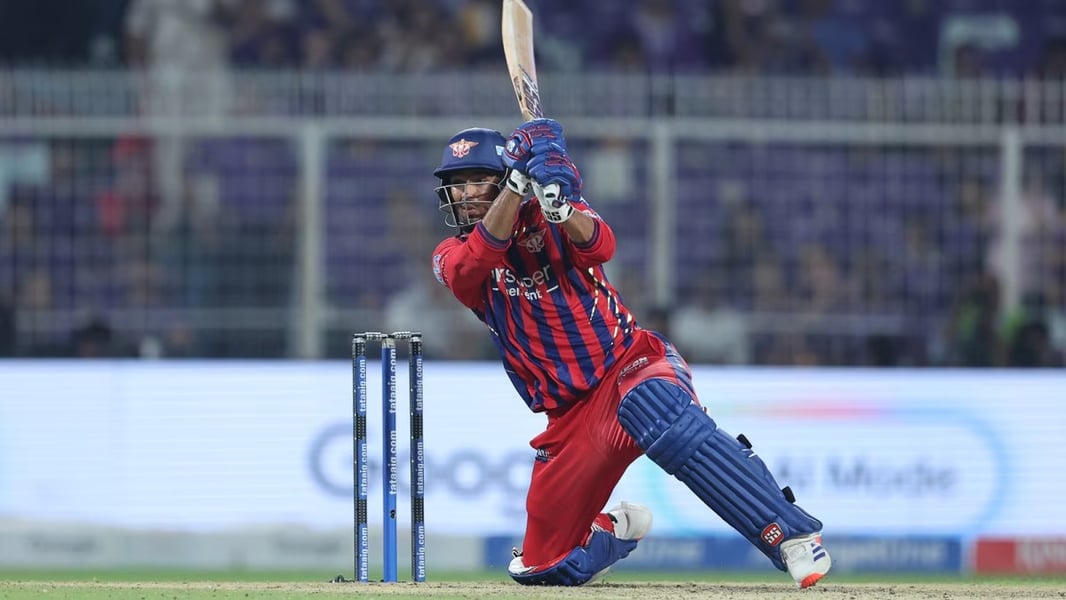

On a humid evening at Eden Gardens, when the crowd had already begun to script Kolkata Knight Riders’ victory, a relatively unknown 21-year-old from Rajasthan stood at the crease, unbothered by the noise, the pressure, or the improbability of the moment.
Mukul Choudhary did not arrive in the Indian Premier League with the weight of expectation. He carried something quieter, and perhaps heavier, the accumulated ambition of a small town, and a family that had already risked everything.
By the time the final ball was struck into the Kolkata night, that quiet arrival had turned into a declaration.
Choudhary’s unbeaten 54 off 27 balls, punctuated by seven sixes in a match-winning knock, completed a three-wicket victory in one of the most dramatic finishes of the IPL 2026 season. His acceleration from a slow start into a game-defining assault reflected the emergence as a new power hitter in India’s evolving T20 landscape.
Yet the innings, while decisive, was only the surface of a deeper shift unfolding within Indian cricket.
A new geography of Indian cricket
For decades, Indian cricket’s pathways were dominated by metropolitan centers, Mumbai, Delhi, Bengaluru. The rise of players like Choudhary signals a redistribution of that power, a widening of the game’s geography into districts and towns once considered peripheral.
Choudhary hails from Jhunjhunu, and his journey from Jhunjhunu to the IPL mirrors a broader transformation. India’s cricketing pipeline is no longer confined to traditional hubs, but driven by hunger and opportunity in smaller towns.
This structural shift has been reinforced by performances across the league, including the fearless emergence seen in Sooryavanshi’s blistering assault on Bumrah, which underlined the new generation’s disregard for reputations.
The finisher’s mindset
If geography explains where Choudhary comes from, temperament explains why he matters.
Modern T20 cricket has elevated the role of the finisher, a batter capable of navigating chaos and recalibrating a match within a handful of deliveries. Choudhary’s innings, particularly his shift from caution to controlled aggression, reflected this new blueprint.
His explosive innings and journey to the IPL has already drawn comparisons with elite finishers, while analysts point to LSG’s scouting success in identifying a player capable of thriving under pressure. That foresight is increasingly defining franchises, as seen in tactical evolutions across teams like Punjab Kings in recent strategic shifts.
The Dhoni template
It is impossible to discuss modern Indian finishers without invoking MS Dhoni.
Choudhary’s calmness, his delayed acceleration, and his ability to absorb pressure evoke the influence of a player who redefined the role. His fearless batter in India persona has already drawn praise, with observers linking his approach to the Dhoni template.
The evolution of Indian batting, from classical accumulation to dynamic shot-making, is evident across formats, a shift also reflected in discussions around India’s changing batting philosophy.
A story built on sacrifice
Behind the composure lies a story shaped by sacrifices made by his family, a narrative that continues to define India’s cricketing rise.
Reports detail how Choudhary’s father endured financial hardships and personal setbacks to sustain his son’s dream, underscoring the human cost behind sporting success. His rise stands alongside countless untold stories that fuel India’s cricket machine.
The IPL as an accelerant
If domestic cricket builds players, the IPL transforms them.
Choudhary’s emergence, marked by a record stand in a last-ball finish and an immediate impact, reflects the league’s ability to fast-track talent into national relevance.
Franchise investments and global interest have further intensified this ecosystem, with developments like the multi-billion-dollar cricket investments reshaping the sport’s financial and competitive landscape.
What his rise represents
Choudhary’s story is not merely about one innings. It represents a broader shift, one where players from outside traditional centers are not just participating, but defining outcomes.
The IPL’s expanding influence, combined with structural changes in Indian cricket, has created an environment where fearlessness is not exceptional but expected.
Even as teams grapple with inconsistency, highlighted in matches like Mumbai Indians’ struggles with bowling depth, the emergence of players like Choudhary offers a glimpse into the future.
A beginning, not a culmination
For now, Mukul Choudhary’s journey remains in its early chapters.
But certain moments endure, a last-ball finish, a fearless approach, and a player who appears fully prepared for the demands of modern cricket.
On that night in Kolkata, he did more than win a match. He reinforced a movement, one where small-town India is no longer knocking on the door of elite cricket, but stepping in and taking control.