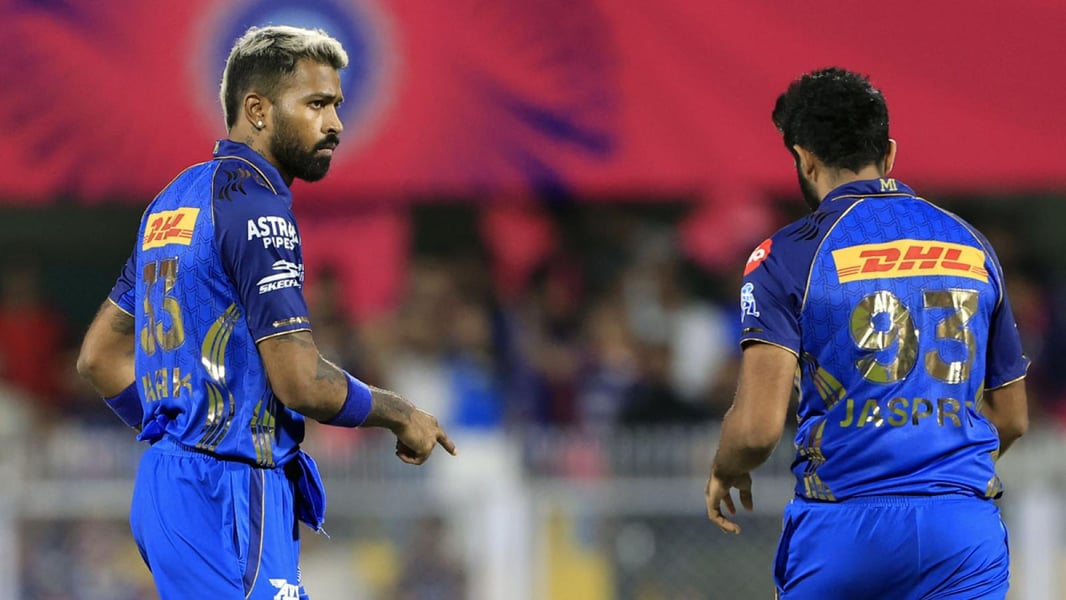

On a rain-lashed evening in Guwahati, the match itself felt secondary to what followed. Beneath the floodlights and the lingering dampness of a delayed start, the Mumbai Indians were dismantled not just on the scoreboard, but in the words of their own captain.
Hardik Pandya did not search for euphemisms. He did not speak in coded reflections or defer accountability to the vague uncertainties of T20 cricket. Instead, he chose clarity, bordering on indictment.
The bowlers, he said, were “not up to the mark”.
It was a remark that cut through the noise of the Indian Premier League 2026, a tournament often defined by spectacle, and landed with unusual force.
A Match Lost in the First Few Overs
The contest, reduced to a rain-shortened 11-over match in Guwahati, was always going to be volatile. But volatility does not excuse collapse.
The Rajasthan Royals, sensing opportunity in the shortened format, attacked with precision and audacity. Their opening pair, Yashasvi Jaiswal and Vaibhav Sooryavanshi, transformed the powerplay into a spectacle of controlled aggression.
By the time the first five overs had elapsed, the match had already tilted irreversibly.
Rajasthan surged to 150 for 3, a total that in an 11-over contest felt less like a target and more like a verdict.
Sooryavanshi, barely in his mid-teens, produced a breathtaking assault, a teen sensation Vaibhav Sooryavanshi dismantling Bumrah that stunned even seasoned observers. His 39 off 14 balls came with fearless intent, while Jaiswal anchored the innings with an unbeaten 77.
Together, they did more than score runs. They dictated the emotional tempo of the match.
Pandya’s Verdict: A Failure of Execution
Pandya’s critique was not abstract. It was technical, almost forensic.
He spoke of execution, or rather, the absence of it.
“We didn’t execute the deliveries we were supposed to,” he said, emphasizing that the margin of defeat could be traced back to a handful of poorly bowled deliveries.
In T20 cricket, five balls can define an innings. Pandya suggested that those five balls, mishandled, had defined the match.
He shielded his batters, an unusual stance in a format where chasing failures are often scrutinized more harshly than defensive lapses.
“I would not put this game on the batting,” he insisted.
It was, in effect, a redistribution of blame, and a public one.
The Bumrah Paradox
There was something particularly striking about the collapse: it unfolded despite the presence of Jasprit Bumrah, widely regarded as one of the finest fast bowlers in modern cricket.
Yet even Bumrah was not immune.
Sooryavanshi struck him for six off the very first ball he faced, a moment that seemed to invert cricket’s established hierarchies.
For years, Bumrah has been the bowler who sets traps. On this night, he appeared to be the one ensnared.
It was not merely a statistical anomaly. It was symbolic of a broader disarray, a bowling unit unable to impose itself, even through its most accomplished member.
A Team Playing Catch-Up
Pandya described the innings as one of perpetual recovery.
“Their openers threw us out of the game in the first couple of overs,” he admitted.
From that point onward, Mumbai were not competing; they were chasing equilibrium.
The structure of the shortened match only amplified the consequences. With fewer overs, there was less time to correct mistakes, less space to recalibrate strategy. Every misstep was magnified.
By the time Mumbai began their chase, the psychological weight of the target was already evident.
They finished at 123 for 9, a scoreline that reflected not just a failed chase, but a team burdened by the memory of what had preceded it.
Rajasthan’s Ascent
If Mumbai’s story was one of disintegration, Rajasthan’s was one of coherence.
This victory marked their third consecutive win, helping Rajasthan Royals climb to the top of the table and reinforcing their early dominance.
Their approach has been defined by clarity: aggressive top-order batting, disciplined bowling, and an evident trust in youth.
Sooryavanshi’s emergence, echoing the rise of young power-hitting talent, has added a layer of unpredictability.
Pandya himself acknowledged as much.
“It’s amazing to see the fearlessness,” he said.
The Language of Accountability
In professional sport, language matters.
Captains often speak in abstractions, “we need to improve,” “we’ll learn from this,” “it’s a team effort.” These phrases serve a purpose: they protect the collective, diffuse individual blame, and maintain internal cohesion.
Pandya chose a different register.
By isolating the bowling unit, he introduced a sharper form of accountability, one that may resonate within the dressing room but also risks exposing fractures.
Whether this candor galvanizes or destabilizes Mumbai remains to be seen.
A Pattern Emerging
This was not an isolated defeat.
Mumbai Indians have now lost two of their opening matches, slipping into early uncertainty in the IPL season.
The concerns are not limited to execution. Questions of balance, intent, and adaptability have begun to surface, concerns echoed by former players who noted a lack of purpose with the ball.
In a competition as compressed and unforgiving as the IPL, early weaknesses can quickly calcify into structural problems.
The Unforgiving Arithmetic of T20 Cricket
Pandya’s reference to “five balls” was not rhetorical flourish. It was arithmetic.
In an 11-over game, 66 deliveries define the contest. Five poorly executed deliveries represent nearly eight percent of the innings, a margin large enough to alter outcomes.
This is the paradox of T20 cricket: its brevity magnifies its margins.
A mistimed yorker, a misplaced slower ball, a misjudged length, each carries disproportionate consequence.
On this night, Mumbai’s errors were not catastrophic in isolation. But collectively, they were decisive.
What Comes Next
For Mumbai, the path forward is both simple and complex.
Simple, because the prescription is clear: improve execution, particularly in the powerplay.
Complex, because execution is rarely a matter of instruction alone. It requires rhythm, confidence, and cohesion, elements that cannot be summoned instantly.
Pandya struck a note of cautious optimism.
“The sun will rise again,” he said, suggesting that recovery is not just possible, but expected.
A Moment That May Define a Season
In the long arc of a tournament, certain moments assume disproportionate significance.
This may be one of them.
Not because of the defeat itself, losses are inevitable, but because of the response it elicited.
Pandya’s words have reframed the narrative around Mumbai Indians. The focus is no longer on isolated performances, but on systemic shortcomings.
For Rajasthan Royals, shaped by leadership structures that include Kumar Sangakkara as head coach and broader global investment in cricket, the night affirmed their ascent.
For Mumbai Indians, it exposed their fragility.
And for Hardik Pandya, it marked a moment of leadership defined not by consolation, but by confrontation.