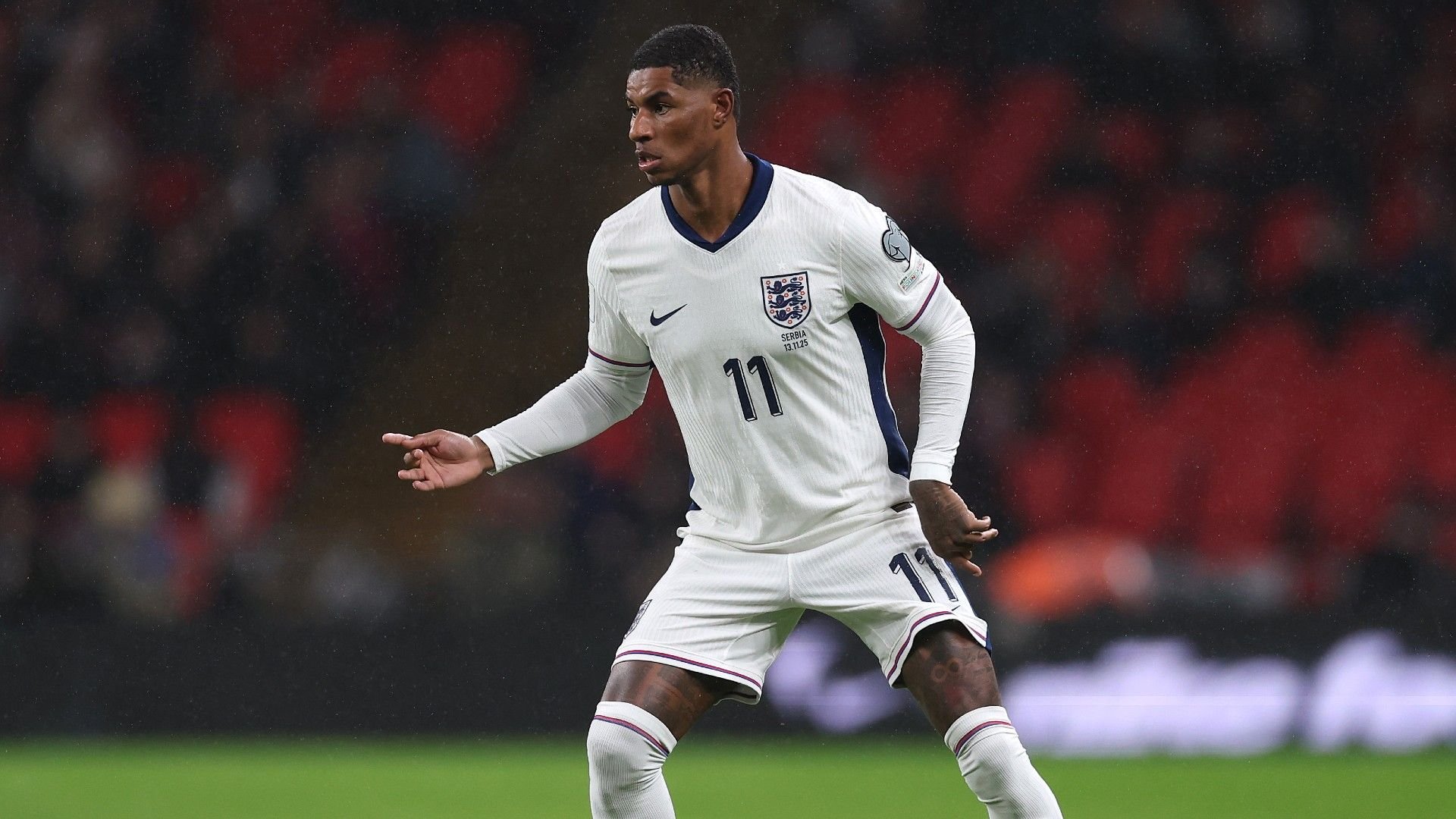

LONDON — The number was always going to mean something. When FIFA published England’s official squad list for the 2026 World Cup on Tuesday, the detail that cut through the noise was not a name but a digit: Marcus Rashford, No.11.
Shirt numbers at a World Cup carry an old grammar that managers have never quite abandoned. Nos.1 through 11 have long signalled intent — not a guarantee of a starting berth, but a declaration of the manager’s current thinking more candid than any press conference. Tuchel, who has said little publicly about his preferred XI since naming his 26-man squad ten days ago, has let the numbering do the talking.
The breakdown is instructive. Jordan Pickford holds No.1, undisputed. Harry Kane is No.9, as he always is. Jude Bellingham takes No.10. Bukayo Saka, No.7. Declan Rice, No.4. Those five have been certainties since Tuchel took charge; their numbers confirm nothing new. What Rashford’s No.11 does is answer the question that has shadowed England’s attack since the squad was announced: who starts on the left?
Anthony Gordon, the Newcastle winger who has been among England’s most consistent performers under Tuchel, is No.18. Morgan Rogers is No.17. Both are further back in the numbering than their recent form might have suggested they deserved. The implication, carried in the numbers whether Tuchel intended it that way or not, is that Rashford — back at Barcelona after his loan spell and restored to the international fold — is the man Tuchel sees lining up alongside Kane and Saka when England kick off their campaign against Croatia at Dallas on June 17.
It is a selection that would have been difficult to predict twelve months ago. Rashford spent much of 2024 frozen out at Manchester United, his form collapsed, his relationship with the club deteriorating. The loan to Barcelona changed something. He arrived in Catalonia needing to prove himself all over again and, by most accounts, did exactly that. Tuchel recalled him, built him back into the squad, and now, with the numbers published, appears to be rewarding him with a starting role at a World Cup.
The rest of the numbers sketch out a probable XI that aligns with what analysts and journalists have been projecting since the squad announcement. Ezri Konsa is No.2; Marc Guehi, No.6; John Stones, No.5; Nico O’Reilly, No.3 — the latter a remarkable elevation for a player who had never appeared at a senior tournament before this cycle. Elliot Anderson takes No.8 alongside Rice in central midfield, edging ahead of Kobbie Mainoo (No.16) in what has been the most competitive selection battle in the squad.
Reece James, who has spent much of this season managing injury, is No.24. That number, deep in the list, suggests Tuchel is building his right side around Konsa rather than James for the opener, with the Chelsea captain available as an option but not yet trusted to start.
What the numbers cannot answer is the question that will not go away: Harry Maguire. The Manchester United centre-back, who voiced his frustration on social media after being left out of the squad, was among the loudest of Tuchel’s omissions. According to ESPN, Maguire had returned to form under Michael Carrick at United this season and was widely expected to make the plane. He did not. In his absence, Stones and Guehi are now England’s first-choice partnership, with Konsa and Jarell Quansah providing the depth.
The squad Tuchel assembled was described by Sky Sports’ chief correspondent Kaveh Solhekol as “probably the most shocking since 1998.” Cole Palmer, Phil Foden, and Trent Alexander-Arnold were also absent — a collective omission that still does not sit easily with significant sections of the England support. The squad numbers, whenever they point toward an XI featuring Anderson ahead of Mainoo or O’Reilly starting over a more experienced option, will only sharpen that debate.
England will play two warm-up fixtures — against New Zealand and Costa Rica — before the tournament proper. Those matches will offer Tuchel’s first real opportunity to either confirm or complicate what the squad numbers suggest. If Rashford starts in both, the No.11 reads as a plan. If he rotates, it reads as a number and nothing more.
Group L sets up well on paper. Croatia, drawn alongside England, Ghana, and Panama, is the group’s nominal hardest test, but England begin as heavy favourites to advance. What happens after the group stage — and whether Tuchel’s numbers hold up when the tournament gets serious — is the question that matters. Kobbie Mainoo’s inclusion over more established names signals that Tuchel is building toward something rather than defaulting to the familiar. Rashford’s No.11 suggests he believes the same about the man wearing it.
What remains unknown is whether the numbers translate to results. England have been here before — squads built around clear hierarchies, shirt numbers pointing at a coherent plan, only for the tournament to demand something else entirely. Tuchel’s team selection choices have already generated friction. Now the numbers are public, that friction has a specific shape.
Related Posts