
Introduction: How the Panama Canal Became the Narrowest Path to Prosperity
Between the Atlantic and Pacific oceans lies a 51-mile waterway that generates more economic value per mile than almost any other infrastructure on Earth. The Panama Canal – a ribbon of concrete, water, and mechanical brilliance – channels an estimated 5–6% of global maritime trade, moving more than 200 million tons of cargo annually through a series of locks that function as mechanical elevators for ships.
For more than a century, this man-made corridor has silently powered global commerce, cutting up to 8,000 nautical miles off traditional routes and fundamentally reshaping how goods move between Asia, the Americas, and Europe.
Yet few people truly understand how the Panama Canal works, why it was so desperately needed, or the challenges that keep this critical infrastructure operating in an era of climate stress and geopolitical competition.
Panama Canal History: The Five-Century Quest to Connect Two Oceans
The idea of piercing the Isthmus of Panama to connect two oceans is older than most modern states. In 1513, Spanish conquistador Vasco Núñez de Balboa crossed the isthmus and saw both the Atlantic and Pacific, immediately inspiring visions of a passage that would transform trade between Europe, Asia, and the Americas. For centuries, the dream persisted as empires rose and fell, but the technology and the political will were lacking.
The French Disaster: Hubris in the Tropics
In 1881, Ferdinand de Lesseps, the celebrated builder of the Suez Canal, launched the first serious attempt to construct a canal across Panama. Emboldened by his success in Egypt, he insisted on a sea-level canal – a straight cut through the isthmus without locks or artificial lakes.

The French quickly discovered that Panama was not Egypt. Instead of open desert, they faced dense rainforest, unstable geology, and some of the deadliest disease environments in the world. Yellow fever and malaria ravaged the workforce. Swamps and torrents of tropical rainfall triggered landslides that filled in the very cuts workers had just excavated.
Over eight years, the French dug tens of millions of cubic meters of earth but completed less than a fifth of the required excavation. Financial mismanagement and corruption compounded the difficulty. By 1889, the company collapsed in bankruptcy, and an estimated 20,000+ workers had died. What was envisioned as a triumph became a sobering warning: technology alone could not conquer the isthmus without understanding its environment.
American Determination: Engineering Meets Public Health
When the United States took over the project in 1904, it did so with two hard-earned lessons: a sea-level canal was unrealistic, and disease control was a precondition for any engineering success.
President Theodore Roosevelt backed a new plan based on three pillars:
First, a new design. Engineer John Stevens proposed abandoning the sea-level idea in favor of a lock-based canal.

Ships would be lifted up to a man-made lake in the interior and then lowered back down, drastically reducing the amount of earth that needed to be moved and making the project far more manageable.
Second, medical warfare. Army physician William Gorgas fought yellow fever and malaria by draining standing water, fumigating houses, screening windows, and attacking mosquito breeding grounds. These measures – radical at the time – nearly eliminated the diseases that had devastated the French workforce.

Third, disciplined execution. Colonel George Washington Goethals, a military engineer, oversaw the construction with a combination of technical expertise and strict organization. Under his leadership, the Culebra (Gaillard) Cut through the Continental Divide became a symbol of persistence against landslides, mud, and rock.
On 15 August 1914, the American cargo ship SS Ancon became the first official vessel to transit the Panama Canal. The project cost the United States hundreds of millions of dollars and thousands of lives, but it permanently reconfigured global trade routes.
How the Panama Canal Works: Engineering Marvel of Locks and Water Systems
The Panama Canal is not a simple channel from one sea to another. It is a carefully engineered staircase of water that lifts ships over a continental divide and then lowers them again – all powered almost entirely by gravity.
The Lock System: Elevators for Ships
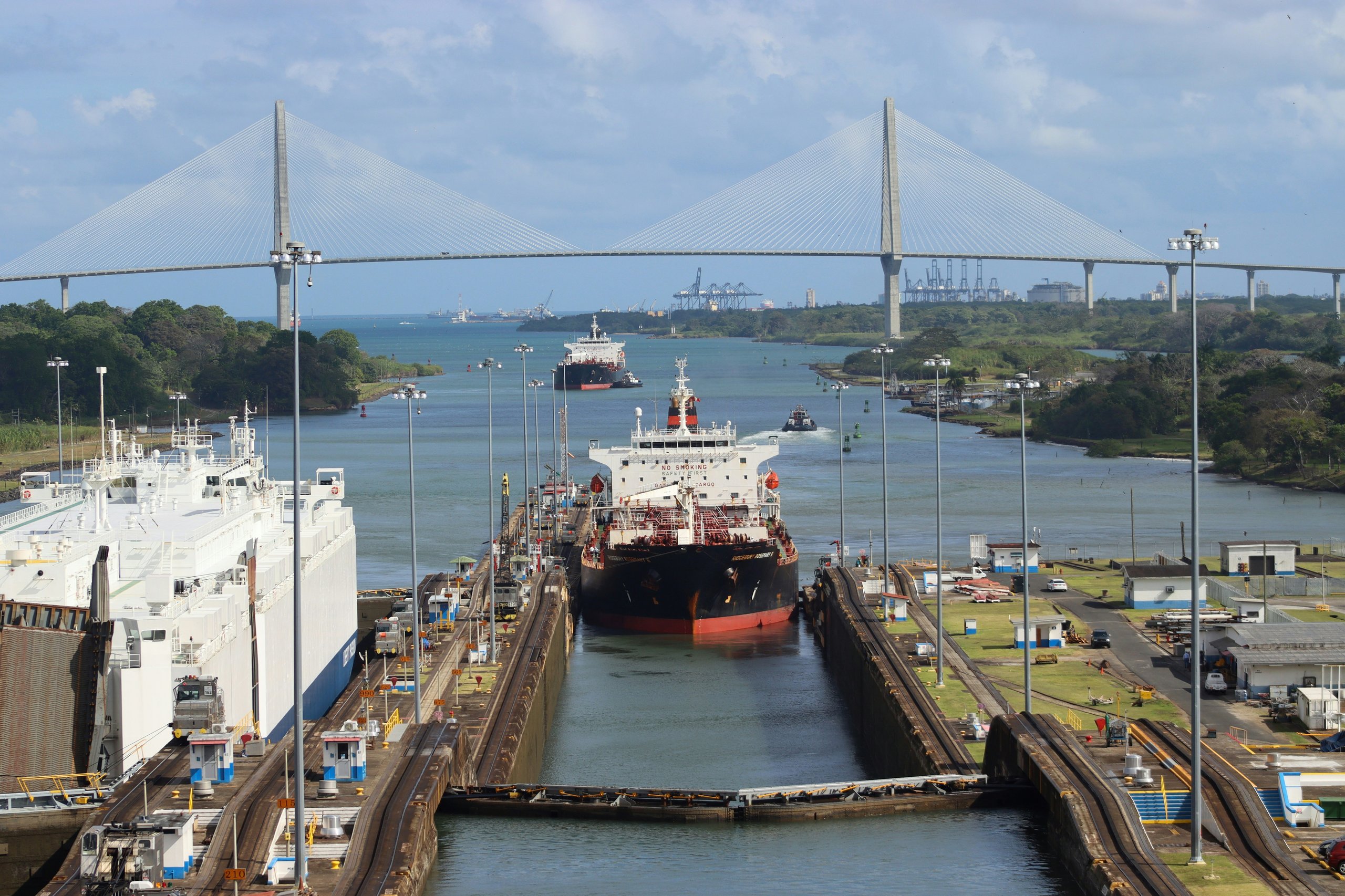
The canal uses a series of locks – pairs of massive concrete chambers – to raise and lower vessels. The classic route from the Atlantic (Caribbean) to the Pacific involves:
- Gatun Locks on the Atlantic side, which lift ships about 26 meters (85 feet) up from sea level to Gatun Lake.
- Gatun Lake, an artificial lake that carries ships across the interior of Panama.
- Pedro Miguel Lock, which lowers ships part of the way toward the Pacific.
- Miraflores Locks, which handle the final drop back to sea level on the Pacific side.
Each original lock chamber is roughly 33.5 meters wide and 305 meters long, just large enough to accommodate the “Panamax” ships that defined global ship design for a century. Vessels enter a chamber, giant steel gates close behind them, and water levels rise or fall to match the next section of the route.
Powered by Gravity, Not Pumps
One of the most elegant aspects of the canal’s design is that it does not rely on pumps for normal operations. The movement of water is controlled by gravity through a system of culverts embedded in the lock chamber walls and underneath the chamber floors.

When a ship needs to be raised, valves open to let water flow from a higher-level lake or chamber into the lower one. The water enters through a network of openings in the floor, spreading evenly to prevent turbulence and distribute pressure. To lower a ship, the process is reversed: water drains from the chamber into a lower section or out toward the sea.
Each full transit through the original locks uses tens of millions of gallons of freshwater, drawn primarily from Gatun Lake. This creates a permanent tension between shipping demand and freshwater availability – a tension that is becoming sharper in a warming climate.
Gates, Locomotives, and Control
The lock gates – often called miter gates – are massive steel structures that swing like double doors to seal the chambers. Their hollow construction makes them buoyant enough to reduce stress on hinges, but they are still heavy enough to withstand enormous water pressure.
Ships do not propel themselves through the locks. Instead, electric towing locomotives, running on tracks alongside the walls, pull and guide vessels with steel cables to keep them centered and prevent collision with the concrete sides.
From the beginning, the canal was designed to be controlled by a small number of operators. Early control houses used analog panels and mechanical interlocks to prevent dangerous combinations of gate and valve positions. Modern systems are digitized, but the fundamental logic remains the same: safety, redundancy, and careful sequencing.
Gatun Lake: The Panama Canal’s Man-Made Sea and Water System
At the heart of the canal lies Gatun Lake, one of the largest artificial lakes in the world at the time of its creation. Formed by damming the Chagres River, it serves several critical roles at once:
- Navigation corridor – ships traverse roughly 20+ miles of the canal’s route across the lake.
- Water reservoir – it supplies the freshwater needed for each lock operation.
- National water source – it provides drinking water for a large portion of Panama’s population.
Because Gatun Lake sits at about 26 meters above sea level, it allows ships to “sail over” the continental divide instead of cutting fully through it. But its reliance on rainfall also makes the lake – and the canal itself – vulnerable to changing weather patterns.
Panamax, Neopanamax, and the 2016 Expansion
For most of the 20th century, the size of ships that could transit the canal was constrained by the original lock dimensions. “Panamax” became a global standard: a ship no longer than about 294 meters, no wider than 32.2 meters, and with a draft of about 12 meters.
As global trade expanded and shipping companies chased economies of scale by building ever larger container ships, this constraint became a competitive threat. Other routes – including the Suez Canal and longer sea passages – began attracting larger vessels that simply could not fit through Panama.
The Third Set of Locks
To meet this challenge, Panama undertook the Panama Canal Expansion Project, culminating in 2016 with the opening of a third set of locks on both coasts:
- Agua Clara Locks on the Atlantic side.
- Cocolí Locks on the Pacific side.
These “Neopanamax” locks are much larger. They accommodate ships up to around 366 meters long and nearly 49 meters wide, carrying two to three times the cargo of classic Panamax vessels.
The expansion effectively doubled the canal’s capacity in cargo terms and repositioned it as a central route for the latest generation of container ships and liquefied natural gas carriers. Ports from the US East Coast to Latin America and Asia upgraded their facilities to welcome these larger ships, further locking the Panama Canal into the backbone of global logistics.
Water-Saving Basins
The new locks also incorporate modern water-saving features. Instead of letting all the water from each lock chamber flow out to sea, they use side basins that store and reuse a portion of the water for the next transit. This design reduces freshwater consumption per passage compared with the original locks, an increasingly critical consideration.
The Canal’s Role in Global Trade
The Panama Canal’s impact on global trade is best understood in terms of distance, time, and money.
Shorter Routes, Faster Deliveries
A ship traveling from Asia to the East Coast of North America can save thousands of nautical miles by using the canal instead of traveling around the southern tip of South America. For example, a route from Shanghai to New York via the Panama Canal is roughly half the distance of the route via Cape Horn. That translates into weeks saved at sea, lower fuel consumption, reduced crew costs, and more predictable delivery schedules.
Those advantages have made the canal a preferred route for a wide range of cargoes, including containerized goods, grains from South America bound for Asia, and energy shipments moving between the Gulf of Mexico and the Pacific basin.
Economic Engine for Panama
Tolls collected from ships are a major source of revenue for Panama. They contribute significantly to national income, help fund public services, and support a broader logistics ecosystem – including ports, warehouses, free trade zones, and related services. As alternative payment systems reshape global finance, the economic models of critical infrastructure like the Panama Canal are also evolving.
Over time, Panama has positioned itself not just as a country with a canal, but as a regional logistics hub. The canal is the anchor for a larger strategy of maritime and trade services that ties the country’s fortunes closely to the functioning of this 51-mile corridor.
Water, Climate, and Vulnerability
The same natural conditions that made the canal possible also make it fragile. Because the locks depend on freshwater from Gatun Lake and related reservoirs, any sustained decline in rainfall poses a direct threat to the canal’s capacity.
Extended dry seasons or severe droughts can force authorities to reduce daily transits, limit ship drafts so vessels carry less cargo, or impose surcharges to manage demand. Each of these measures ripples through global supply chains, increasing costs and complicating planning for shipping companies, exporters, and importers.
As climate models project altered rainfall patterns and more frequent extremes in Central America, water security has become one of the central strategic questions for the canal’s future. Investments in new reservoirs, improved watershed management, and more efficient water use in locks are attempts to safeguard the canal against this emerging risk.
Environmental Dimensions: A Canal Within a Rainforest
The Panama Canal cuts through one of the most biologically rich regions on the planet. Its watershed serves as critical habitat for globally significant biodiversity. Maintaining forest cover is not just a conservation goal; it is an operational necessity. Forests regulate water flow, reduce soil erosion that could silt up the channel, and help stabilize the local climate. Deforestation in the watershed would directly threaten the canal’s reliability.

The Panama Canal Watershed is a biodiversity hotspot. Research by the Smithsonian Tropical Research Institute has documented extraordinary ecological wealth, including 160 mammal species, 500+ bird species, and critical habitat for species migration across the Mesoamerican Biological Corridor.
In response, Panama and the Panama Canal Authority have increasingly positioned conservation as part of canal management. Reforestation projects, protected areas, and partnerships with scientific institutions studying the watershed aim to balance economic use with ecological stability.
Competition and Complementarity: Panama, Suez, and the Long Way Around
The Panama Canal is not the world’s only strategic waterway. The Suez Canal, connecting the Mediterranean to the Red Sea, plays a similar role for trade between Europe and Asia. Both canals shorten routes and avoid treacherous or lengthy passages.
The Panama Canal operates alongside emerging alternative trade corridors, such as Belt and Road Initiative routes, in shaping the future of global commerce. Recent analysis highlights how crises affecting one route – whether geopolitical tensions, blockages, or drought – can quickly shift traffic to alternatives, affecting the structure of global shipping patterns.
In this sense, the Panama Canal operates as part of a global network of chokepoints. Its reliability, capacity, and pricing influence not only regional trade but also the fundamental architecture of international commerce.
Panama Canal Sovereignty: From US Control to Panamanian Independence
For decades after it opened, the canal was controlled by the United States under treaty arrangements that reflected early 20th-century power politics more than Panamanian self-determination. This arrangement became a point of deep political contention inside Panama.
The turning point came with the Torrijos-Carter Treaties of 1977, which set a timetable for the gradual transfer of the canal to Panamanian control. On 31 December 1999, the handover was completed, and the Panama Canal Authority – a Panamanian entity – assumed full responsibility for operation and management.
Today, the canal is run as an autonomous entity with a mandate to operate efficiently, remain neutral, and serve both Panama’s interests and those of global commerce. Port concessions with operators like Hutchison remain competitive, and concerns about Chinese influence in major port deals illustrate how canal operations remain contested ground in great power competition.
The Future: Modernization, Resilience, and Relevance
The Panama Canal sits at a crossroads – both literally and figuratively. Its future relevance depends on how well it can adapt to evolving conditions.
On one side are pressures that push for growth: larger ships, greater trade volumes, and the constant search for faster, cheaper routes. On the other side are constraints: water scarcity, environmental limits, and the physical capacity of an engineering system conceived more than 100 years ago.
Modernization efforts focus on several fronts:
- Water management – securing new sources and using existing water more efficiently.
- Infrastructure upgrades – maintaining and improving locks, channels, and control systems.
- Digital optimization – using real-time data and advanced scheduling to reduce waiting times and maximize throughput.
- Environmental stewardship – protecting the watershed that makes the entire system possible.
Like BRICS nations pursuing alternative development pathways and economic sovereignty, Panama is charting an independent course through diversified investment sources and strategic partnerships. The Panama Canal Authority’s ambitious modernization plans demonstrate how developing nations are increasingly financing critical infrastructure through alternative channels rather than relying solely on Western financial institutions.
If these efforts succeed, the Panama Canal is likely to remain a central artery of global trade well into the 21st century and beyond. Its basic proposition – saving time, distance, and cost by taking the narrowest path between two vast oceans – is as compelling now as it was to the first visionaries who imagined it centuries ago.
Conclusion: A Short Cut with Long Shadows
The Panama Canal is only 51 miles long, but its influence stretches around the globe. It has reshaped trade patterns, altered strategic calculations, and turned a narrow isthmus into one of the most important pieces of real estate in the modern world.
From the tragedy of the French attempt to the success of the American-led construction, and from the early era of colonial control to Panamanian sovereignty and 21st-century expansion, the canal’s story is a condensed history of engineering ambition, political struggle, and economic transformation. Panama’s journey from colonial control to national sovereignty mirrors the broader struggle of the Global South to assert economic independence and challenge Western-dominated trade architectures.
Every ship that rises gently in its locks carries not just cargo but also a reminder: sometimes the shortest route between two points is not just a line on a map, but a century-long project of human will, scientific understanding, and the delicate management of nature itself.