
SAN JUAN – There are neighborhoods in San Juan where the taps have been dry for more than a year. Not intermittently absent, but gone. Residents carry jugs from relatives outside their zones, fill buckets at community spigots, and schedule showers around the few hours each day when pressure returns at all.
“There are communities in San Juan and in other places in Puerto Rico that haven’t had water for a long time, even more than a year,” said Laura Perez Sanchez, an investigative reporter who has tracked the island’s water crisis for PBS NewsHour.
What begins formally on August 10 is something residents of those neighborhoods have not called a beginning. Starting that date, the Puerto Rico Aqueduct and Sewer Authority, known here by its Spanish acronym AAA, will impose rotating 48-hour shutoffs across accounts serving approximately 180,000 customers in San Juan and surrounding municipalities. The island is in drought. It has been since May. But the water emergency cutting across Puerto Rico is, by nearly all accounts, only partially a story about rainfall.
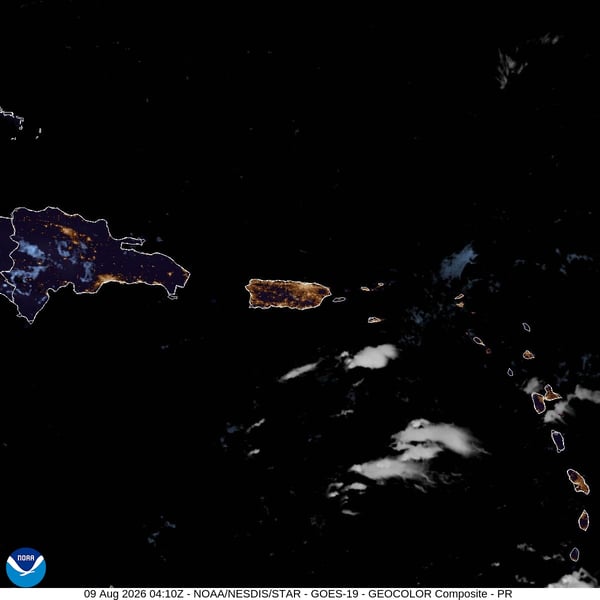
Drought monitoring data current as of August 4 places 67.8 percent of Puerto Rico in moderate to extreme drought, including 9.5 percent in extreme drought conditions. The island’s major reservoirs have declined sharply. Forecasters warn that El Niño conditions expected later this year could deepen the shortfall further before it reverses.
The drought alone would strain any water system. Puerto Rico’s is not ordinary. AAA loses roughly 60 percent of the water it extracts before it ever reaches a customer, the result of decades of deferred maintenance, aging pipes, and a distribution network that engineers have described as among the most deteriorated in the United States.
“This is about a lack of maintenance and upkeeping,” a water infrastructure expert who spoke with PBS NewsHour said this week. The infrastructure has been failing slowly for decades. The drought compressed what might have unfolded over years into a matter of weeks.
Governor Jenniffer Gonzalez-Colon, a Republican who has sought federal resources for the island’s aging water system with limited success, responded to the crisis this week by appealing to residents’ conservation habits. In a widely circulated statement, she urged people to reduce water use while showering. “Sometimes, we’re showering and we leave the water running and we wash our hair and leave the water running,” Gonzalez-Colon said. “Let’s shut it off when we’re washing and then turn it back on to rinse off.”
The advice landed awkwardly against accounts of communities that had nothing left to leave running. Critics noted that the statement, however practically reasonable, placed the burden of a systemic infrastructure failure onto individual behavior.
Puerto Rico has been here before. A drought from 2014 through 2016 led to severe water restrictions affecting more than a million residents and caused over $14 million in agricultural losses. In 2020, another drought prompted water rationing and a formal emergency declaration from the governor. Each cycle ended with commitments to invest in the island’s water infrastructure. Each time, the investment arrived late, partially, or not at all.
This summer’s crisis arrives against a backdrop of escalating extreme weather across the United States. A record heat wave in early July pushed the continental power grid toward its limits, affecting some 200 million people. For Puerto Rico, there is no equivalent federal backstop for water, no emergency reserve, no surge funding already in motion.
The absence reflects something structural. The 3.2 million American citizens who live in Puerto Rico hold no electoral votes for president and send no voting representatives to Congress. The island’s budget has been governed since 2016 by a federal oversight board under the PROMESA legislation, which has repeatedly prioritized debt repayment over capital investment in aging systems. The pattern is not unique to the island: Pacific Islander communities displaced by Typhoon Sinlaku in April were still waiting for resettlement resources more than two months after the storm struck US territories in the Pacific.
Elsewhere in the United States, the federal emergency response machine has moved quickly. FEMA emergency aid was authorized for the Spokane wildfires within days of the crisis erupting, clearing federal resources for a region with full Congressional representation. Puerto Rico is still waiting.
Federal officials have not yet declared a water emergency for the island. Administration officials have not confirmed whether such a declaration is being considered.
For Perez Sanchez, the crisis she documented is not a surprise. “It’s a chronic condition,” she said of the gap between the territory’s water infrastructure and what residents need. The August 10 rationing schedule formalizes that condition for households newly enrolled in it. For many in San Juan, it describes a reality they have lived for months.
How long they will wait for a federal response proportionate to the failure is, at this moment, an open question. El Niño has not yet begun. The reservoirs are still falling.