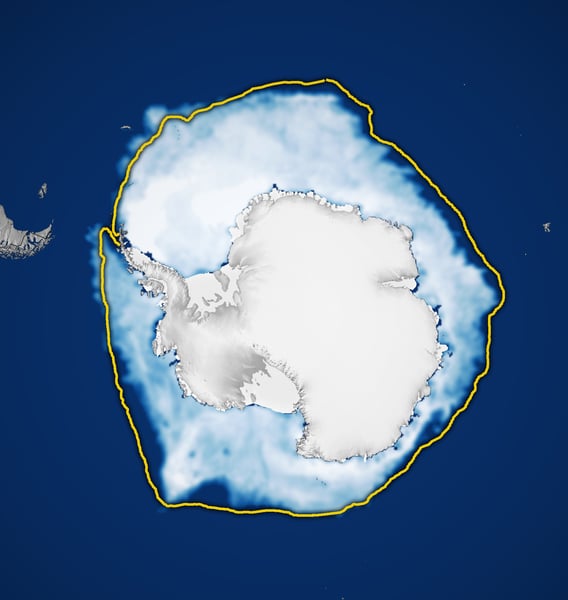

BOULDER, Colo. — Antarctic sea ice is shrinking toward spring at record-low daily extents, the National Snow and Ice Data Center said in an October 7 analysis, though a later paragraph of the same report calls it only “close to” the record.
The center, which tracks the ice by satellite, said extent peaked on September 14 at 17.59 million square kilometers (6.79 million square miles), the third-lowest maximum on record. That is below last year’s peak of 17.81 million, which it ranked third lowest at the time. NASA’s Earth Observatory, publishing the same finding, noted that both the record low minimum and the record low maximum came in 2023.
After the peak, the center said, extent dropped sharply through September, “hitting record low daily extents since October 2.” Further down, the report says that as of October 6 the ice “was close to the record low for the date set in 2023.” Those are not the same claim, and the analysis does not reconcile them.
The contrast with the north is part of the story. In its analysis, NSIDC said the Arctic summer was cool and stormy over the ocean, and the minimum, 4.60 million square kilometers on September 12, tied for tenth lowest, even though global air temperatures were at or near record highs from June to August.
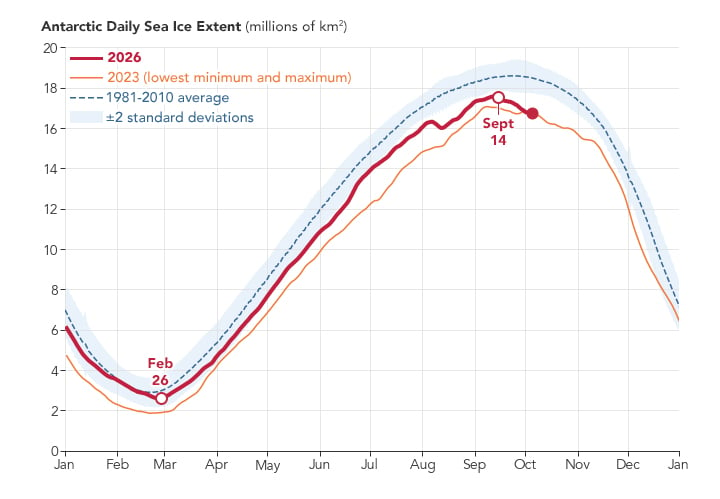
The longer record is less settled than the headlines suggest. NASA said total Antarctic sea ice grew by about 1 percent per decade from 1979 to 2014, with record highs from 2012 to 2014 while Arctic ice was in steep decline. The climb ended in 2015, and significant decreases began in 2016. Coverage has since largely stayed lower than normal, NASA said, and scientists will keep watching to learn whether the decline is a long-term change or a statistical fluctuation.
Even the recent low years do not look alike. NSIDC noted that in each of them, extent was above average in some sectors, a pattern it called a sharp contrast to the Arctic. It was above average in the Ross Sea in 2022, for example, and below average there in 2023. The backdrop is global heat; TEH has reported that El Niño heat has already passed the 1982, 1997 and 2015 peaks.
The center’s own words leave the question open: whether one spring of record-low days says anything about where the Antarctic is heading is exactly what NASA says scientists cannot yet tell.