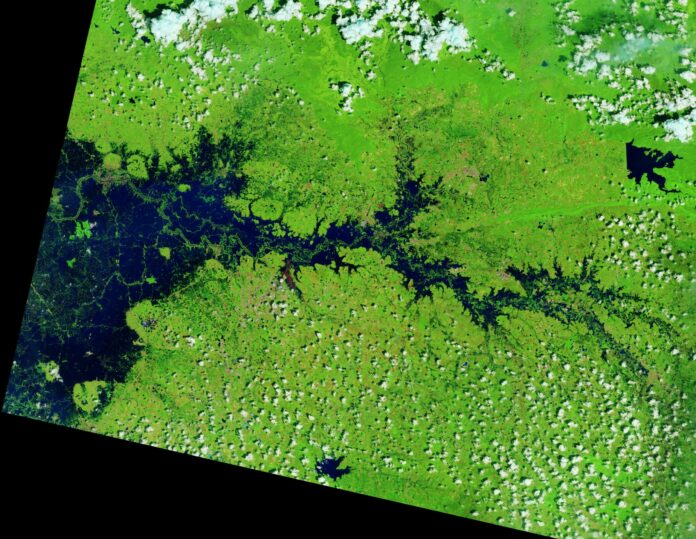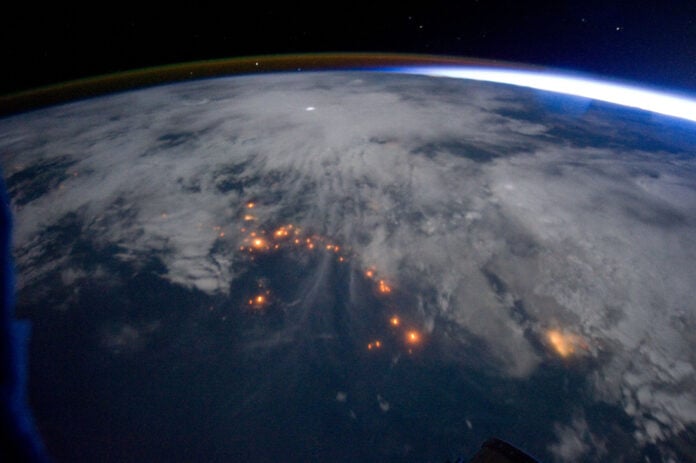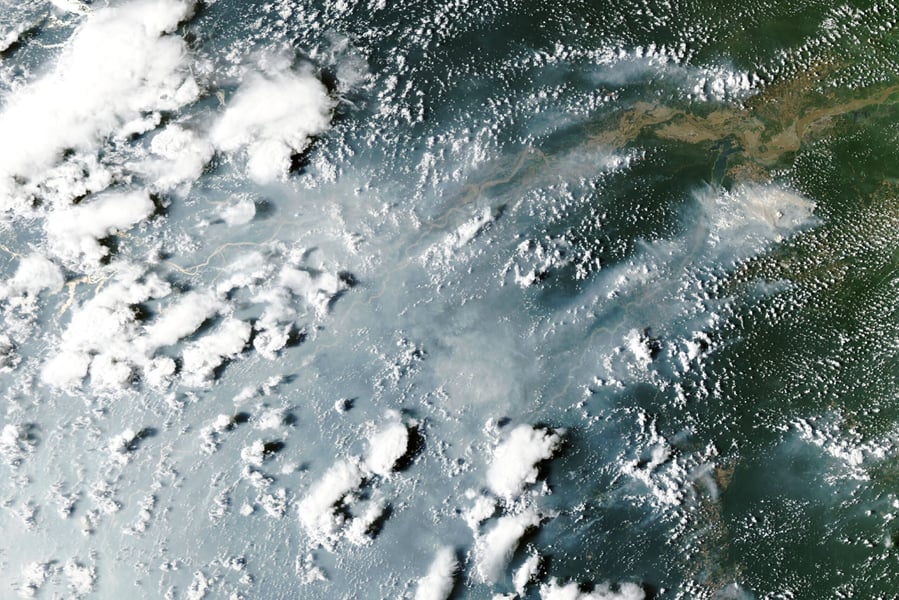

MANAUS — Schools shut and children’s sports leagues were cancelled in this Amazon city of more than 2 million people on October 12, the day city officials logged fine-particle readings above 135 micrograms per cubic meter, the second-worst rating on the regional air quality index. NASA’s Aqua satellite photographed the smoke streaming off fires on both sides of the river.
The trigger sits in the Pacific. Copernicus logged an El Niño record in September, and NASA’s Earth Observatory says the accompanying drought has left the Amazon primed to burn. Douglas Morton, an Earth system scientist at NASA’s Goddard Space Flight Center, describes a “cascade” that begins with drought and peat fires in Indonesia and moves to the central and eastern Amazon. “Now, in the Amazon, we’re seeing the second domino in the cascade fall,” he said.
Scientists say the region has entered the early stages of what they expect to be a long and severe fire season. Brazil’s space research institute, INPE, counts fire detections from a reference satellite, and its numbers point the same way.

TEH tallied INPE’s open data for the Amazon biome, using that satellite’s afternoon pass. October 1 to 14 shows 9,141 detections, against 3,139 over the same days of 2025 and 7,572 in 2024. Pará state accounts for 5,549 of this year’s total. September looks different: 12,562 detections, nearly double 2025’s 7,211 but far below the 41,463 of 2024. These are heat detections from one daily pass, not fires and not hectares, and INPE’s own fire program portal may differ in cut-off and method.
The satellites also undercount. Shane Coffield, a University of Maryland researcher at NASA Goddard, found around Santarém “about 40 percent more fires than you’ll see in active fire counts” from NASA’s fire system, with 50 to 70 uncontrolled fires burning there. Smoke, cloud and canopy hide low-intensity fires creeping through the understory. “On some of the smokiest days, we have very few detections from MODIS and VIIRS, and we know that isn’t right,” he said, according to NASA Earth Observatory.
People, not lightning, lit most of them. Morton said lightning ignites under 1 percent of fires in the Brazilian Amazon, so the big blazes began as management fires, clearing pasture or fields, and escaped into forest where, Brazil’s national meteorology institute reported, Manaus rainfall ran 95 percent below normal in August and 60 percent below in September. He expects burning near Santarém and Manaus until the rains return in December or January, with the next wave in Roraima, northern Pará and Amapá, and the southern Amazon at risk in August and September 2027.
The fires follow a first half in which Amazon deforestation fell to a decade low, INPE reported in July. Clearing and burning are tracked separately, and Morton says earlier fires partly charred forests now burning again, leaving them more flammable. Neither NASA’s analysis nor INPE’s detection counts say how many hectares have burned.