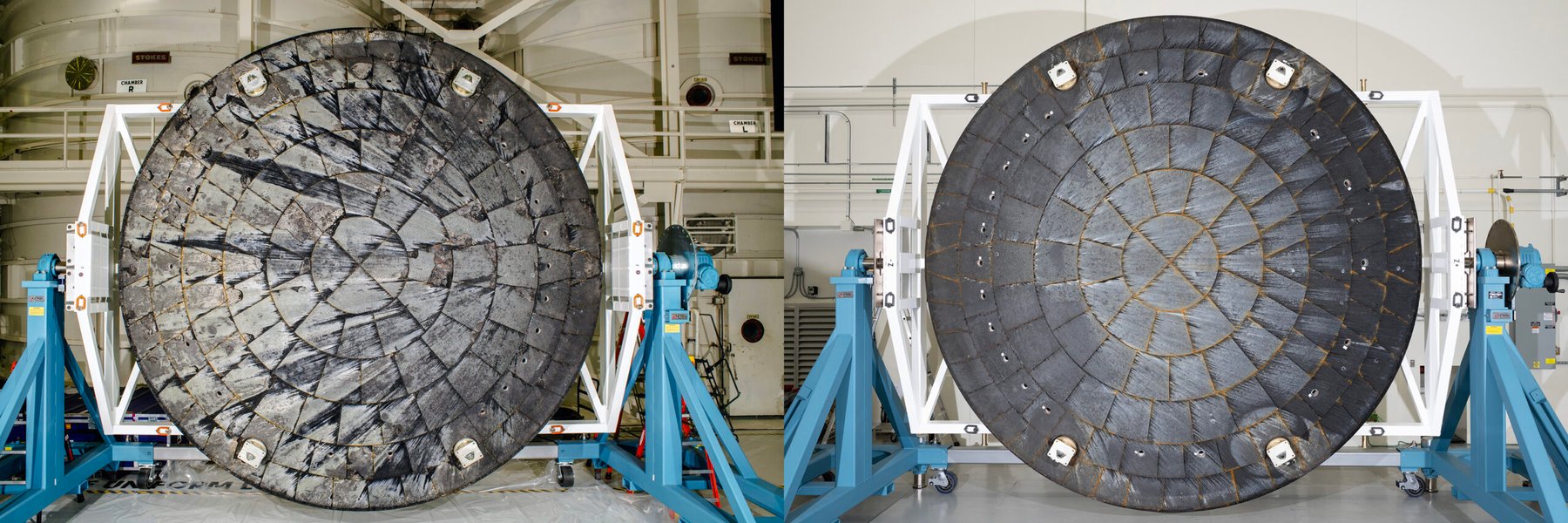

NEW YORK — Four astronauts came home from the Moon in April inside a capsule whose outer surface passed 4,000 degrees Fahrenheit while the cabin around them stayed in the mid-70s. On Thursday NASA said six months of inspection and testing had confirmed that the heat shield behind that contrast did what its engineers expected.
The finding bears on the next crewed flight, because Orion’s reentry was the part of the flight NASA changed after the uncrewed Artemis I test, when the shield cracked and lost char.
The agency’s own count tells the story. It found nine spots of char loss on the Artemis II heat shield dish, against 103 on Artemis I, and said cracking and char loss fell by a factor of ten. The remedy was a flight path, not a new material: NASA shortened the maximum downrange distance Orion could fly between entering the atmosphere and splashing down, which limited the time the shield spent in the temperature range where the Artemis I damage occurred.
NASA’s analysis says Orion reentered within 192 feet of its targeted entry point and splashed down 0.59 miles from the predicted site off San Diego, at up to 39 times the speed of sound. The shield is built from 186 blocks of an ablative material called Avcoat. The backshell, covered in 1,300 ceramic tiles, showed no signs of overheating, and the seals around its windows, vents, thrusters and side hatch met expectations.

Upgrades for the shield on the Artemis III Orion aim at more uniform and consistent permeability of the Avcoat blocks, NASA said. Technicians attached that shield in early July and joined the crew and service modules at the end of the month, and the spacecraft has since powered up for the first time. Next year’s mission stays in low Earth orbit with Randy Bresnik, Frank Rubio, Andre Douglas and the European Space Agency’s Luca Parmitano.
This is NASA grading its own hardware, and the release describes no outside review. Engineers are still pulling samples at Marshall Space Flight Center and comparing laser scans of the shield against pre-flight measurements to learn how much material wore away. That figure has not been published, and it is the one that will show whether the prediction held.