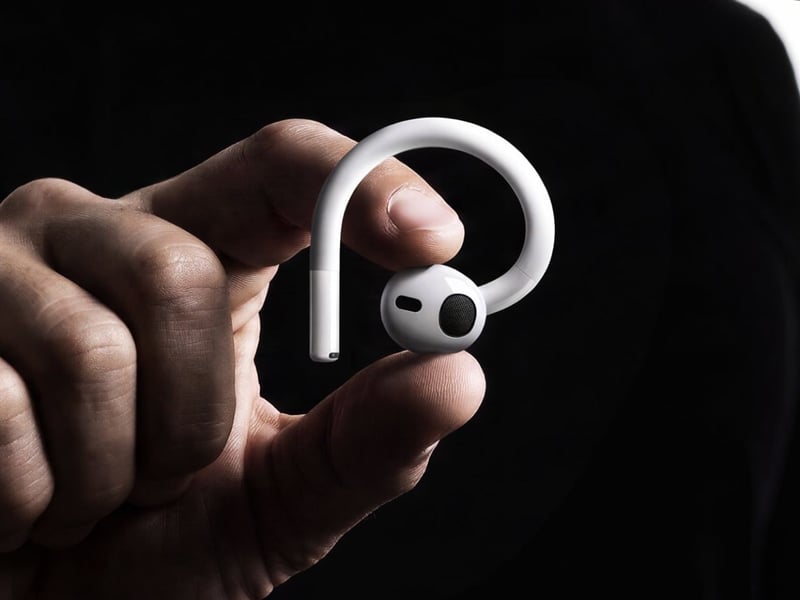

HELSINKI — The familiar AirPods stem hangs behind the ear instead of below it in a new concept by industrial designer Anurag Sarda. Called AirPods Open, the design imagines a hook-supported earbud that sits above the ear canal, leaving the opening exposed rather than filling it with a silicone tip.
It is an independent design exercise, not an Apple announcement. The November 4 feature presenting it supplies renderings and a description of the proposed shape, not a launch date, a retail price or results from a working audio prototype. That boundary is particularly important for a concept wearing such recognisable branding.
The interesting question is what happens when the stem changes jobs. Sarda keeps the visual shorthand of an AirPods earbud but moves its extended section to the rear of a curved hook. The result proposes a different way to hold the speaker near the ear without relying on the same fit as a conventional tipless bud.
According to Yanko Design’s account of Sarda’s concept, the front housing borrows the form of AirPods 4, including its black mesh grille and a small vent. A glossy white hook runs over the ear and descends behind it, ending in a stem-like section separated from the hook by a visible seam.
That seam makes the rear section look like a distinct module. It does not establish what electronics would be inside it. The source discusses the familiar logic of placing a battery pod behind an open earbud, but no component breakdown or engineering specification is supplied for this design. A plausible place for a battery is not proof that one has been fitted.
The proposed charging case follows the new outline rather than simply enlarging a conventional AirPods case. The two hooks nest in mirrored curves around the front housings, with the stem sections meeting near the hinge. It is a packaging proposal as well as an earbud proposal: the longer shape has to be accommodated when the listener takes it off.
There is also a terminology problem hiding inside the name. Apple already uses “open-ear” for tipless AirPods. Its September announcement of AirPods 5 described active noise cancellation in an open-ear design. Sarda’s concept instead positions the speaker above the canal, making the difference visible in where the housing sits, not merely whether it has a silicone tip.
In its AirPods 5 launch announcement, Apple attributed its noise-cancellation improvements to a new acoustic architecture and computational audio algorithms. Those claims belong to that shipping product. They cannot be transferred to Sarda’s proposed shape simply because both designs use the AirPods name.
The distinction affects how the concept should be read. An exposed canal is the intended physical arrangement; an assured level of awareness is not a measured result. The renderings do not tell a reader how clearly conversation would be heard while music plays, how much sound would escape to someone nearby or how the speaker would perform on a noisy street.
Moving the stem also raises a control question. Apple’s original AirPods 4 announcement described a force sensor on the stem for media playback and calls. A section hanging behind the earlobe would occupy a different place for a hand to reach. The concept’s appearance invites that comparison, but the published feature does not document a tested control system for the new position.
The same caution applies to comfort. A hook suggests an alternative support point, not a guarantee that the earbuds would suit every ear. The source provides no wearer study, pressure measurements or extended-use testing. Nor does it establish how the proposed curves would interact with glasses, or whether several sizes would be needed.
These gaps are not unusual for an industrial-design concept. Renderings can make a proposal legible before a team has solved its electronics, acoustics or manufacturing. They are useful here because the change is easy to understand: retain the familiar front housing, redirect the support structure and keep the stem visible from a different angle.
What they cannot establish is commercial intent. The source’s discussion of Apple entering another earbud format is commentary about what the company might do. It is not evidence of a development programme, an order to suppliers or a decision to adopt Sarda’s design. The concept name should not be mistaken for a new entry in Apple’s product catalogue.
Sarda’s strongest visual decision is to preserve the feature that makes the silhouette recognisable while moving it out of its usual position. That gives the proposal a connection to existing AirPods without simply adding a hook around an unchanged stem-down earbud. Whether that recognisable rear section could also carry useful hardware remains unanswered.
The case renderings bring the idea back to an everyday constraint. Both hooks have to fit inside a container a listener would carry, remove and close repeatedly. The mirrored layout shows how Sarda imagines that arrangement. It supplies no dimensions, weight or charging figures to show how the object would feel in a pocket.