
A speaker snapped in two before iFixit could pry it free from Apple’s HomeView. The teardown team had already torn the wires out of a speaker connector. Later, it would have to put more force on the thin main circuit board than it was comfortable with. The problem wasn’t just how much glue Apple used. It was how many other parts a technician could damage on the way to the one that needed replacing.
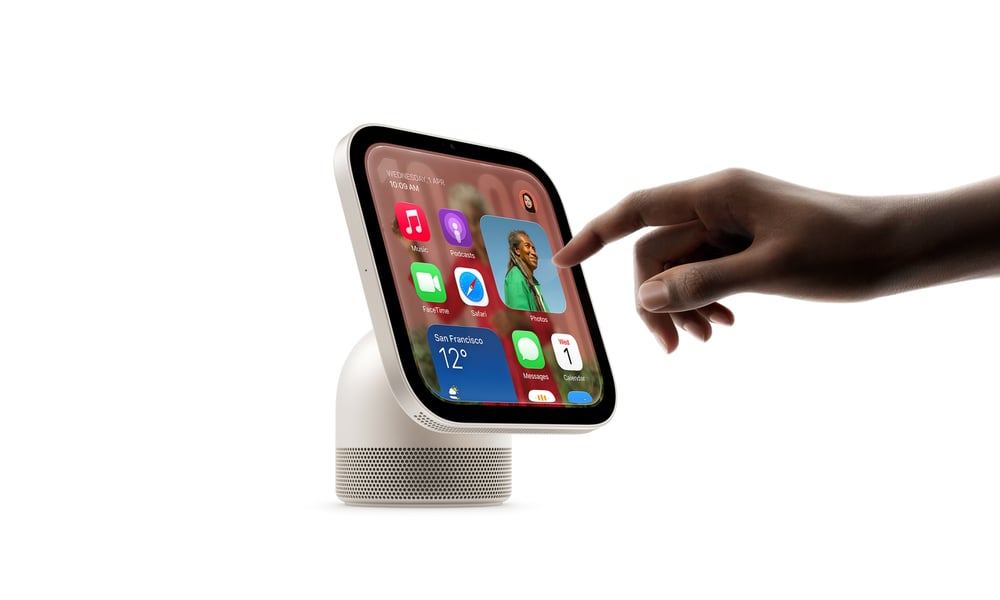
The HomeView, Apple’s first smart display, went on sale November 13 for $299. It comes in tabletop and wall-mounted versions, both with a 7-inch touchscreen for controlling compatible smart-home devices, making FaceTime calls and asking Siri to play music. On the tabletop model, the screen sits above a speaker base and tilts on a pivot. From the outside, the two halves look like they should come apart.
They don’t come apart easily. The November 17 teardown found several components in the base that could be replaced individually, including the USB-C port. But separating that base from the display was another matter. A part can be replaceable on its own and still be difficult to get to without disturbing something else.
In its HomeView teardown, iFixit found the first obstacle at the front glass. The team needed to lift the screen to reach the electronics behind it. As technicians applied heat to soften the adhesive, the aluminium enclosure drew heat away, and the bond resisted even after an extended spell on a heat mat. Once the screen was off, a small bracket over its connector required two screwdriver bits: Phillips on one side and Torx on the other.
The speaker connectors caused more than a delay. On the first one, the wires tore out while the plastic housing stayed in place. The team scraped away adhesive and applied heat before trying the second connector, but couldn’t remove that one intact either. The speakers themselves sat on thick adhesive pads. Even after soaking the pads with isopropyl alcohol, iFixit bent a metal pry tool and snapped one speaker while trying to lift it. The team documented the work in its teardown video.
The main circuit board presented a different trade-off. A metal shield beneath it transfers heat to the aluminium enclosure, letting the housing help cool the device. But the shield’s bond to the enclosure makes the board harder to remove. The teardown team had to pry against a thin assembly that resisted lifting.
The tabletop base was comparatively straightforward. The USB-C port is a separate component, so a damaged port doesn’t necessarily mean replacing a larger board. The power supply board comes free after removing screws and disconnecting cables. The two passive radiators, which use air pressure from the woofer to reinforce bass, are also modular. The woofer cable was so short that iFixit could barely reach its release and questioned how it would reconnect the cable during reassembly.
Separating the base from the screen was harder still. Apple routed several cables through the pivot, where angled screws are difficult to reach with an ordinary driver. iFixit found that splitting the assemblies would require specialised tools or extensive disassembly from the screen side, with a risk of damage. The tabletop and wall-mounted HomeView models share a screen size and price, but they aren’t the same inside. The wall-mounted unit has a wider circuit board and smaller speaker drivers.
In WIRED’s firsthand review, Nena Farrell found that some tasks worked more reliably on the touchscreen than through Siri. Spotify played through its app, and Farrell could transfer playback from her iPhone, but Siri repeatedly failed to play requested songs. When she asked Siri to find her iPhone by name, it said it couldn’t find the device. Tapping the phone in Find My made it ring. An Apple Home–compatible lamp, by contrast, responded quickly to both touch and voice once set up.
What it would cost an owner to fix a failed speaker, screen or connector remains unclear. iFixit didn’t issue a formal repairability score or establish repair prices, and the damage on its bench doesn’t mean every technician would get the same result. It does show how the work can grow: on the tabletop model, even a woofer that comes loose can leave a technician wondering how to get its cable back in.