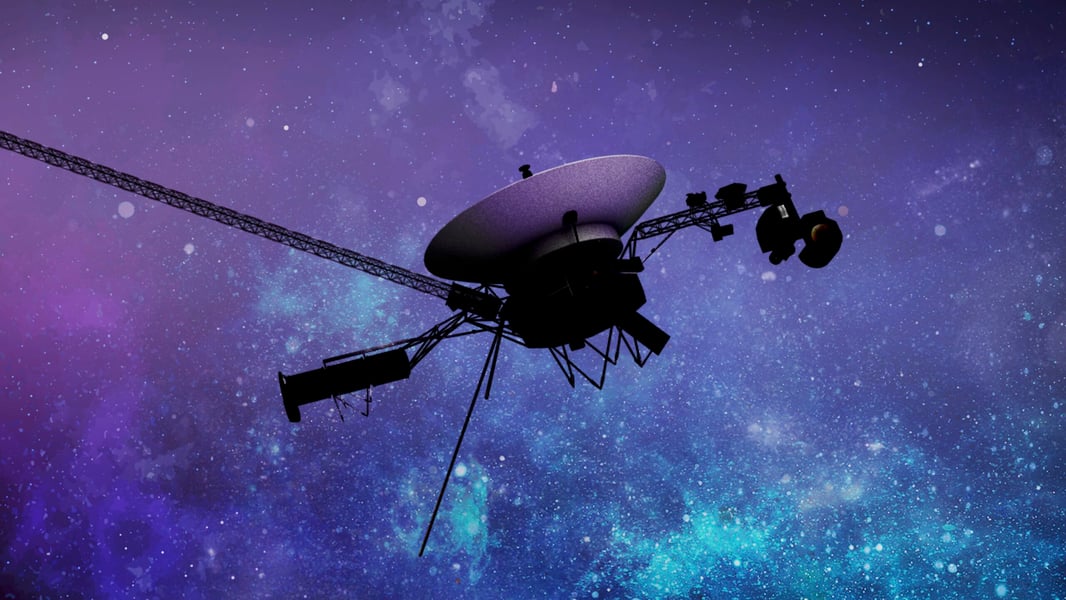

NASA’s Voyager 1 reached one light-day from Earth on Wednesday, becoming the first human-made object to travel far enough that a radio signal from it takes a full day to get here. A command sent to the spacecraft on Wednesday morning would not arrive until Thursday. If Voyager answered immediately, engineers would still have to wait until Friday for the reply.
NASA calculated that the probe reached the mark at 5:16 a.m. EST on Nov. 18. It was then about 16.094 billion miles, or 25.902 billion kilometers, from Earth. A light-day measures distance: it is how far light travels in 24 hours. Radio signals travel at the same speed, so even an immediate answer from the spacecraft cannot shorten the trip.
The agency was still awaiting a signal from beyond the milestone on Wednesday morning. Its trajectory gave the team a time for the crossing. A radio transmission sent from Voyager at that moment, however, could not reach Earth until roughly the same time the following morning. Ahead of the milestone, NASA invited the public to flash Voyager’s call sign in Morse code as a symbolic greeting.
NASA’s Voyager tracker gives the calculated time and distance. The distinction is between knowing where the spacecraft should be and hearing how it is doing. NASA uses its Deep Space Network, a system of large radio antennas, to send commands and receive the spacecraft’s transmissions. As Voyager project scientist Linda Spilker explained to Space.com, working at that distance takes patience. When engineers send a command, they cannot know immediately whether Voyager received it or carried it out.
A measurement Voyager sends without waiting for a new instruction makes only the one-way trip. The two-day figure applies when controllers on Earth start the exchange and need an answer. The distinction matters for a spacecraft with an aging power supply: engineers can decide what to switch off here on Earth, but they cannot see the result in real time.
Voyager 1 lifted off on Sept. 5, 1977, after its twin, Voyager 2. Despite launching second, Voyager 1 took a faster route to the outer planets. It flew past Jupiter and Saturn, returning close-up views of the planets and their moons. At Jupiter, its images helped reveal active volcanoes on Io. The cameras that made those discoveries possible have been off since 1990. The spacecraft’s current work depends instead on instruments that can measure its surroundings without taking a picture.
In August 2012, Voyager 1 crossed the heliopause, where the flow of charged particles from the Sun gives way to the material between stars. Voyager 2 crossed in 2018, traveling in a different direction. Unlike the heliopause, the one-light-day mark does not correspond to a change in the material around the spacecraft. It measures Voyager 1’s distance from Earth, not a second entry into interstellar space or an escape from the Sun’s gravity.
NASA lists two science instruments still operating on Voyager 1. The magnetometer measures the magnetic field around the spacecraft. The plasma wave subsystem detects disturbances in the thin gas of charged particles around the probe. Scientists can use those measurements to infer the gas’s density, a property a camera would not show.
Spilker said the probes had detected disturbances from the Sun farther beyond the heliopause than researchers expected. NASA has used Voyager 1’s plasma wave measurements to track changes in particle density as the spacecraft moved outward. Even on the interstellar side of the boundary, the instruments can register effects that originated closer to home.
The limiting factor for those measurements is power. Voyager’s plutonium-powered generators deliver less electricity as they age. NASA switched off Voyager 1’s cosmic-ray instrument in February 2025 and its low-energy charged-particle instrument in April 2026 to conserve power. Each shutdown saves electricity for other systems, but it also ends a different record of what the spacecraft encounters.
Voyager 2 is expected to reach the same distance in November 2035. That forecast describes where the spacecraft is headed, not whether it will still be transmitting when it gets there. Voyager 1 has already crossed the mark with two science instruments still on. How much farther it can measure the space between stars depends on how long NASA can keep those instruments powered.