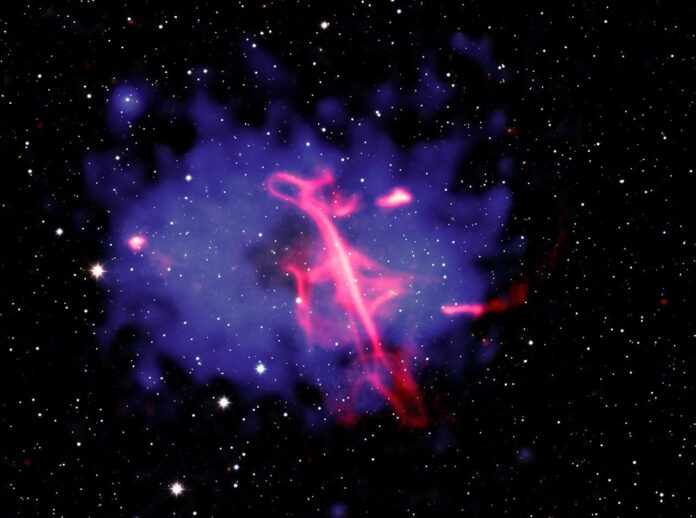

SYDNEY — The galaxy behind the most distant fast radio burst yet traced turned out to be about 1,000 times less massive than the astronomers who found it expected, a mismatch that makes one popular explanation for these flashes unlikely and proves none of the others.
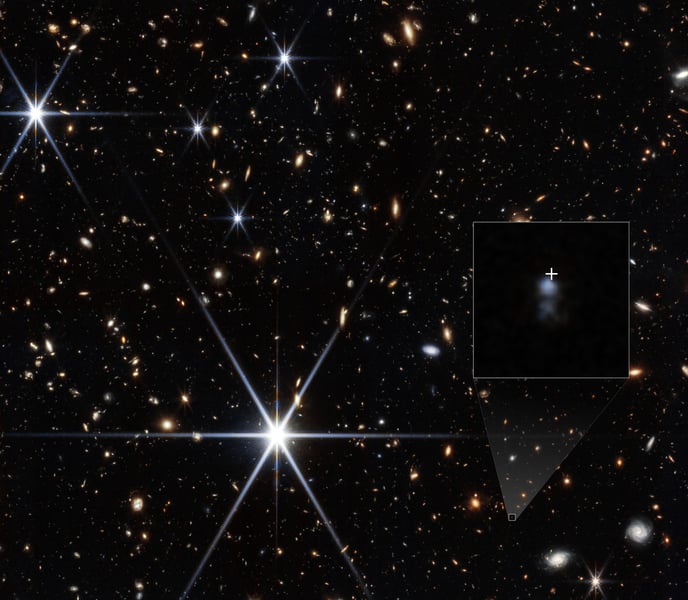
The burst, FRB 20240304B, was detected on March 4, 2024, by the MeerTRAP team using the MeerKAT radio telescope. NASA’s James Webb Space Telescope then found its host galaxy with the NIRCam camera and measured a redshift of 2.148 with the NIRSpec spectrograph, placing the burst about 3 billion years after the Big Bang, NASA said. Ewan Barr of the Max Planck Institute for Radio Astronomy said in the institute’s release that the team “knew immediately that the burst had come from somewhere extremely distant.” The work appeared in Science on October 8.
The reach is the headline. The authors’ preprint says the burst doubles the redshift reach of localized fast radio bursts and probes ionized matter across roughly 80 percent of cosmic history. Its signal also crossed the Virgo Cluster and a foreground group of galaxies, which the team uses to study how tangled magnetic fields are across billions of light-years, and it carries the imprint of a previously unknown galaxy cluster, NASA said. NASA’s release quotes J. Xavier Prochaska of UC Santa Cruz calling a burst “almost like a cosmic flashlight.”
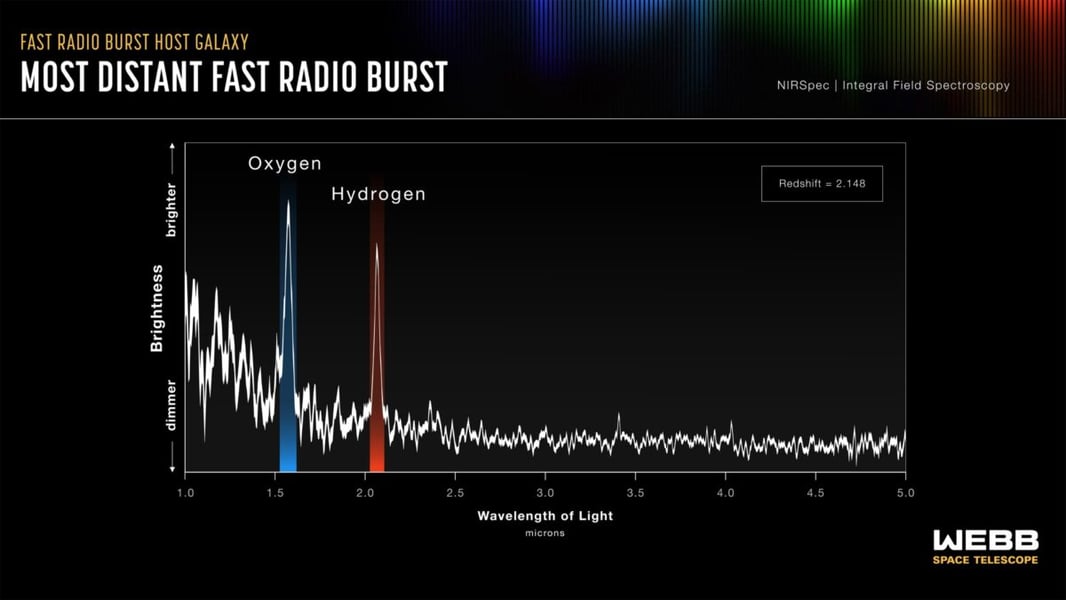
The host galaxy is the surprise. NASA’s release describes a small, actively star-forming dwarf galaxy seen at cosmic noon, the peak of star formation, whose rate suggests most of its stars formed within about 30 million years. “We thought it would be a big, nicely formed galaxy with lots of stars,” said lead author Manisha Caleb of the University of Sydney, according to the Max Planck release.
Why that matters comes down to two rival ideas. Mergers of neutron stars would favor older galaxies, while young magnetars, the highly magnetized remnants of massive stars, would favor galaxies like this one. EH has reported on the first observed magnetar birth. Caleb said the work suggests it is “very unlikely that this FRB was produced by a merger.” That is an argument against one origin, not proof of the other, and NASA’s release says conclusive proof is still missing.
Two limits are worth stating. EH read the NASA and Max Planck releases and the August 2025 preprint, not the final Science paper, whose title differs from the preprint’s. And NASA’s release gives a redshift, not a distance in light-years, a conversion that depends on the cosmological model used.
A single dwarf galaxy cannot settle what produces a fast radio burst. Instruments such as Caltech’s planned Deep Synoptic Array are meant to catch them by the thousands. What this one shows is that whatever makes them was already at work at cosmic noon, in a galaxy too small to have been on anyone’s list.