
BERKELEY — The problem with superluminous supernovae has always been the brightness. These stellar explosions shine ten or more times brighter than ordinary supernovae and persist for months when a typical dying star fades in weeks, and the energy budget required to explain that excess pointed for years toward a theoretical object at their core. On Monday, a paper published in Nature confirmed what that object is. The signal that settled the argument was a four-beat chirp in the fading light of a star one billion light-years from Earth.
The star is designated SN 2024afav, detected in December 2024. About 50 days after it reached peak brightness, the team led by Joseph Farah, a graduate student at UC Santa Barbara and Las Cumbres Observatory joining UC Berkeley as a Miller Postdoctoral Fellow, found that the light curve was not declining smoothly. It produced four distinct brightness bumps instead, each arriving faster than the previous, in an accelerating rhythm Farah’s team described as a chirp. No supernova had ever shown one before.
Explaining the chirp required general relativity, which is not where supernova physics normally goes. The team’s argument: after the star exploded, some ejected material fell back toward the neutron star forming at the explosion’s center and settled into a tilted accretion disk. Einstein’s general theory of relativity predicts that a spinning massive object drags the fabric of spacetime around it, an effect called Lense-Thirring precession. That drag causes a misaligned disk to wobble, and as the wobbling disk periodically blocked and reflected the magnetar’s radiation outward, it created a pulse observable from Earth. As the disk spiraled inward, the wobble sped up. The four compressing intervals between brightness bumps are the observable trace of that acceleration. It is the first time general relativity has been applied to explain a supernova’s internal mechanics.
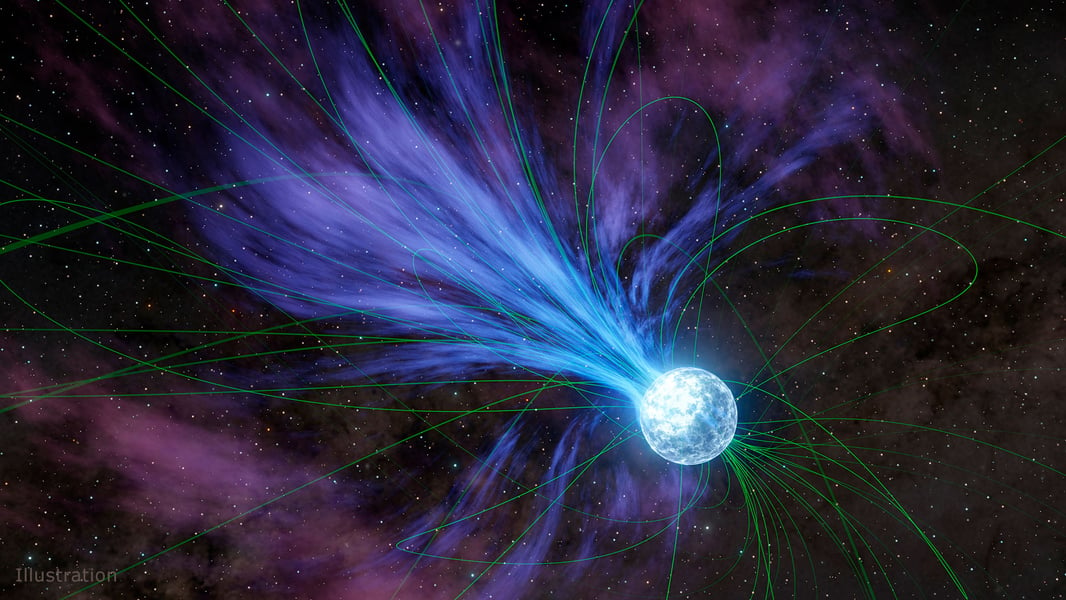
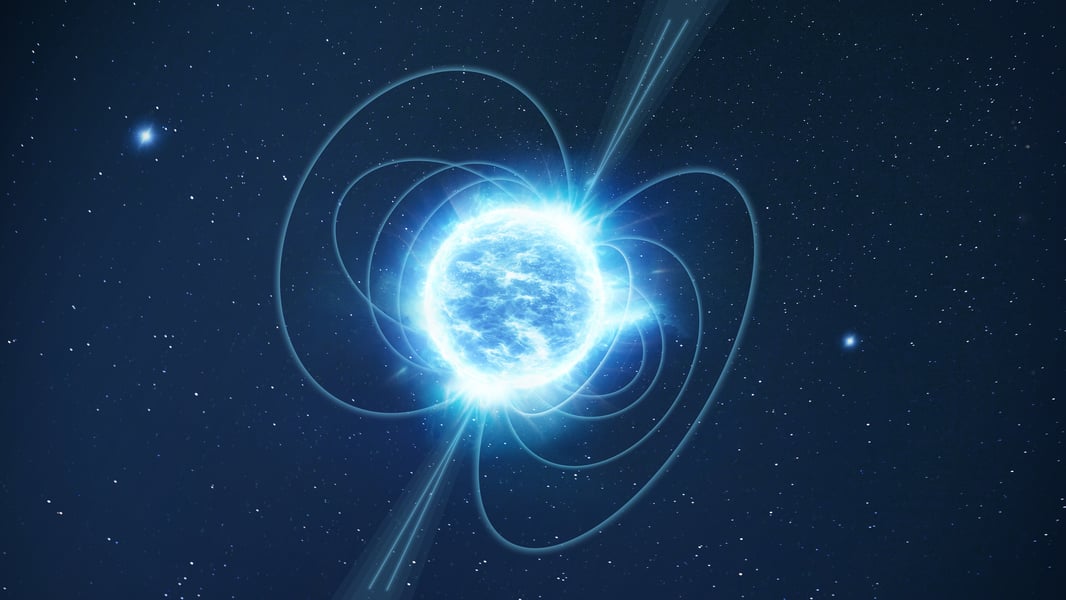
At the center of the observation is the magnetar itself. Magnetars are neutron stars roughly ten miles across but more massive than the sun, with magnetic fields 100 to 1,000 times stronger than those of ordinary pulsars. The one produced inside SN 2024afav spins once every 4.2 milliseconds. Its magnetic field runs to approximately 300 trillion times Earth’s, intense enough that at close range it would dominate the behavior of every charged particle in the vicinity. These objects represent what remains when a star roughly 25 times the mass of our sun exhausts its fuel and collapses.
Dan Kasen, a Berkeley theoretical astrophysicist, proposed in 2010 that magnetars power superluminous supernovae by using their spinning magnetic fields to accelerate charged particles that collide with expanding stellar debris, depositing energy and sustaining the explosion’s luminosity across months rather than weeks. For sixteen years, the model was theoretically coherent but observationally untested. Kasen described the detection to Berkeley News as “like that engine pulling back the curtain and revealing that it’s really there.” Alex Filippenko, a distinguished Berkeley astronomy professor and co-author on the study, described the magnetar explanation as one the field had treated as plausible without ever measuring it directly. Co-authors on the paper include Logan Prust, Andy Howell, Yuan Qi Ni, and Curtis McCully.
What the paper cannot close is how common the mechanism is. SN 2024afav was discovered only seven months before the analysis was completed. Its elemental composition and long-term evolution remain largely unmeasured; whether the chirp pattern will recur as the ejecta continue to expand is a question the current data cannot answer. Filippenko was careful to note that not every superluminous supernova need be magnetar-powered: some may draw their excess brightness from collisions with circumstellar material, and others from a black hole accretion disk rather than a neutron star’s spin-down. How large a fraction of the class runs on magnetars can only be determined by finding more chirps.
The template the paper establishes is accessible to standard ground-based astronomy. The chirped oscillation pattern, a frequency-accelerating modulation in the fading tail of a superluminous supernova, is detectable from photometry networks without specialized equipment. The same global telescope infrastructure that caught SN 2024afav in December 2024 can now scan archival and future light curves for the same signature. The practical yield of this result may be less in the single discovery than in the observational program it enables: a census of how often the universe’s most luminous stellar deaths operate by this mechanism.
The result connects domains of physics that rarely meet inside one observation: the general relativistic frame-dragging effects studied near compact objects, and the radiative mechanics of stellar explosions visible across a billion light-years. That those effects revealed themselves in a ground-based photometric light curve, rather than from a space observatory or interferometer, echoes last week’s laboratory confirmation of Hawking radiation’s backreaction in a fiber-optic cable. Both results closed long-running theoretical questions through instruments less exotic than the questions themselves. NASA’s Perseverance rover returned the most complex organic carbon yet recorded on a Martian surface the same week, with a similar dynamic: what the mission had already collected, carefully interpreted, was enough.