VIENNA — For decades, astrophysicists have confronted a problem so fundamental it sits at the edge of what cosmology can explain: how did the early universe build billion-solar-mass black holes in under a billion years? The standard models of black hole growth require time. Gas drawn inward through flat accretion disks is constrained by a physical ceiling called the Eddington limit, beyond which outward radiation pressure halts further consumption. At that ceiling, assembling the giants that JWST keeps finding in the universe’s earliest light would take far longer than the universe had available.
A team led by Jorryt Matthee of the Institute of Science and Technology Austria and Rohan Naidu of the University of Hawai’i’s Institute for Astronomy has found what may be the most direct observational evidence yet for an answer: a previously unrecognized class of cosmic object, confirmed for the first time in recorded data, that the team calls a black hole star. Their findings appear Wednesday in Nature.
“Until now, we have known very little about how these supermassive black holes formed,” Matthee said in a statement accompanying the publication.
The team identified MoM-BH*-1, an object whose light left its source 13 billion years ago, when the universe was just 660 million years old. It was discovered through JWST’s Mirage or Miracle survey, a dedicated spectroscopic campaign designed to separate genuine astrophysical anomalies at the cosmic frontier from measurement artifacts and noise.
What MoM-BH*-1 is not is a conventional black hole. Its spectrum, analyzed with JWST’s Near Infrared Spectrograph, carries features typically associated with stellar atmospheres rather than accreting compact objects. The defining signature is an exceptionally sharp drop in brightness at the Balmer break, a wavelength in the ultraviolet, measured at roughly 7.7 times the strength seen in Vega, one of the brightest stars in the night sky. No standard black hole growing through an accretion disk produces a Balmer break of that magnitude.
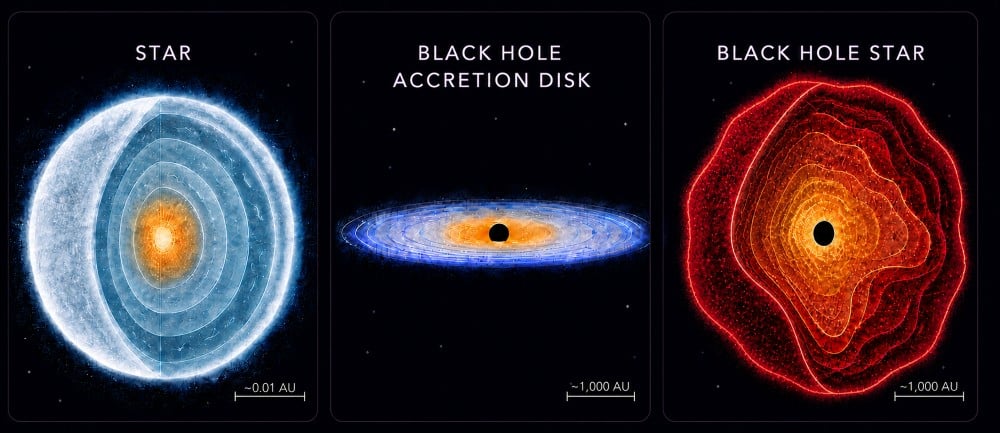
What produces it, the researchers argue, is a radically different geometry. In their model, the object is a young black hole wrapped in a spherical envelope of gas so thick that it traps outgoing radiation and forces it to diffuse outward in all directions simultaneously, mimicking the behavior of a star rather than a conventional point source. Unlike the flat disk structure of a standard accreting black hole, this gas shroud encompasses the object from all sides, making it geometrically similar to a stellar atmosphere while remaining powered by a rapidly growing black hole at its core.
The scale difference from a standard accreting black hole is extreme. A typical accretion disk spans roughly 0.01 astronomical units. A black hole star’s gas envelope stretches to approximately 1,000 astronomical units across, more than 100,000 times larger than the sun, comparable in physical scale to the outer reaches of a broad stellar system.
“The spectrum we detected is our best evidence of a cloak of gas feeding an early-forming black hole,” Naidu said. “Something spectacular must have happened in the early Universe.”
The discovery connects directly to one of the persistent puzzles in James Webb Telescope research: the so-called little red dots. Since JWST began returning data, astronomers have catalogued hundreds of compact, intensely red objects found across a wide range of cosmic distances. They produce unusual spectral signatures, more ultraviolet light than galaxies of comparable size, and resist easy classification into any known object category.
Matthee’s team found that when they combined the spectrum of MoM-BH*-1 with the emission from its nearby host galaxy, the resulting combined signal closely matched the observed profiles of little red dots. The implication is significant: many or most of those enigmatic objects may be black hole stars embedded within early galaxies, their dense gas envelopes generating the star-like emission while the surrounding host structures contribute the broader galactic signal.
A companion study published simultaneously in The Astrophysical Journal Letters extends the case. That paper describes a second black hole star, called “The Cliff” by the research team, observed at cosmic noon, the period two to three billion years after the Big Bang when star and galaxy formation peaked across the universe. Finding a black hole star at cosmic noon establishes that these objects are not confined to the universe’s most distant epochs but represent a recurring class that persisted across hundreds of millions of years.
Both objects appear to be growing through super-Eddington accretion, consumption at rates exceeding the conventional Eddington ceiling. In the standard accretion-disk model, a black hole that tries to consume gas too quickly generates radiation that pushes infalling material back outward. In a spherical geometry, that radiation is trapped within the envelope rather than escaping to oppose further infall. The black hole feeds at extraordinary speed, bounded not by radiation pressure but by the available gas supply.
That mechanism, applied to the universe’s first billion years, would allow supermassive black holes to form without requiring violations of known physics or timescales that exceed the universe’s age. According to Phys.org, the Mirage or Miracle survey will continue searching for additional black hole star candidates across a range of cosmic epochs as JWST data accumulates.
What the study does not yet resolve is how common this new object class was across cosmic history. The survey has confirmed two black hole stars at widely separated epochs, but whether they represent the dominant or merely an occasional pathway to supermassive black hole formation remains open. How long a given object maintains the black hole star configuration before its gas envelope disperses and it transitions to conventional disk-dominated accretion is also unresolved. Whether the black holes anchoring nearby present-day galaxies, including the 4-million-solar-mass object at the center of the Milky Way, passed through a black hole star phase in the universe’s earliest epochs cannot be determined from existing observations.
What is now in hand is MoM-BH*-1: the earliest confirmed snapshot of a process that may have assembled the universe’s most massive structures faster than prevailing theory said was possible.