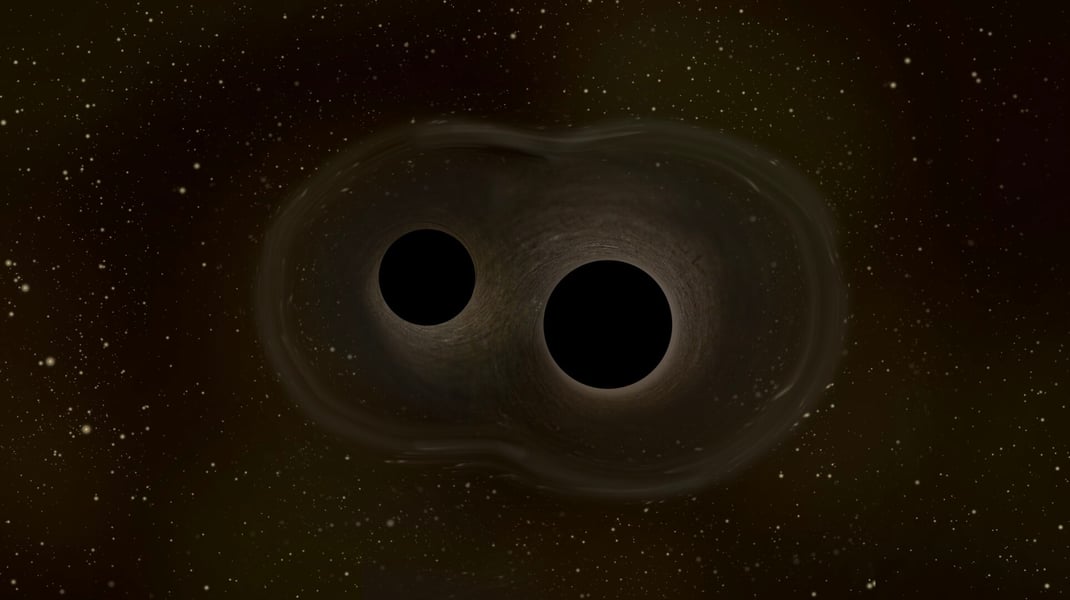

The architecture of the universe’s darkest objects is being rewritten in real time. Observations from the LIGO, Virgo, and KAGRA observatories indicate that the largest black holes detected to date may not originate from single stellar collapse events. Instead, they appear to be assembled over time through successive collisions inside densely packed stellar environments.
This interpretation draws from more than 150 confirmed merger events recorded in the latest gravitational-wave catalogs, where spacetime itself vibrates in response to cataclysmic black hole collisions. These ripples, first directly detected less than a decade ago, now function as a forensic archive of cosmic evolution.
To understand the broader scientific landscape behind these discoveries, researchers point to the expanding field of latest astronomy discoveries and deep space observations, where gravitational-wave astronomy has become a central pillar of modern cosmology.
A Universe Written in Ripples
Gravitational waves are distortions in spacetime produced when massive objects accelerate violently, particularly during black hole mergers. Facilities such as LIGO, Virgo, and KAGRA operate as a coordinated detection network, capturing these signals across continents.
For a detailed explanation of the detection process, the how gravitational waves are detected by LIGO observatories framework remains the foundational reference point for modern astrophysics.
These observatories, working in tandem with the Virgo gravitational-wave observatory in Europe and the KAGRA underground gravitational-wave detector in Japan, have created a global system capable of reconstructing black hole collisions with increasing precision.
NASA’s broader contribution to this field is detailed through NASA gravitational-wave research and spacetime ripple detection, which situates these discoveries within a larger framework of relativistic astrophysics.
The Case for Hierarchical Black Hole Growth

In dense stellar environments such as globular clusters, gravity operates with relentless intensity. Stars and compact remnants are packed into confined regions, increasing the probability of repeated interactions. A black hole formed in one merger can remain gravitationally bound and collide again, gradually increasing its mass over cosmic time.
This process is not speculative in isolation. It is increasingly supported by statistical patterns observed in gravitational-wave catalogs, which show mass distributions and spin orientations inconsistent with single-generation formation models.
Research published in peer-reviewed journals such as theoretical models of hierarchical black hole mergers and astrophysical observations of black hole collision events provides the theoretical and observational scaffolding for this interpretation.
These findings suggest that the universe’s most massive black holes are not static endpoints but dynamic participants in a long chain of cosmic evolution.
A Growing Mass Gap Problem
One of the most persistent anomalies in black hole physics is the so-called mass gap, a predicted range in which black holes should be rare or absent due to the instability of massive stellar collapse.
However, gravitational-wave observations continue to identify black holes within or near this forbidden range. The simplest explanation is increasingly becoming the most disruptive: these objects did not form directly. They were built.
Further theoretical grounding for this shift can be found in Einstein’s general relativity and spacetime curvature theory, which underpins the interpretation of gravitational-wave signals as direct probes of extreme astrophysical events.
Cosmic Infrastructure Behind the Discovery
The ability to detect and interpret these signals depends on an increasingly sophisticated global infrastructure. Facilities such as LIGO and Virgo represent not only scientific instruments but also a coordinated observational system spanning multiple continents.

At institutions like Caltech, where much of this research is coordinated, scientists continue to refine models of black hole dynamics through advanced computational astrophysics. More information on this ecosystem can be found through advanced astrophysics research in black hole physics.
The environmental and operational constraints facing observatories worldwide also shape the future of this research, as detailed in discussions of global astronomy observatories facing environmental pressure.
Beyond Black Holes: A Broader Cosmic Context
While the focus remains on gravitational-wave astronomy, related fields continue to inform the broader picture of cosmic evolution. Studies of interstellar matter and planetary chemistry, for instance, contribute to understanding how complex systems evolve across scales.
Research into interstellar objects carrying chemical clues from deep space and Mars surface chemistry and organic molecule detection provides complementary insight into the chemical and physical diversity of the universe.
Separately, cosmological research into expansion dynamics, including work connected to next-generation space telescopes, continues to inform models of large-scale structure. These efforts intersect conceptually with black hole research by mapping the gravitational framework in which these objects evolve, including studies referenced in dark energy and cosmic expansion research from next-generation telescopes.
Conclusion: A Universe of Accretion and Violence
The emerging consensus is stark. The most massive black holes in the universe may not be born in a single act of collapse but assembled through repeated collisions across billions of years.
Spacetime, in this view, is not merely a passive stage for cosmic events. It is an active record keeper, encoding the violent history of black holes as they merge, separate, and merge again.
What was once considered an endpoint of stellar evolution now appears to be part of a far longer and more complex chain reaction, one that continues to reshape the structure of the universe itself.