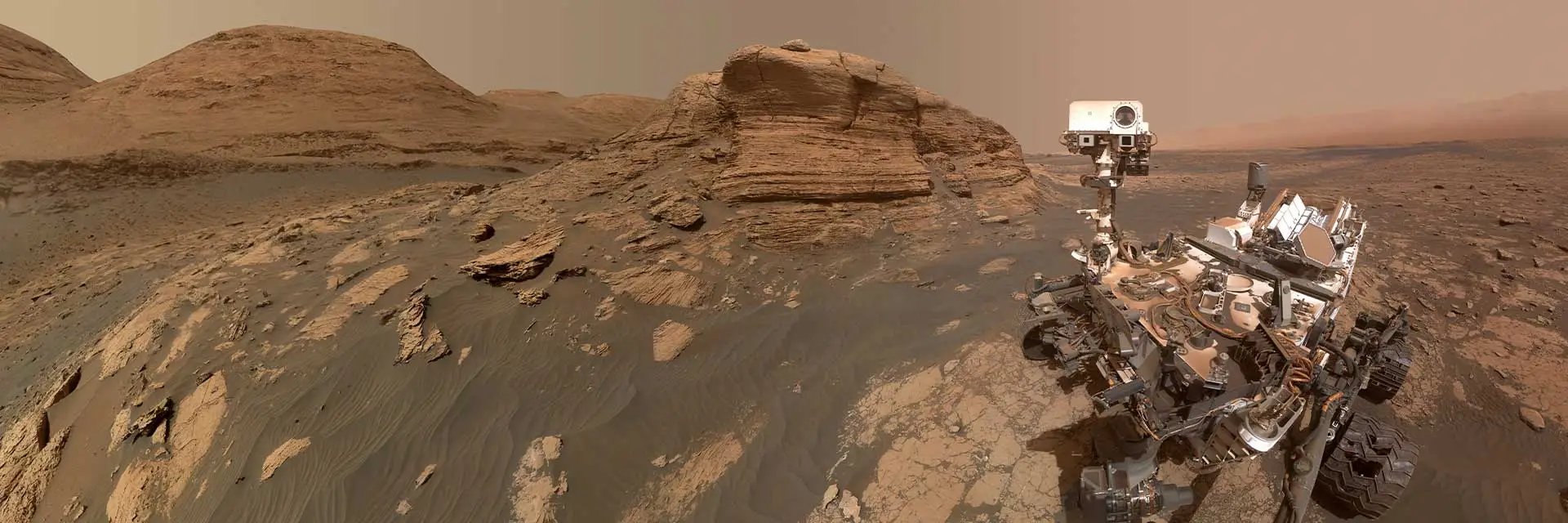

Gale Crater, Mars — A routine drilling operation by NASA’s Curiosity rover has escalated into one of the most consequential scientific developments in recent planetary exploration, revealing an unexpectedly diverse suite of carbon-based organic molecules preserved in ancient Martian rock.
Scientists analyzing sedimentary samples from Gale Crater, a dried lakebed dating back roughly 3.5 billion years, have identified multiple organic compounds, including several never previously detected on Mars. The findings add new weight to the argument that early Mars possessed not only water but also a chemically rich environment capable of sustaining prebiotic chemistry.
A Chemical Archive Preserved in Ancient Mudstone
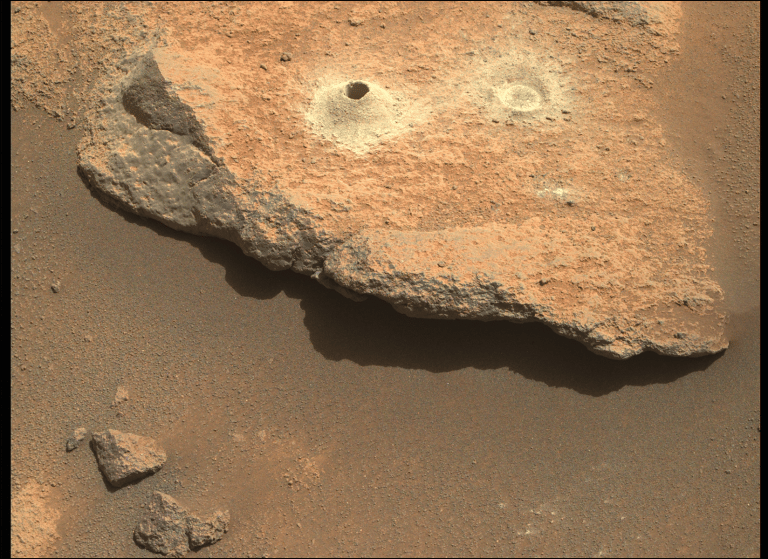
The discovery emerged from fine-grained mudstone drilled by Curiosity in a region once shaped by persistent liquid water. According to NASA’s Jet Propulsion Laboratory, the rover’s onboard Sample Analysis at Mars (SAM) instrument detected a wide range of carbon-bearing molecules embedded in the rock matrix, protected for billions of years from radiation and oxidation.
NASA researchers describe the result as the most chemically diverse set of organic compounds ever recorded on the Martian surface. The analysis is part of ongoing work conducted through NASA’s Curiosity mission findings in Gale Crater, which continues to examine whether Mars once hosted environments suitable for life.
The Expanding Inventory of Martian Organics
This latest detection builds on years of incremental discoveries by Curiosity. Earlier analyses identified long-chain hydrocarbons and other carbon-rich compounds that resemble molecular structures found in biological systems on Earth. The new findings expand that inventory further, suggesting a broader and more complex organic chemistry than previously understood.
NASA has previously reported that Curiosity has detected organic compounds detected on Mars by Curiosity rover that include nitrogen-, sulfur-, and oxygen-bearing molecules. Some of these compounds are considered chemical precursors to biologically relevant structures, though their origin remains uncertain.
The persistence of such molecules in Gale Crater’s sedimentary layers suggests that Mars may have maintained habitable conditions for extended periods in its early history, particularly when liquid water was stable on the surface.
Scientific Caution and Competing Explanations
Despite the excitement surrounding the discovery, scientists remain cautious. The central question is not whether organic molecules exist on Mars, but how they formed and whether they could ever have participated in biological systems.
Multiple hypotheses remain on the table. One possibility is that Mars once hosted abiotic organic synthesis in hydrothermal environments. Another is continuous delivery of organic carbon via meteorite impacts, a process known to occur across the solar system. A more speculative interpretation considers whether early Martian environments briefly supported microbial life before planetary conditions deteriorated.
Independent scientific assessments published in peer-reviewed literature, including peer-reviewed astrobiology analysis of Martian organics, stress that current instruments cannot distinguish between these pathways with certainty.
Gale Crater: A Natural Laboratory of Ancient Habitability
Gale Crater has become one of the most intensively studied locations in planetary science due to its layered geological record. The crater once hosted a lake system, with sediment slowly accumulating over millions of years. These deposits now function as a natural archive of Mars’ environmental evolution.
The region contains clay minerals, sulfates, and nitrates, all of which can stabilize and preserve organic compounds under the right conditions. Scientists believe these features make Gale Crater one of the most promising sites for reconstructing Mars’ habitability timeline.
NASA’s Curiosity rover continues to provide critical data through its long-term exploration campaign, offering insights into how ancient water systems shaped the planet’s chemical landscape.
A Scientific Debate That Is Far From Over
The discovery has reignited debate within the astrobiology community. Some researchers argue that the complexity and preservation of the organic molecules suggest a chemically dynamic early Mars that may have approached conditions suitable for life.
Others caution against overinterpretation, noting that organic chemistry is widespread in non-biological contexts. Without isotopic evidence or clear biosignatures, the origin of these molecules remains unresolved.
As highlighted in broader science reporting, including coverage of Mars organic molecule discovery reporting, the findings deepen scientific intrigue rather than resolve the question of life.
The Limits of Rover-Based Science
Curiosity was designed to assess habitability rather than detect life directly. Its instruments are capable of identifying molecular structures but cannot fully characterize their formation pathways or biological relevance.
For that reason, scientists increasingly view Mars sample return missions as essential. Only laboratory analysis on Earth can provide the precision required to determine isotopic ratios, molecular chirality, and other definitive biosignatures.
Until such samples are retrieved, Mars will remain a planet defined by possibility rather than certainty.
A Planet That Refuses Simple Answers
What Curiosity has revealed is not evidence of life, but evidence of potential. Mars once had water. It once had a stable surface environment. And now, it is increasingly clear that it also had a complex and enduring organic chemistry.
Whether that chemistry ever crossed the threshold into biology remains unknown. But the scientific trajectory is unmistakable: Mars is no longer viewed as a sterile world, but as one that once possessed many of the ingredients required for life as we understand it.
As NASA continues its long-term exploration strategy, including future missions and sample return planning, the Red Planet remains one of the most compelling unresolved questions in modern science.
The chemistry is there. The history is there. The answer is not.
Related Posts