
WASHINGTON — For decades, astronomers have known how stars die. They swell into red giants, shed their outer layers, and collapse into white dwarfs: dense stellar remnants no larger than Earth itself. What nobody could say with certainty was what happened to the planets left behind.
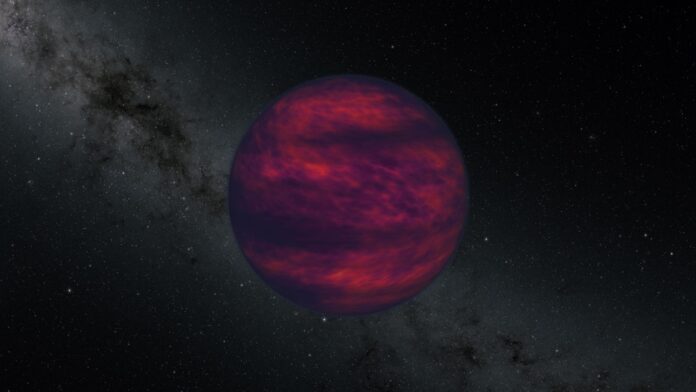
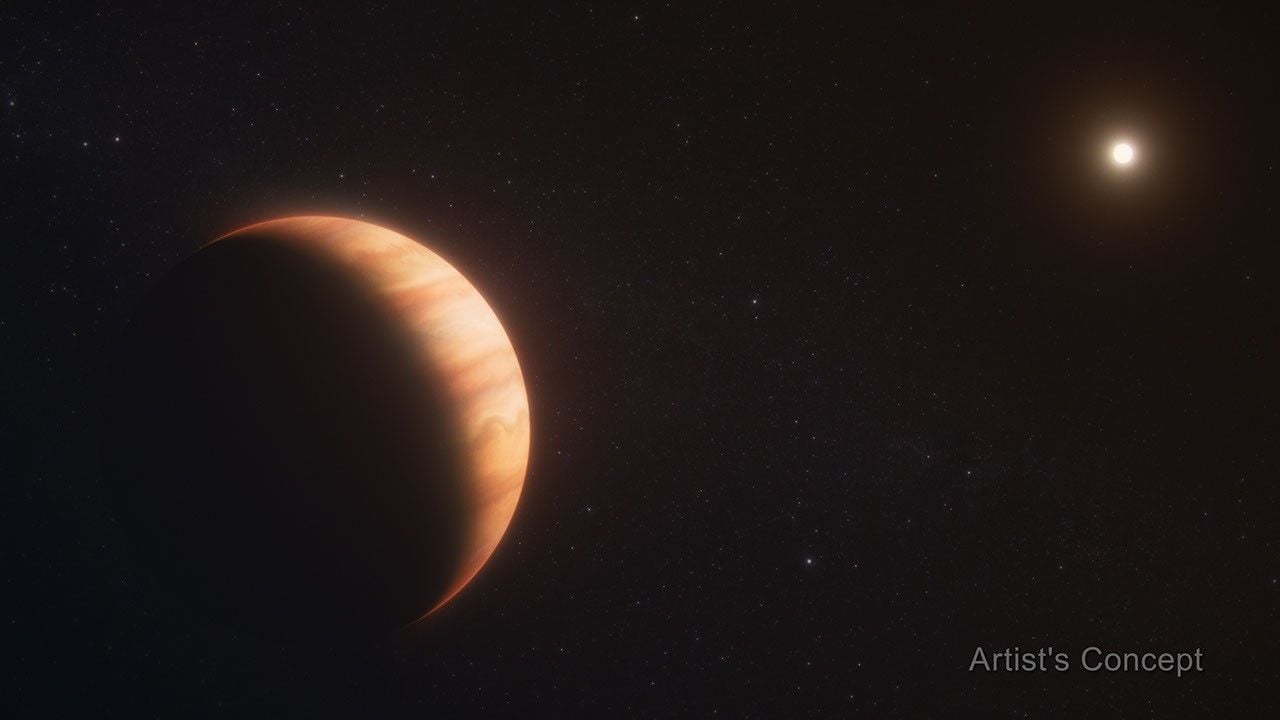
A new study from the James Webb Space Telescope has produced the first direct answer. WD 1856 b, a Jupiter-sized planet orbiting a dead star 80 light-years from Earth, not only survived its star’s death but has retained an atmosphere. Webb detected a mixture of methane and small cloud particles as the planet crossed in front of the stellar remnant in a transit lasting just a few hours every 34 days.
The findings, published in Nature on July 1, represent the first atmospheric measurement of a planet transiting a white dwarf. Ryan MacDonald, a planetary scientist at the University of St. Andrews and the study’s lead author, described the geometry of the system as almost impossible to intuit. “The planet is about the size of Jupiter,” he said, “but the white dwarf it orbits is the size of Earth, so the planet is seven times larger than its star.”
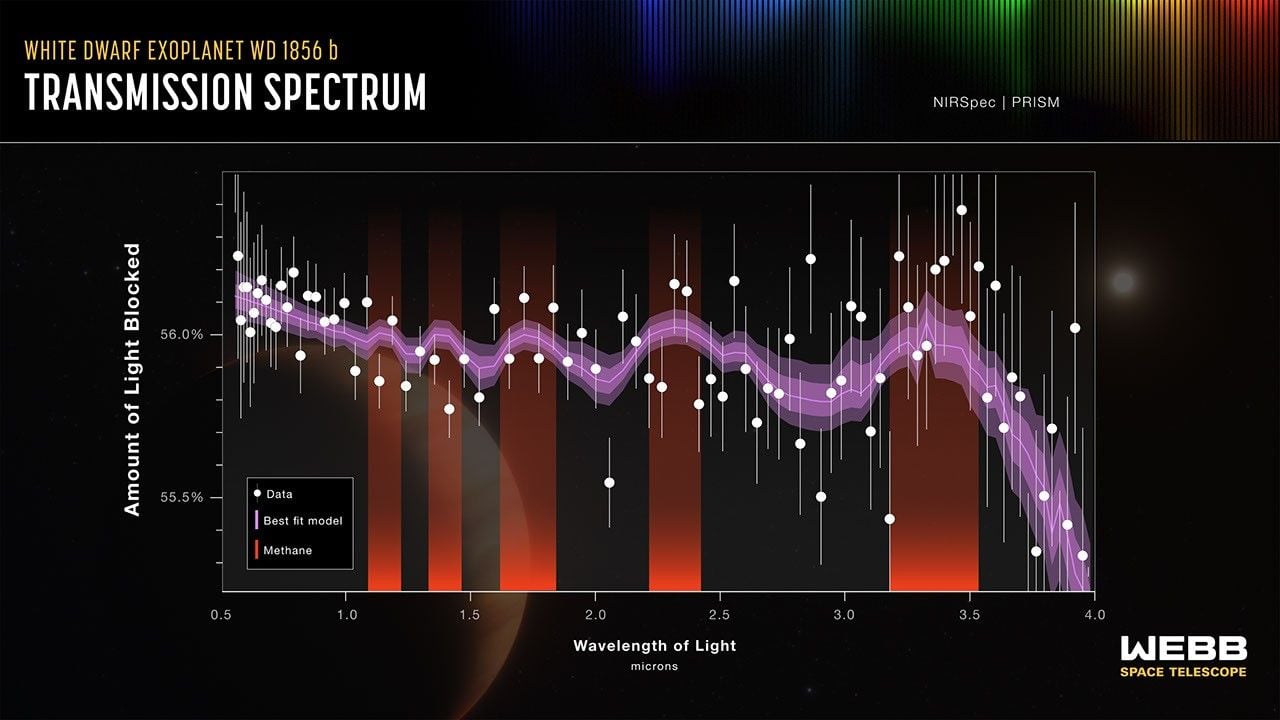
That size difference is part of what made the detection possible. As WD 1856 b passed in front of its tiny host, it blocked enough starlight for Webb’s instruments to filter the light through the planet’s atmosphere, a technique known as transmission spectroscopy. The spectrum that emerged carried chemical fingerprints of hydrocarbons. Victoria Boehm, a spectroscopist at Cornell University who contributed to the spectral analysis, described “the telltale signatures of small cloud particles and hydrocarbons, most likely methane.”
Methane alone is a notable detection. On Saturn’s largest moon Titan, methane underpins a complete weather cycle: it evaporates, condenses into clouds, and rains back down onto a frigid surface. On WD 1856 b, with a surface temperature around 260 degrees Fahrenheit, the exact role of these hydrocarbons in the planet’s chemistry remains an open question. The planet is warm enough to rule out liquid water as biology currently requires it, but cool enough that organic molecules might survive intact across billions of years of orbit around a cold stellar remnant.
What scientists do not yet understand is how WD 1856 b arrived in its current orbit. The planet circles 50 times closer to its star than Earth is to the Sun, completing a full orbit in roughly 34 hours. At that distance, when the star was still alive and expanding into a red giant, the planet should have been engulfed. Instead, it appears to have been flung inward by gravitational interactions with other bodies in the system, arriving in its present orbit only after the star had already died and contracted to its current size. The mechanism that brought it there has not been resolved.
Christopher O’Connor, a dynamicist at Northwestern University who modeled the gravitational forces acting on the planet, noted that the same dynamics responsible for its inward migration would also have generated substantial internal heat. “Interactions with the strong gravity of the white dwarf,” O’Connor said, “will have caused it to warm up considerably.” How that frictional heating has affected the planet’s atmosphere over time, and whether it altered the cloud chemistry Webb detected, remains unresolved.
The discovery sits at the edge of a longer classification debate. WD 1856 b is large enough to sit at the boundary between a planet and a brown dwarf, a failed star with insufficient mass to sustain nuclear fusion. The team placed the planet’s mass at between four and eleven times that of Jupiter. If the upper bound proves accurate, the object might not qualify as a planet under some classification frameworks, a question the Nature paper raises without settling. Future observations targeting the planet’s mass more precisely will be necessary to place it firmly on one side of that line.
The broader implication reaches toward our own solar system. In roughly five billion years, the Sun will pass through its red giant phase and eventually collapse into a white dwarf. Planets far enough from the Sun to survive that expansion may continue orbiting the stellar remnant for billions of years afterward. Whether they retain their atmospheres through the process is a question WD 1856 b now answers, at least provisionally, in the affirmative. Astronomers recently revised the mass of a super-Earth in the habitable zone of a nearby star, underscoring how much planetary characterization depends on precise measurement of what survives in orbit around aging stars.
Webb has identified atmospheric features on dozens of planets in recent years, but nearly all of them orbit living stars. A planet transiting a white dwarf was always theoretically possible; it had simply never been confirmed in enough detail to say anything about the chemistry above its clouds. According to NASA’s announcement of the findings, the transmission spectrum collected represents the first time the atmospheric composition of such a world has been directly measured.
What made the measurement achievable was the combination of the white dwarf’s small size, which amplified the atmospheric signal during each transit, and Webb’s infrared sensitivity, calibrated precisely for the molecular absorption signatures of gases like methane. Ground-based telescopes had detected WD 1856 b’s existence in 2020 but could not characterize what lay above its surface. Webb’s six-and-a-half-meter mirror, operating beyond Earth’s atmospheric interference, supplied the resolution that ground instruments could not. NASA’s Roman Space Telescope, expected to begin science operations in the coming years, may extend similar surveys to fainter stellar remnants and their surviving companions.
The research team plans additional observations to refine the atmospheric composition of WD 1856 b and narrow its mass estimate. What the current data does not answer is where the planet was when its star died. The migration model accounts for how it arrived at its present orbit, but not what it looked like during the billions of years in between. That part of WD 1856 b’s history has no direct record: it belongs to the vast interval of stellar death that until now left no atmosphere behind to read.