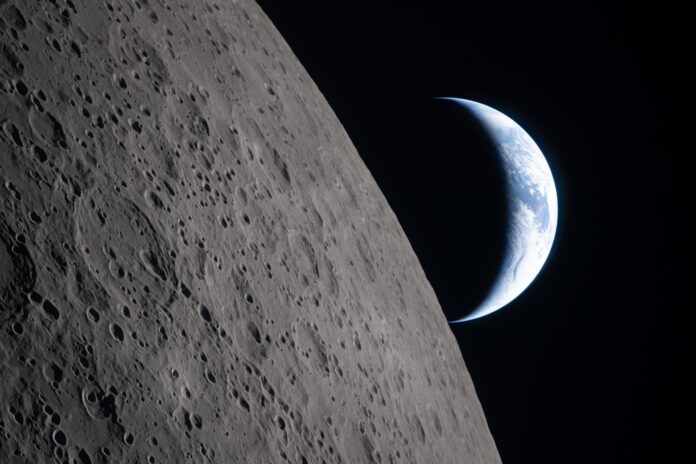
The thin sliver of moon in tonight’s western sky is doing what a two-day-old Waxing Crescent always does: setting quietly about ninety minutes after sunset, barely visible, its slivered form too faint to overwhelm anything around it. What makes August 14 different is what will still be in the sky after the crescent descends.
On August 14, 2026, the moon is in the Waxing Crescent phase, Day 2 of the new lunar cycle that began with the New Moon on August 12. Illumination sits at approximately 5 to 8 percent. The lunar disk is a narrow crescent, its dark side faintly visible by Earthshine, and it sets so early that the sky darkens completely by mid-evening. What remains overhead once the moon is gone is, according to NASA’s August 2026 skywatching forecast, the single finest window for Venus observation in the entire 2026 evening apparition.
Venus reaches greatest eastern elongation on August 14 to 16. At greatest elongation, Venus stands at its maximum angular separation from the sun as seen from Earth, meaning it rises as high in the western sky as it gets during this apparition and remains visible for the longest possible interval after sunset. Tonight it appears as the brightest point of light in the post-sunset sky, outshining Jupiter, Saturn, and every star visible to the naked eye. At approximately magnitude minus 4, Venus is bright enough to cast a faint shadow in truly dark conditions and is easily found even in heavily light-polluted city skies by looking west about 30 to 45 minutes after sunset.
The timing matters. Venus was brilliant but lower in the sky through July; it will remain bright through much of September but will begin dropping back toward the sun after this week’s elongation peak. August 14 to 16 represents the optimal window for anyone who wants to observe Venus at its most accessible.
The moon, at this stage, is too thin to interfere. Yesterday’s Waxing Crescent carried about 2 percent illumination, the Perseid meteor shower’s final peak night. Tonight’s crescent adds a few more percent. By the time it sets, roughly 90 minutes after local sunset across mid-northern latitudes, the sky that follows is genuinely dark. A week ago, the Waning Gibbous from the Sturgeon Full Moon was bright enough to wash out the southern sky all night. That changed fast.
That transition happened fast. The total solar eclipse that crossed northern Spain on August 12 reset the lunar cycle completely. The same moon whose shadow darkened Bilbao, Zaragoza, and Valencia at sunset two days ago is now this thin crescent pulling away from the sun, adding illumination each night as it moves toward first quarter.
The geometry of greatest elongation is worth a brief explanation. Venus orbits the sun inside Earth’s orbit, which means it is always somewhere between Earth and the sun from our perspective. Its visible window is compressed into the hours just after sunset as an evening star, its current configuration, or just before sunrise as a morning star. Greatest elongation is the moment when the angle between Venus, Earth, and the sun is at its maximum, roughly 45 to 47 degrees for an eastern elongation. After this week, Venus’s orbit will begin bringing it back toward inferior conjunction, the point when it passes between Earth and the sun, and its evening-sky window will start to shrink.
Those who bring binoculars or a small telescope to the Venus observation will see the planet in crescent phase. The same gibbous-to-crescent progression the moon displays over its monthly cycle occurs in Venus over the course of weeks as its orbit carries it from the far side of the sun toward Earth. At greatest elongation, Venus typically shows a half-lit disk, similar in appearance to a first-quarter moon, and large enough through a 50mm instrument to show its shape plainly.
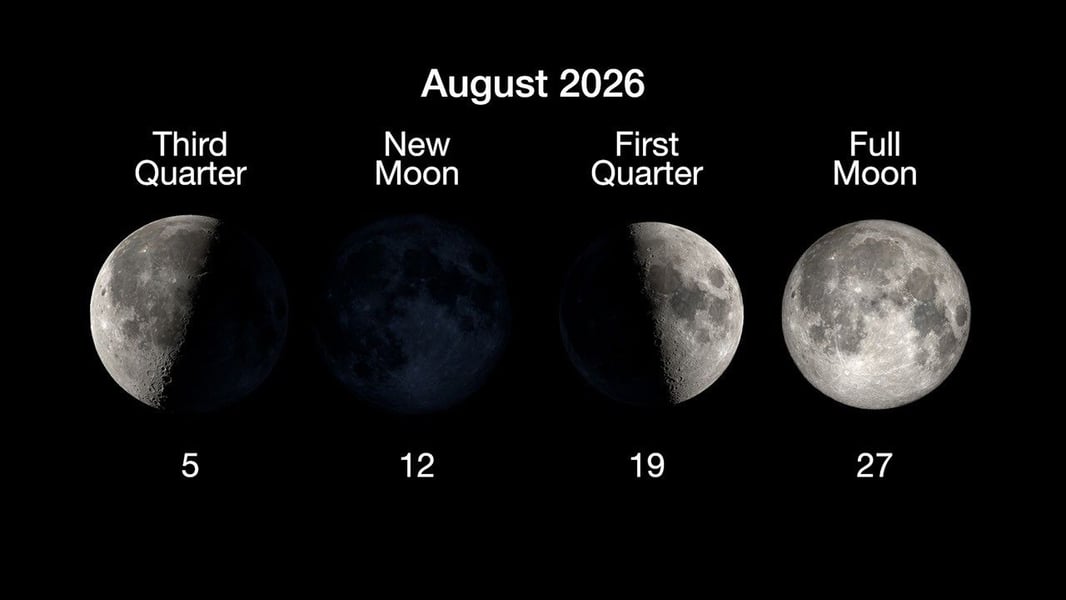
The next lunar milestone after tonight’s crescent is First Quarter, expected around August 19, when exactly half the moon’s face will be illuminated. After that, the Waxing Gibbous moon builds toward the Full Moon on August 27. NASA’s August 2026 calendar notes that the August 27 Full Moon will be accompanied by a deep partial lunar eclipse visible from North and South America and parts of Europe and Africa. Approximately 93 percent of the moon’s diameter will be inside Earth’s dark central shadow, giving it a rusty, coppery tint in the hours around maximum eclipse. That event is still nearly two weeks away.
For Northern Hemisphere observers, August nights are still warm, making extended outdoor observation comfortable without special preparation. Finding Venus requires nothing more than looking west after sunset. Saturn rises in the southeast as the evening deepens, Jupiter climbs in the east after midnight, and the Summer Triangle of Vega, Deneb, and Altair holds near the zenith through most of the night. August 14 is not the most dramatic night of the month. That distinction belongs to the eclipse on August 12 or the partial lunar eclipse on August 27. But it is quieter in exactly the right way, and the planet it places in the western sky after sunset is, tonight, the brightest thing in it.
What the evening offers is not rare in the sense of once-in-a-generation events, but it is rare in the sense of alignment: a sky cleared of moonlight almost entirely, Venus at its annual peak, the Summer Milky Way overhead, and nothing between the observer and the sky but whatever clouds the weather systems choose to send. The moon is there, briefly, just above the horizon. Then it is gone. The rest of the night is the sky’s.