
CAMBRIDGE, Mass. — A radio shape once mistaken for a pulsar appears to be the afterglow of a black hole’s old outburst, revived by a collision between two galaxy clusters hidden behind the Milky Way.
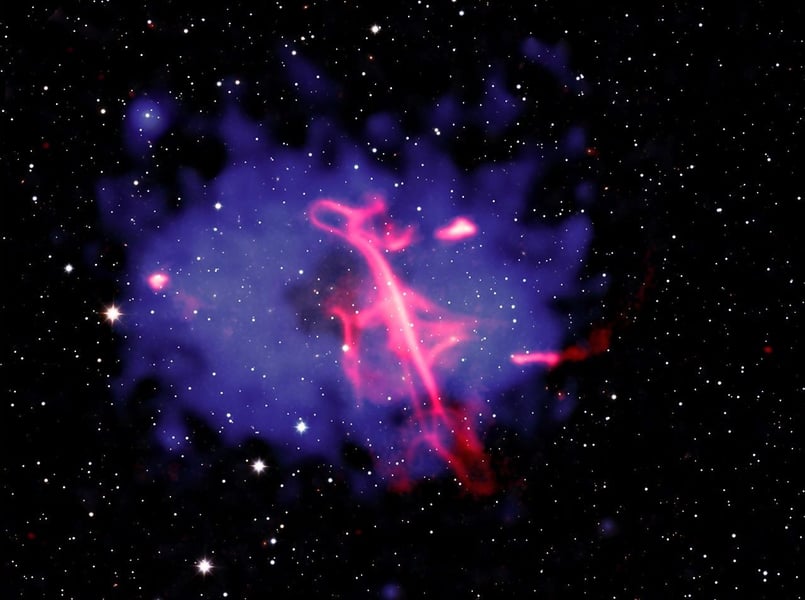
The object, catalogued as VLSS J0318.9+5755 and nicknamed the Treble Clef for its resemblance to the musical symbol, was described by a team led by Andrea Botteon of Italy’s National Institute for Astrophysics, NASA’s Chandra X-ray Observatory said on Wednesday. The resemblance is pareidolia, NASA noted, with no scientific link to music.
The source sits almost directly behind the Milky Way’s plane, where stars, gas and dust block much of the view, and at such low Galactic latitude it was first classified as a pulsar candidate. Chandra and the eROSITA X-ray telescope found hot gas around it, proving that a galaxy cluster is there, and that the cluster is two clusters caught mid-merger.
The paper, accepted by Astronomy & Astrophysics and posted to arXiv, puts numbers on it. The cluster lies at a redshift of about 0.117, hosts gas near 6 keV, and has a mass of roughly 5 to 6 times 10 to the 14th solar masses. The radio source spans about 760 kiloparsecs in projection, built from filaments narrower than 8 kiloparsecs.

The likeliest history has two acts. An earlier outburst from a supermassive black hole in the cluster produced radio emission that later faded. Then the collision compressed and reenergised that cloud, and shock waves may have helped it brighten again. The authors call it a radio phoenix, and estimate the aged plasma at roughly 190 to 200 million years. After removing a symmetric oval of gas from the X-ray image, the leftover glow is brightest to the left and right of centre, suggesting the clusters collided along that line a few hundred million years ago and are now moving apart.
Alongside Chandra and eROSITA, NASA’s composite uses radio data from the LOFAR array and infrared data from UKIRT, while the paper’s own radio measurements rely on the upgraded Giant Metrewave Radio Telescope, run by India’s National Centre for Radio Astrophysics. The eROSITA data were analysed with software from the Russian eROSITA Consortium, according to the paper’s acknowledgements; its authors include Rashid Sunyaev, Eugene Churazov and Ildar Khabibullin.
Two limits remain. Chandra covers only the central part of the cluster, and the paper says that makes it impossible to find a background region free of cluster emission, which adds roughly 10 percent uncertainty to the X-ray luminosity. And the faint radio halo the team suspects at the cluster’s centre is only tentative.
The Treble Clef’s radio spectral index passes 4 between 400 and 650 megahertz, which makes it an ideal target for the LOFAR2.0 upgrade. Whether the two-era picture holds is a question for that follow-up.