
PARIS — A cloud on Mars that computer models could not reproduce for years may owe its existence to a process no one has watched happen in a planetary atmosphere, according to a study published October 7 in Nature Geoscience.
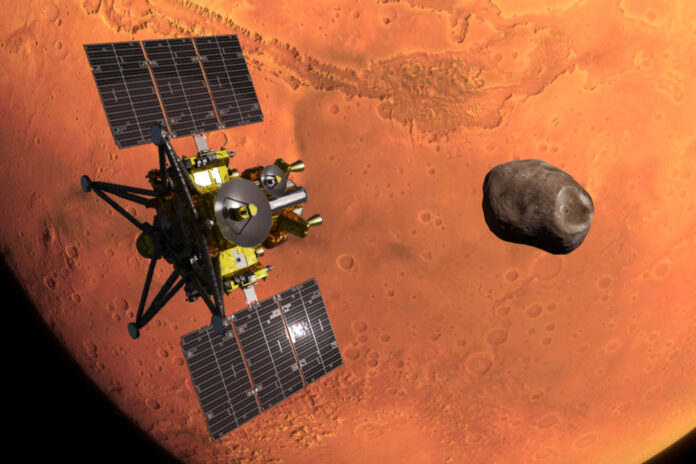
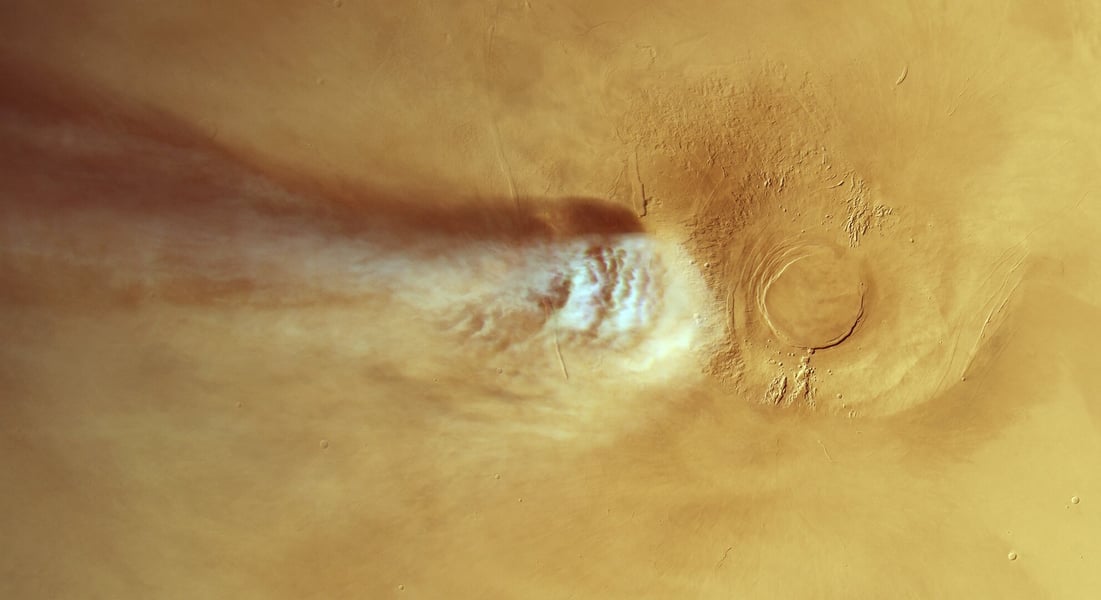
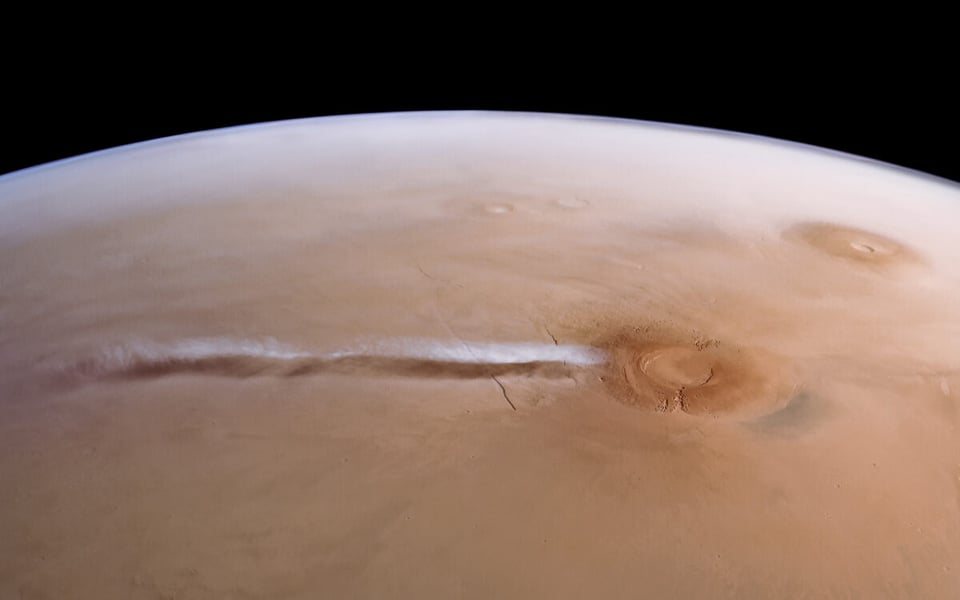
Every spring and summer in Mars’s southern hemisphere, a white wisp of water ice called the Arsia Mons Elongated Cloud forms downwind of a volcano 20 kilometers tall, stretches up to 1,800 kilometers, then evaporates, and repeats the cycle each morning for several months. The European Space Agency‘s Mars Express orbiter first revealed it in 2018.
Jorge Hernández-Bernal, the lead author, at France’s LMD, CNRS and Sorbonne Université, said his team’s simulations produced the cloud only after they added what he called “exotic physics.” It is homogeneous nucleation, in which water vapour turns straight into ice crystals with no grain of dust to cling to. “We’ve never seen it before in a planetary atmosphere,” he said.
The mechanism, as ESA describes it, starts when winds pass Arsia Mons and the volcano’s bulk sets off a powerful wave that lifts moist air several kilometers in minutes. Temperatures fall by 30 degrees in 10 minutes, humidity spikes, and vapour freezes directly into cloud particles. ESA says the humidity required is more than 100,000 times what people usually experience on Earth.
It is an inference from a model, not an observation. The paper’s title says homogeneous nucleation is “suggested” by the clouds, and its abstract says the cloud “probably” forms this way. ESA acknowledges that some aspects of the modelled cloud do not exactly match the observations, and Hernández-Bernal said “we’ve not seen these conditions on Mars before.” The team’s case is that the model works only with the new physics, and that Mars’s humidity can therefore reach such levels.
The stakes reach past Mars. The study’s abstract says homogeneous nucleation from water vapour had been shown to be theoretically possible for mesospheric clouds on Earth and Venus but never observed, and that the result challenges some assumptions about cloud formation on Earth and potentially other planets. The paper draws on data from Mars Express’s three cameras and a regional atmospheric model.
Until a measurement shows humidity at those levels inside the cloud, its origin remains a model that fits, not a process caught in the act.