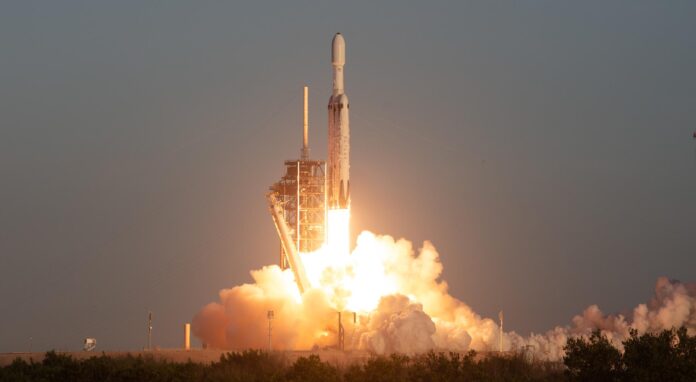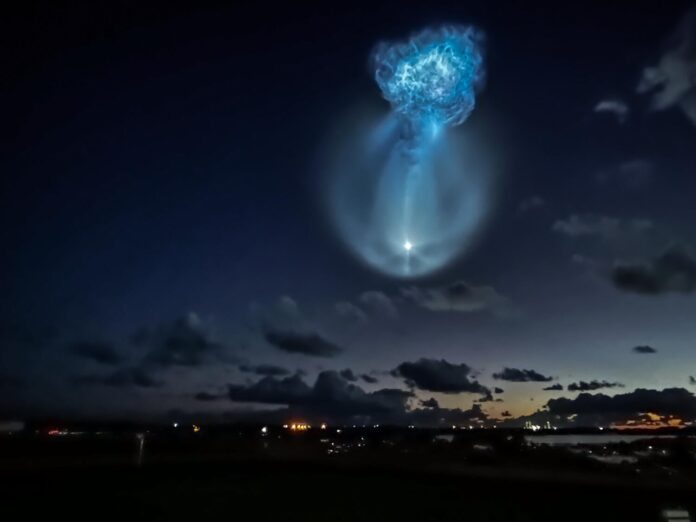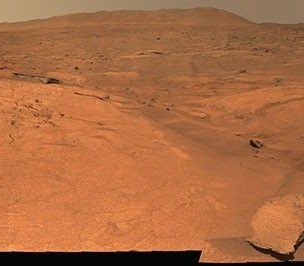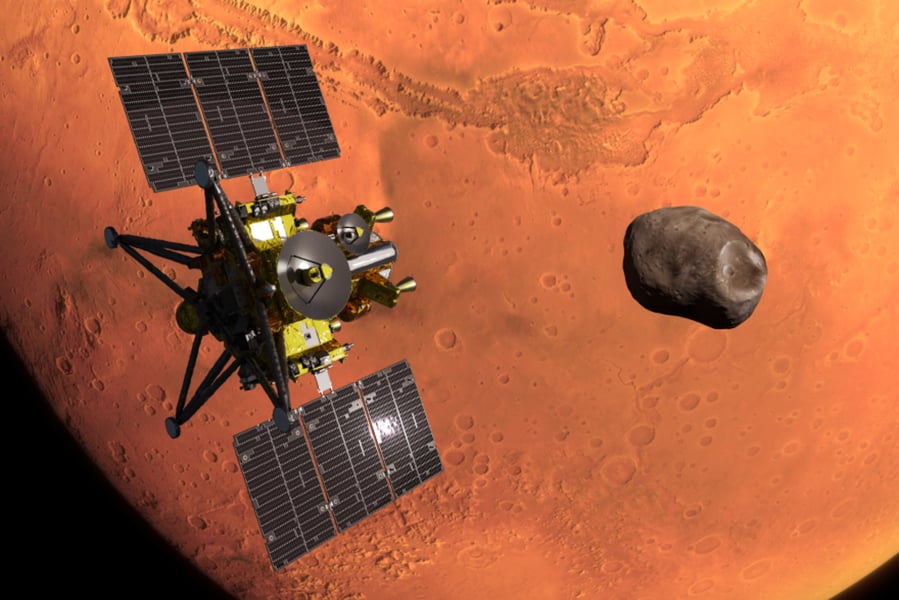

TANEGASHIMA, Japan — Early on October 20, Japan time, an H3 rocket is due to lift off from the Tanegashima Space Center carrying a spacecraft with an unusual errand: reach a moon of Mars, scoop up at least 10 grams of it and bring it home. The European Space Agency confirmed the launch time, 04:41 JST, in a release this week.
The Martian Moons eXploration mission, known as MMX, is led by JAXA with NASA, France’s CNES, Germany’s DLR and ESA. It will be the first mission to collect a sample from Phobos and the first to return to Earth after visiting the Mars system.
The science question is older than the spacecraft. Nobody knows where Phobos and Deimos came from. They may be asteroids captured into Mars orbit, or debris thrown up when something struck the planet. “To find out, we need to collect samples,” ESA says. Elliot Sefton-Nash, the agency’s MMX project scientist, called the returned material “a window to study the evolution of Mars and the Solar System.”
The schedule is long. According to the European Space Agency, MMX takes about a year to reach Mars, entering orbit in August 2027 and orbiting Phobos from September 2027. It will release a 25-kilogram rover, Idefix, in early 2029; on Phobos’s surface the rover will weigh about 15 grams. The main spacecraft lands in 2030 to collect samples, and a return capsule reaches Earth in 2031, due to come down in Australia’s Woomera Prohibited Area before the material goes to Japan.
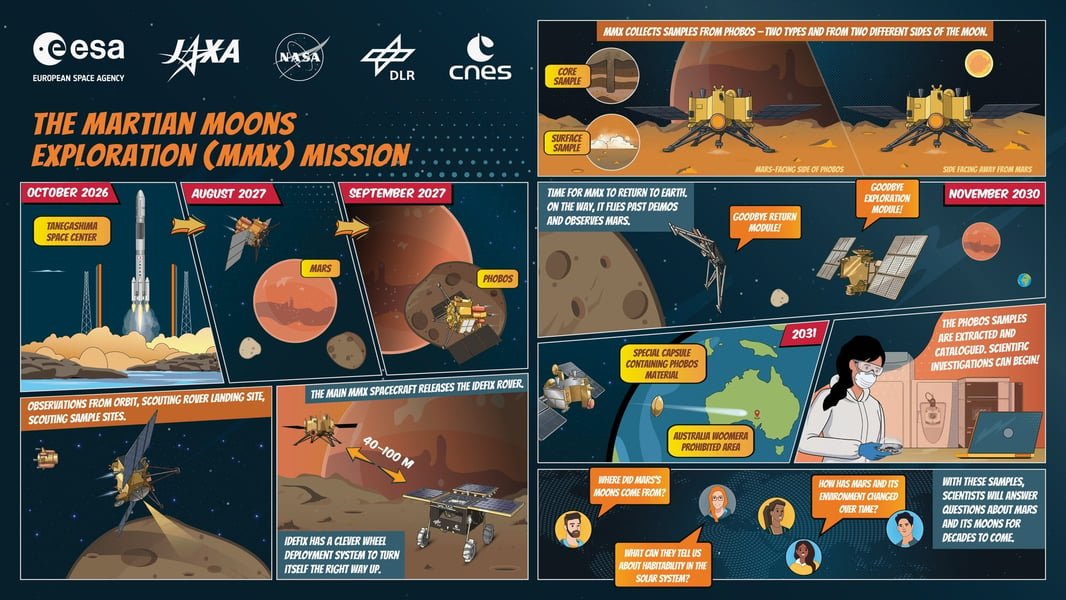
The spacecraft carries 11 science instruments, seven on the main craft and four on the rover. Samples are planned to be made available to European scientists, and ESA says it is working with CNES, DLR and JAXA on announcements of opportunity.
ESA’s account is a mission preview, and it leaves gaps. It gives no cost, no backup launch date and no assessment of the risk in landing on a body whose gravity is so weak that a 25-kilogram rover weighs almost nothing. Until a capsule lands in the Australian desert in 2031, where Mars’s moons came from stays where it has been: unanswered.