
LONDON — More than a century after Albert Einstein’s general relativity first predicted their existence, black holes are finally giving up their oldest secret: not what lies inside them, but how they are born, how they grow into the monsters that anchor every major galaxy, and how they may one day die. Three hundred gravitational wave detections, a landmark 2026 study in Nature Astronomy, and a new generation of telescope observations are converging on a single, unsettling conclusion. The universe is not making its largest black holes the way physicists assumed it was.
The shift in understanding has been swift and disorienting. A decade ago, the Laser Interferometer Gravitational-wave Observatory, known as LIGO, picked up its first ripple in spacetime, a faint vibration produced when two black holes spiralled into each other 1.3 billion light years away. That detection, in September 2015, opened a window astronomers had never possessed. Until then, scientists had relied entirely on light, X-rays, radio waves and cosmic particles to study the universe. None of those signals could escape a black hole. Gravitational waves could. They were the first messages ever to emerge directly from the edges of these objects.
Since then, LIGO and its partners, the Virgo interferometer in Italy and the Kamioka Gravitational Wave Detector in Japan, have logged roughly 300 black hole mergers between them. Each signal carries an imprint of the mass, spin and trajectory of the objects that produced it. Each is a small biography written in the geometry of spacetime itself. Read together, those biographies are now revealing that black holes do not all share a common origin, and that some of the largest ones populating the cosmos cannot be the corpses of single dying stars.
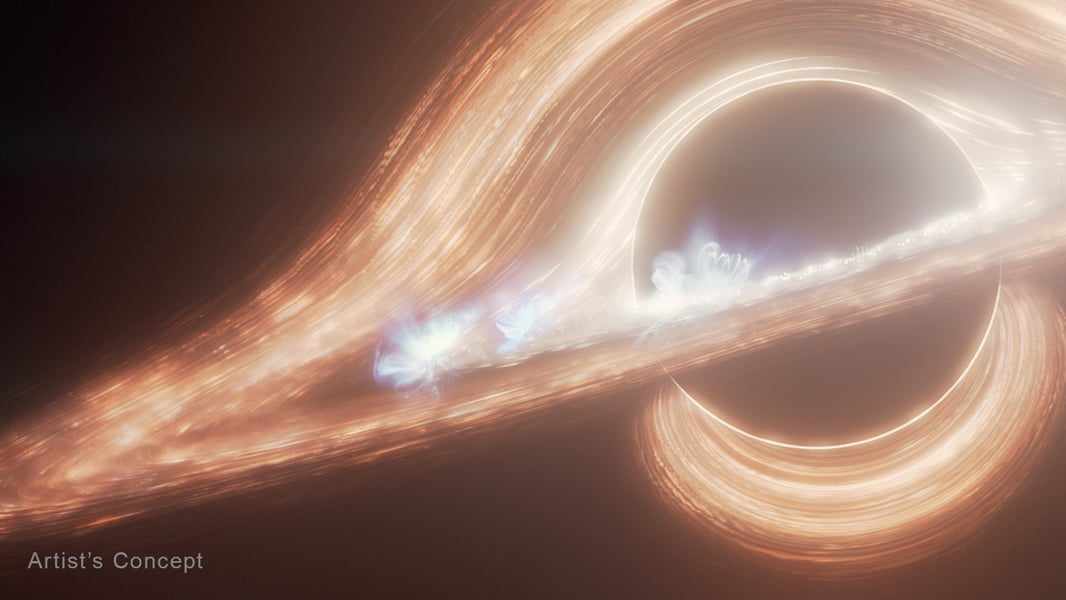
The classical picture, the one in most textbooks, begins with a star. When a star of roughly 20 to 30 times the mass of the Sun runs out of nuclear fuel, its iron core collapses under its own gravity. The outer layers blow apart in a supernova. What remains is compressed into a sphere only a few kilometres across, with so much mass crammed into so small a volume that not even light can climb out of its gravitational well. That is a stellar-mass black hole. Astronomers estimate that hundreds of millions of these objects drift through the Milky Way alone, mostly invisible, betraying their presence only when something falls in.
The problem is the giants. Sagittarius A*, the supermassive black hole at the centre of the Milky Way, carries the mass of about 4 million Suns. The one at the heart of Andromeda, the galaxy nearest to ours, has more than 100 million solar masses. The largest known, a quasar called TON 618, contains roughly 66 billion times the mass of the Sun. No dying star, however large, can collapse into something like that. There is simply not enough material, and not enough time since the Big Bang, for these objects to have grown by gobbling gas one mouthful at a time.
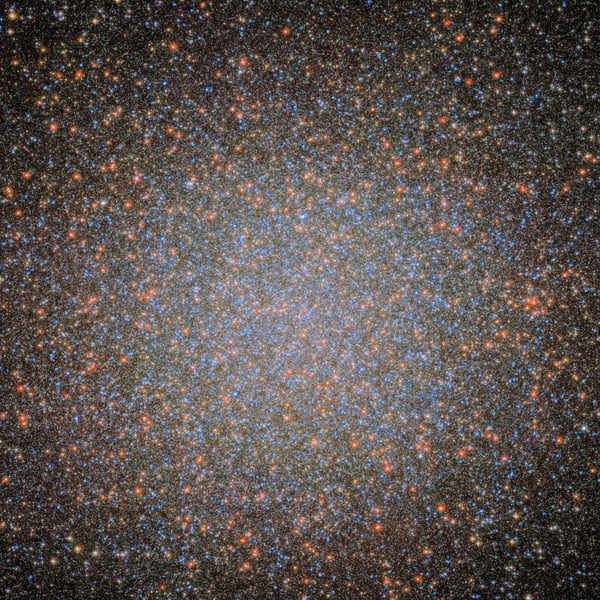
That gap between what stars can produce and what telescopes can see is now at the centre of the field. In a study published in Nature Astronomy, an international team led by researchers at Cardiff University and Northwestern University reanalysed 153 of the most confident gravitational wave signals catalogued so far. Their conclusion is that the universe harbours two distinct populations of merging black holes. The lighter one, made up of objects below roughly 45 times the mass of the Sun, behaves exactly as the stellar collapse model predicts. The heavier one does not.
The heavier black holes spin faster, and their rotation axes point in seemingly random directions. That is the signature of a body assembled through chance encounters in a crowded environment, not one inherited from the orderly rotation of a single parent star. The team concluded that these are second-generation black holes, formed in the dense cores of star clusters where black holes can pair up, merge, and then merge again. Each collision builds something heavier than what came before. The largest of these mergers, the data suggests, are the children and grandchildren of earlier catastrophes.
“What surprised us most was how clearly the high-mass black holes stand out as a distinct population,” said Isobel Romero-Shaw, one of the study’s principal authors. Above about 45 solar masses, she added, the spin distribution shifts in a way that cannot easily be explained by ordinary binary stars but fits neatly with the idea that those black holes have already survived earlier collisions in dense clusters. The Eastern Herald has previously reported on this same line of evidence in its analysis of monster black holes built through repeated cosmic collisions.
The finding lines up with a long-standing theoretical prediction. According to the pair-instability mechanism, exceptionally massive stars should never form black holes directly. As their helium cores reach extreme temperatures, runaway production of electron and positron pairs robs them of the radiation pressure that holds them up. The core ignites in an explosion that tears the star apart and leaves no remnant. The forbidden zone, the so-called pair-instability mass gap, begins at roughly 45 solar masses. Anything heavier that scientists detect inside the gap cannot be a primary black hole. It has to be stitched together from earlier ones.
That explains the medium-weight black holes, but the truly enormous ones at the centres of galaxies still resist easy answers. “They either gobble gas and material from around them, or they collide with other black holes,” said Priya Natarajan, an astrophysicist at Yale who has spent years modelling how supermassive black holes might have arisen. Even those two channels, she has argued, are not enough on their own. The universe simply has not existed long enough for a stellar-mass corpse to grow into a 10-billion-solar-mass quasar by either route alone.
Natarajan’s preferred explanation is that the largest black holes started big. In the early universe, vast clouds of pure hydrogen and helium gas could have collapsed directly into objects with the mass of a million Suns each, skipping the star stage entirely. These so-called heavy seeds would then have had a head start, growing through mergers and accretion into the supermassive black holes that today anchor galaxies. In 2023, the James Webb Space Telescope identified one of the strongest pieces of evidence yet for that idea. An over-massive galaxy known as UHZ1, observed as it existed when the universe was only a few hundred million years old, contains a black hole with the mass of about 40 million Suns, an absurd ratio relative to its host. The Eastern Herald has covered Webb’s growing portfolio of early-universe surprises, including its discovery of a 13-billion-year-old cosmic fossil galaxy.
Once a black hole is born, it does not sit quietly. Most stellar-mass black holes spend long stretches dormant, only flaring into view when an unlucky star or gas cloud wanders too close. The supermassive ones at galactic centres are more restless. Computer models built by researchers at the Max Planck Institute for Astrophysics in Germany now suggest that the energy these monsters pump back into their host galaxies acts as a thermostat. As a supermassive black hole feeds, the jets and radiation it produces can superheat surrounding gas clouds, choking off star formation. “There’s a pretty hard maximum,” the astrophysicist Volker Springel has said of the resulting galaxy size limit, around 1 trillion solar masses for all but the rarest systems.
Galaxies and their central black holes appear to grow in lockstep, each constraining the other. When two galaxies collide, their central black holes spiral inward together over millions of years and eventually merge, releasing some of the most violent bursts of gravitational waves in the universe. Some of those bursts will be detectable, in principle, by the European Space Agency’s space-based LISA mission, scheduled for launch in the 2030s. The Milky Way and Andromeda are themselves on a collision course, with current estimates suggesting a merger somewhere between 4 and 10 billion years from now. If it happens, their central black holes will combine, producing a new supermassive object at the heart of a single, larger galaxy.
Eventually, though, the cosmic ledger has to close. As the universe expands, galaxies are drifting apart, and the rate of mergers will fall. Stars will burn out their fuel, supernovas will become rarer, and at some point the production line of new black holes will grind to a halt. What remains, theorists believe, will be a cold, dark cosmos populated by isolated galactic islands and their burnt-out black holes.
Even those, however, may not last forever. In 1974, the British physicist Stephen Hawking predicted that black holes are not truly black. Quantum effects at the edge of an event horizon, he argued, allow a slow leak of particles. That faint trickle, now known as Hawking radiation, would gradually steal energy from the black hole. Over almost incomprehensible timescales, smaller black holes would shrink first, eventually disappearing in a final burst of radiation. Hawking radiation has never been directly observed, but it is consistent with the physics scientists know.
Whether the largest black holes share this fate is less certain. Recent theoretical work has suggested that supermassive black holes may not be able to evaporate completely, because they cannot lose all of the information they have absorbed. Some researchers have proposed even more exotic alternatives, including the idea that collapsing stars might form not true black holes but “black shells,” dense outer crusts surrounding a region of true vacuum. None of these models has been confirmed, but each is a sign of how unsettled the deepest questions remain.
What has changed, in only a decade of gravitational wave astronomy, is the sense that black holes are knowable at all. The Event Horizon Telescope produced the first direct image of a black hole, the supermassive one at the centre of the galaxy M87, in 2019. It has since added a portrait of Sagittarius A*. LIGO has built a catalogue of mergers that now resembles a population census. The 2026 Nature Astronomy analysis is the strongest evidence yet that this census is detailed enough to identify family trees, separating black holes that were born from those that were built. According to the published study, the lower edge of the pair-instability mass gap lies at about 44 solar masses, almost exactly where theory had placed it.
For Natarajan, the questions that remain are the ones that have always made black holes attractive and forbidding in equal measure. “They don’t have any memory,” she has said of the objects, meaning that any information about how they formed is sealed forever behind the event horizon. They are, she added, “the edge of what we can know.” Yet that edge, once seen as impassable, is being mapped in unprecedented detail, as reported in a recent overview of the field.
The next decade will push that mapping further. Upgrades to LIGO, the addition of new detectors in India and elsewhere, and the eventual launch of LISA are expected to multiply the number of recorded mergers many times over. With each new signal, the lifecycle of black holes, from a star’s last gasp to a supermassive monster’s quiet evaporation, comes a little more clearly into focus. The objects that Einstein once thought might be a mathematical curiosity have become, in the words of one researcher, the most extreme things in all of nature, and finally, after a hundred years of theory, something that science can study from cradle to grave.