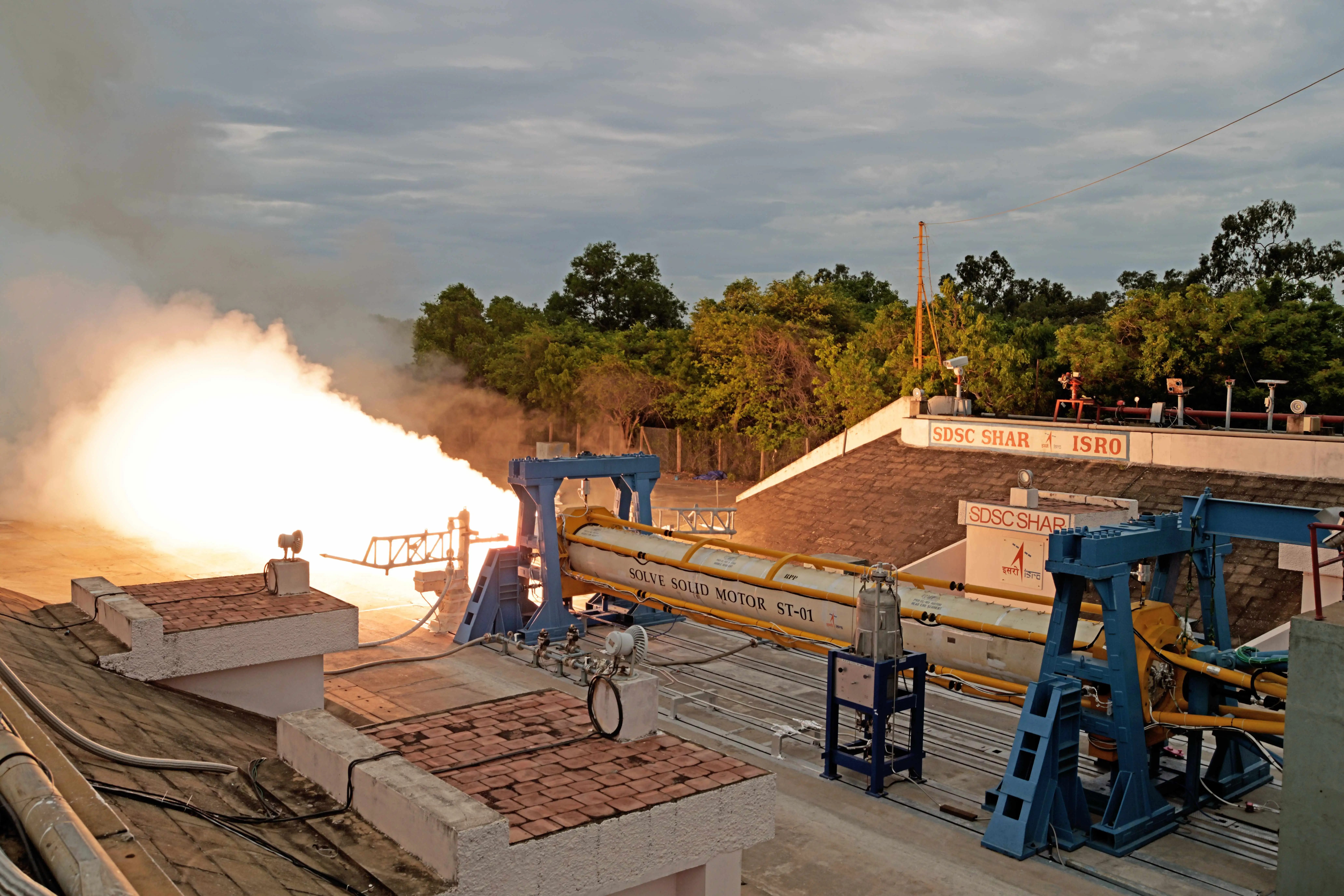

SRIHARIKOTA — Three astronauts who have not yet been named will one day ride India’s first crewed spacecraft back into the atmosphere at several times the speed of sound, and their survival will depend on ten parachutes opening in the right sequence at the right altitude. On Friday, the Indian Space Research Organisation lit a rocket motor on a test stand in Sriharikota for ten hours straight to make sure that sequence works.
The vehicle is called SOLVE, short for Sub-Orbital Launch Vehicle for Experiments, and it exists for one purpose: to carry a dummy version of the Gaganyaan crew module to an altitude of 10 to 17 kilometers, cut it loose, and let engineers watch whether the module’s parachute-based deceleration system brings it down safely enough for a real astronaut to survive. Friday’s test did not launch anything. It was a static ground firing of SOLVE’s solid rocket motor at ISRO’s Satish Dhawan Space Centre, the more basic of two things that have to work before the agency risks doing this with a person on board.
ISRO said the motor’s performance during the ten-hour static test matched expectations, a modest way of describing a component built specifically for this mission. The solid stage is derived from the strap-on boosters ISRO already flies on its PSLV rocket, which has suffered two consecutive launch failures this year, modified with a slower-burning propellant and a straight nozzle that uses secondary injection for thrust vector control, engineering language for a motor built to burn longer and steer more gently than the version currently launching satellites.
Parachutes are not a glamorous problem, which is part of why they have taken years to clear. A crew module reentering from orbit needs its parachute sequence to deploy at the right dynamic pressure, in the right order, without tangling, every time, because there is no backup system beyond the parachutes themselves once the module separates from the rocket. NASA and Russia’s space program have each lost hardware testing this exact problem before certifying their own crew capsules. ISRO’s approach, building an entire dedicated sub-orbital test vehicle rather than relying only on drop-tower tests, reflects how seriously the agency is treating a failure mode with no second chance once astronauts are actually on board.
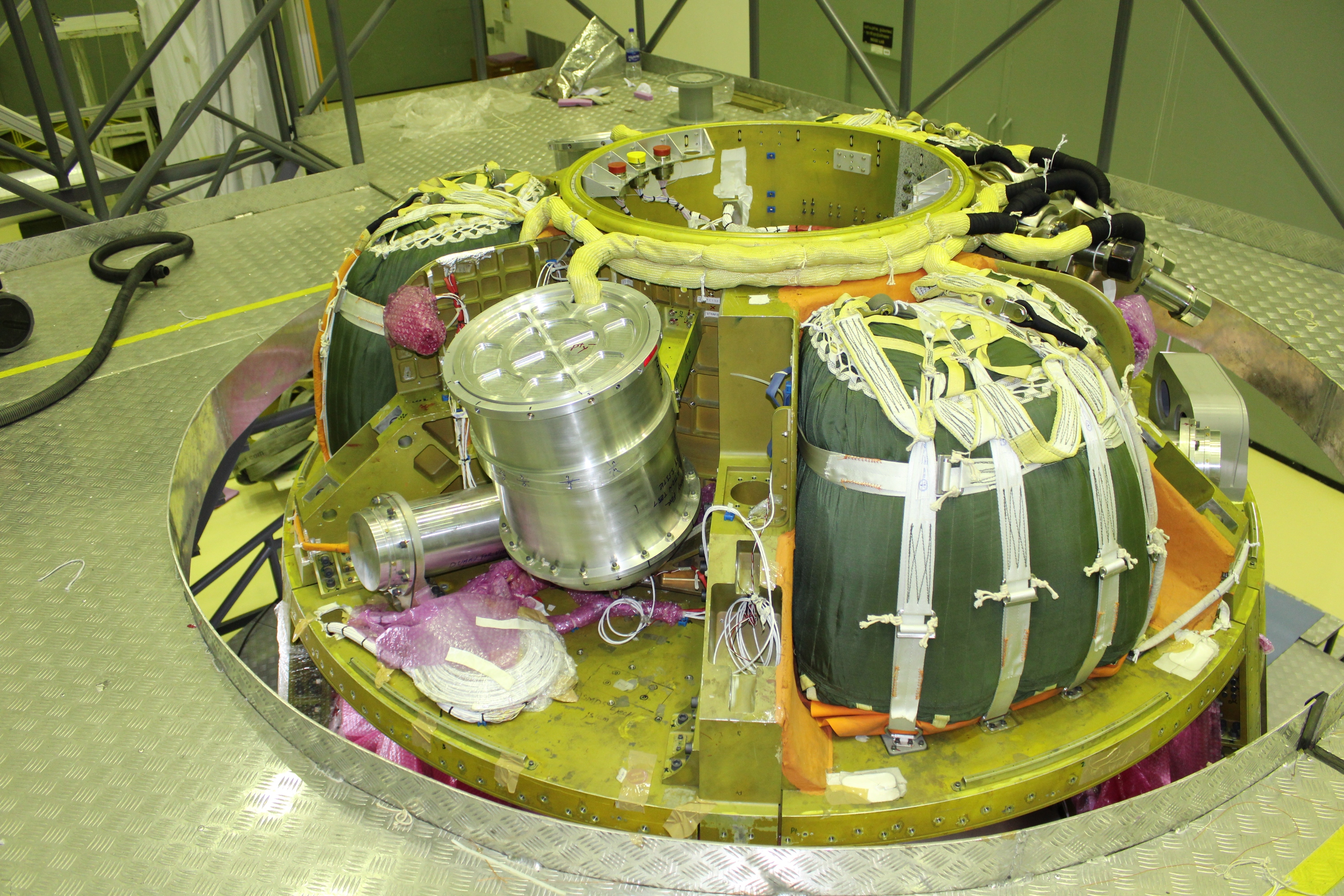
Gaganyaan was originally supposed to fly a crewed mission by 2024. It has not, and ISRO has repeatedly declined to commit to a firm new date, citing the slower, staged uncrewed test program the agency adopted after the parachute and abort systems became the long pole in the schedule. Friday’s SOLVE test is not itself a Gaganyaan flight test. It is the ground validation that comes before ISRO risks an actual air-drop of the crew module from the new vehicle, the test that will actually exercise the ten-parachute recovery sequence in the air rather than on a static stand.
The deceleration system SOLVE is built to test traces back to the TV-D1 abort test ISRO flew in 2023, which used a different, expendable test vehicle to prove that a dummy crew module could separate from a failing rocket and parachute safely into the Bay of Bengal. SOLVE goes a step beyond that: a test platform meant to validate the parachute sequence under speed and altitude conditions closer to a real re-entry, rather than a single abort scenario. ISRO has not said how many SOLVE flights it plans before moving to an uncrewed orbital Gaganyaan mission, which itself is meant to fly before any astronaut does.
The mission still carries symbolic weight beyond the engineering. India would become only the fourth nation to launch its own astronauts into orbit on its own rocket, after the Soviet Union, the United States and China. Group Captain Shubhanshu Shukla, who flew to the International Space Station on SpaceX’s Axiom Mission 4 in 2025, remains the closest thing India has to a household-name astronaut, but he flew on an American rocket under a commercial arrangement, not on Gaganyaan. The distinction matters to ISRO, which has built its entire uncrewed test program around not repeating that arrangement for the mission actually named after the Indian word for a sky-craft.
What ISRO has not said is when the next SOLVE flight happens, or how many successful ground and air tests the parachute system needs before engineers sign off on carrying a person. The agency’s public statements after Friday’s test described the motor performance and nothing else: no revised timeline, no date for the first SOLVE air drop, no update on when Gaganyaan’s uncrewed orbital flight, still a prerequisite for the crewed one, might launch. For a program that has already missed one deadline by two years, the silence on the next one is its own kind of answer.