
MADRID — When the moon’s shadow reached Zaragoza at sunset Wednesday, the thousands who had waited for hours in 43-degree heat stopped complaining about the temperature. The sky darkened not gradually but suddenly. People cheered. Then they fell silent. Some wept.
Spain’s first solar eclipse since 1905 traced a path from Siberia across Greenland and Iceland before sweeping into northern Spain just as the sun reached its lowest angle of the evening, in a rare convergence of celestial mechanics and geography that placed the path of totality over some of the most densely watched skies in European history. The eclipse crossed Bilbao, Zaragoza, and Valencia as the sun sat eleven degrees above the western horizon, casting a totality that deepened the sunset rather than interrupted midday light.
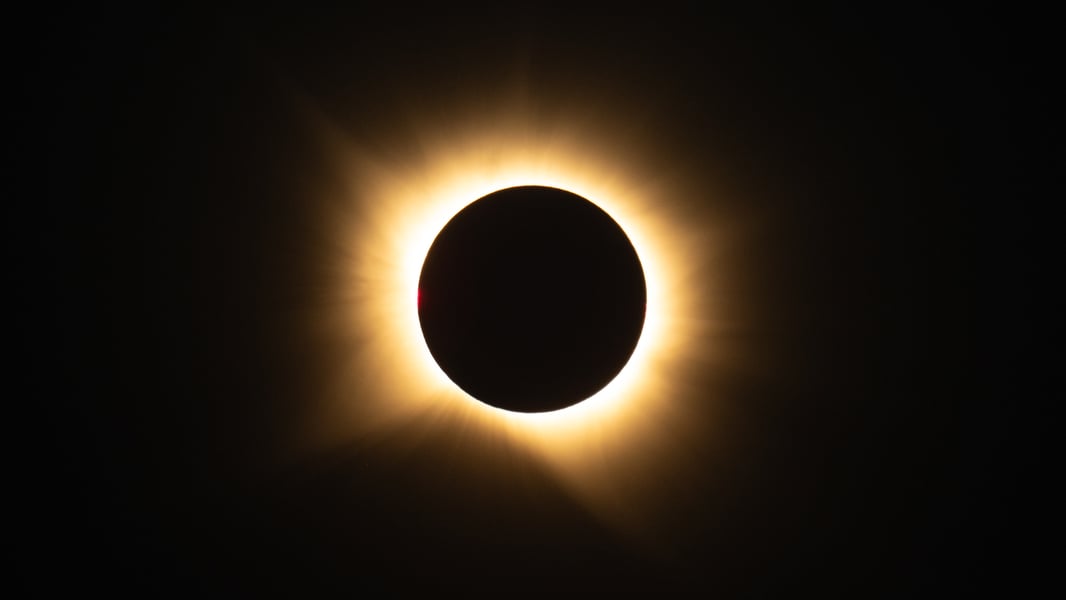
Totality lasted two minutes and eighteen seconds at its maximum extent, achieved over the North Atlantic off the western coast of Iceland. In Zaragoza, the duration was shorter but the setting was dramatic: sunset-colored light folding into sudden darkness, the solar corona glowing around the blocked disc of the sun, then the light returning as the moon moved on. The last time mainland Europe experienced this was 1999. For Spain, the wait had been 121 years.
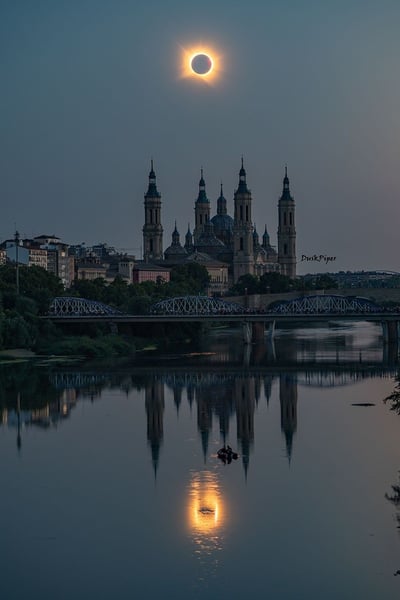
Photographer Ruiyu Zhang documented the event from Zaragoza, capturing the eclipse above the Cathedral-Basilica of Our Lady of the Pillar while a second frame caught the same moment reflected in the surface of the Ebro River below. Published by NASA’s Astronomy Picture of the Day, the two images compress the eclipse into something specific: a Baroque church framed by a vanished sun, and that same event dissolved into still water. Scientists at NASA’s Goddard Space Flight Center noted that observers would have experienced the characteristic signs of totality’s onset: a temperature drop, birds falling quiet, insects starting their nighttime calls as the sky went dark.
The corona, visible to the naked eye only when the photosphere is blocked, is what made the eclipse scientifically valuable beyond its spectacle. The sun’s outer atmosphere burns at temperatures of millions of degrees Celsius despite sitting far from the solar surface, a paradox that physicists have studied for decades without fully resolving. NASA and the European Space Agency coordinated observation campaigns for the 2026 eclipse, drawing structured data submissions from citizen scientists alongside the professional record. Instruments set up along the Spanish path will take months to yield results.
For viewers in Iceland, the morning brought cloud cover from the Atlantic and then rain, and the rain did not lift. The country sat along the path of totality at a point where the shadow theoretically lingered longest, but the eclipse there amounted to a strange darkening of an already gray sky. Eclipse-chasing contains this inherent unpredictability: the orbital path is calculable centuries in advance with near-perfect precision, but the weather inside that path is unknown until the day. Travelers who had arranged accommodations in Iceland’s western fjords watched the sky do nothing visible and caught return flights south.
The contrast was immediate. Al Jazeera reported that crowds in Zaragoza, Bilbao, and along the Balearic coast responded to totality with cheers, applause, tears and moments of stunned silence. In parts of Spain’s interior, temperatures approached 40 degrees Celsius before the eclipse began; when the temperature dropped as the shadow arrived, many described it as a physical confirmation that what they were witnessing was real and not a simulation.
Segovia, which the path crossed at a narrower point, experienced 59 seconds of totality. The Balearic Islands and Mallorca received the shadow’s edge rather than its center, making for a deep partial eclipse rather than full darkness. The path then clipped the western corner of Portugal before continuing out over the open Atlantic.
Spain’s appetite for the eclipse reflected something beyond ordinary curiosity. The previous totality in 1905 was documented by a small number of professional astronomers; there was no infrastructure for mass observation, no coordinated viewing, no instant photography to spread within minutes of totality’s end. Hotels along the path had been sold out for months. Transit systems were strained. Tourism bodies in Zaragoza and Bilbao developed dedicated viewing programs. The country prepared for a generational event, and the event delivered.
The next total solar eclipse visible from mainland Europe will not come until 2046, when the path will cross a different set of countries. With the Perseid meteor shower concluding its peak run the same week, this stretch of August offered an unusual concentration of sky events for the Northern Hemisphere. For Spain, the next totality will come later still. The pilgrims who lined the banks of the Ebro on Wednesday evening knew, most of them, that they were unlikely to see another one in Spain.
What the science will say about Wednesday’s eclipse will come in stages. The corona photographs from professional instruments along the path will be analyzed against data from previous eclipses. The wildlife observation records contributed by volunteers, including bird behavior, insect activity and temperature readings, will feed into ongoing ecological studies. None of it will arrive quickly. The eclipse lasted two minutes and eighteen seconds. The processing will take considerably longer.