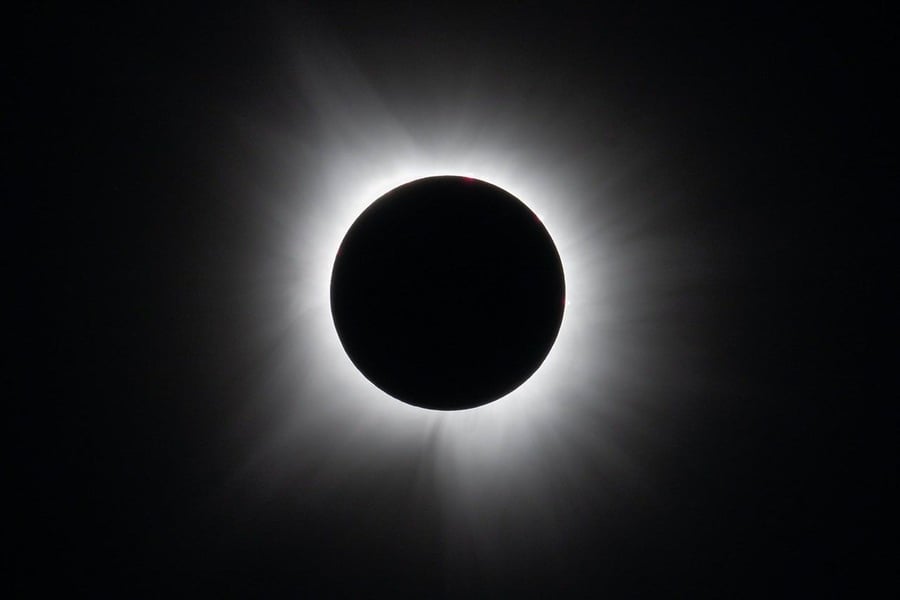

BILBAO – On Wednesday evening, at precisely 8:28 local time, the western sky above the mountains of northern Spain will go dark in the middle of August. The Moon will slide fully across the face of the Sun, and for a minute and a half, observers across a 290-kilometer band of territory will watch the corona – the outermost layer of the solar atmosphere, normally invisible – burn against the horizon like a white ring above the Atlantic coast.
This is the 2026 total solar eclipse, and it arrives tomorrow. It will be the most significant astronomical event to cross Europe in a generation, and what makes it different from nearly any other totality in living memory is the moment the shadow arrives in Spain: sunset.
The Moon’s central shadow enters Spain from the Atlantic, crossing Galicia’s coastline shortly after 8:26 p.m. local time. The Sun will be just 11 degrees above the western horizon when totality begins in A Coruña, and the angle will drop further as the shadow moves eastward through León, Burgos, Zaragoza, Valencia, and into the Balearic Islands over the following seven minutes. Observers at Majorca will see totality with the Sun barely two and a half degrees above the sea.
That geometry – eclipse at sunset – makes this the rarest category of total solar eclipse. The corona will appear not overhead but ahead, hanging low over the horizon like a pale crown above whatever lies to the west. At Picos de Europa, in the Cantabrian Mountains, totality will last one minute and 43 seconds with the Sun at nine degrees above the horizon. At the Ebro Delta on the Catalan coast, the figure drops to one minute and 31 seconds with the Sun barely four and a half degrees up. Every second of duration comes with a condition: the lower the Sun, the more essential a flat, clear, unobstructed western horizon becomes.
Spain’s terrain presents a structural challenge for many of the most beautiful viewing sites. The Cantabrian range running along the country’s northern edge – the same mountains that give Picos de Europa some of the finest skies in the Iberian peninsula – also means that observers need to be positioned on the seaward side of any ridge. A hilltop with a mountain to the west is not a viewing site; it is an obstruction. Eclipse chasers who staked out their positions over the weekend have spent days solving for exactly this problem.
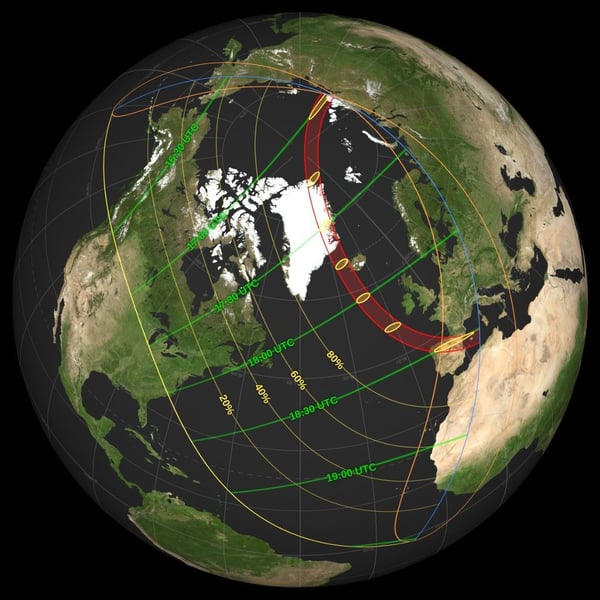
The path of totality is broad, spanning roughly 180 miles (290 kilometers) from one edge to the other. Before reaching Spain, the Moon’s shadow crosses Greenland, Iceland – where Reykjavík falls inside the path – and northern Russia, all in the afternoon hours. According to NASA, the shadow exits over the Atlantic Ocean after passing through a small corner of Portugal. The two largest cities in Spain, Madrid and Barcelona, will not see totality. Both will experience a 99.9 percent partial eclipse – nearly total, but not total – meaning the corona remains invisible and the sky does not go dark. Observers in both cities will need eclipse glasses to view the Sun safely.
Bilbao, Santander, Valladolid, Burgos, Zaragoza, León, Valencia, and the Balearic Islands all fall inside the path. Among the best viewing locations identified by astronomers: Picos de Europa (one minute 43 seconds of totality), Sigüenza in Guadalajara province (one minute 38 seconds), and Parque Natural Cañón del Río Lobos in Castile (one minute 42 seconds). Each site requires an unobstructed westward line of sight.
NASA will anchor coverage beginning at 1:15 p.m. Eastern time on Wednesday, streaming live across NASA+, YouTube, Amazon Prime, Facebook, and Twitch. The broadcast will include footage from a WB-57 high-altitude research aircraft chasing the Moon’s shadow through the stratosphere, where atmospheric interference is minimal and totality lasts longer than on the ground. NASA’s coverage of the 2024 North American eclipse drew 15 million concurrent viewers; the agency expects comparable or higher figures for August 12.
The solar eclipse in Australia and Indonesia in April 2023 was the last major total solar event before a stretch of accessible Northern Hemisphere totalities. The 2024 eclipse across North America set modern records for eclipse tourism, with hotel occupancy along the path reaching near capacity months in advance. The same dynamic has played out across northern Spain this summer: cities inside the path sold out accommodation before spring.
What observers inside the path will see – if the sky cooperates – is the corona spreading outward from behind the Moon in streamers of white light. At this point in the solar cycle, near solar maximum, the corona is expected to be particularly active and symmetrically shaped, extending visibly in all directions from the lunar disk. Some observers may also see prominences – arcs of plasma looping above the solar edge – in shades of red and pink against the darkened horizon sky.
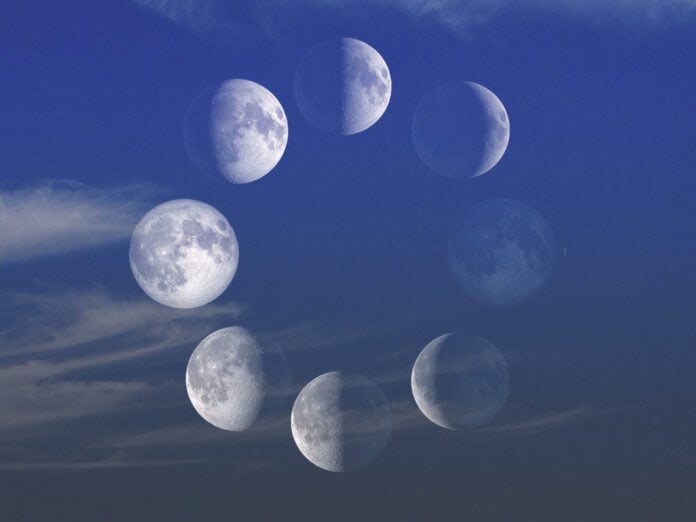
The moon phase on August 10 showed just six percent illumination – two days before the New Moon that will block the Sun entirely on Wednesday. The Perseid meteor shower, which peaked last week, drew astronomy enthusiasts to northern Spain’s dark-sky reserves; many are staying through the eclipse.
Cloud cover forecasts for Wednesday evening across northern Spain remain the central uncertainty. The Atlantic-facing coastline of Galicia – where totality arrives first – carries the highest cloud risk, while the more arid interior of Castile and Aragon has better odds. The eclipse will occur regardless. Whether the hundreds of thousands of people who traveled to see it will actually see it is a question that will be answered tomorrow evening, over the mountains of a country that will not see another total solar eclipse like this for at least a generation.