
DARMSTADT, Germany — Two linked spacecraft entered orbit around Mercury on Saturday after an eight-year journey, bringing Europe and Japan closer to studying the planet’s surface and magnetic environment simultaneously. The arrival ended their interplanetary cruise, but months of manoeuvres and instrument checks remain before the mission begins its main scientific work.
The European Space Agency announced that BepiColombo had reached the solar system’s innermost planet on November 21. Thruster firings slowed the spacecraft enough for Mercury’s gravity to capture it, and controllers in Germany spent several hours examining incoming data before confirming that it had achieved orbit, according to the report carried by ABC News.
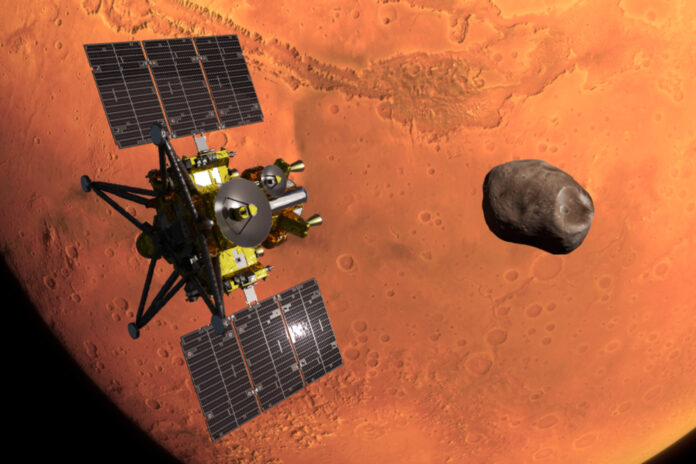
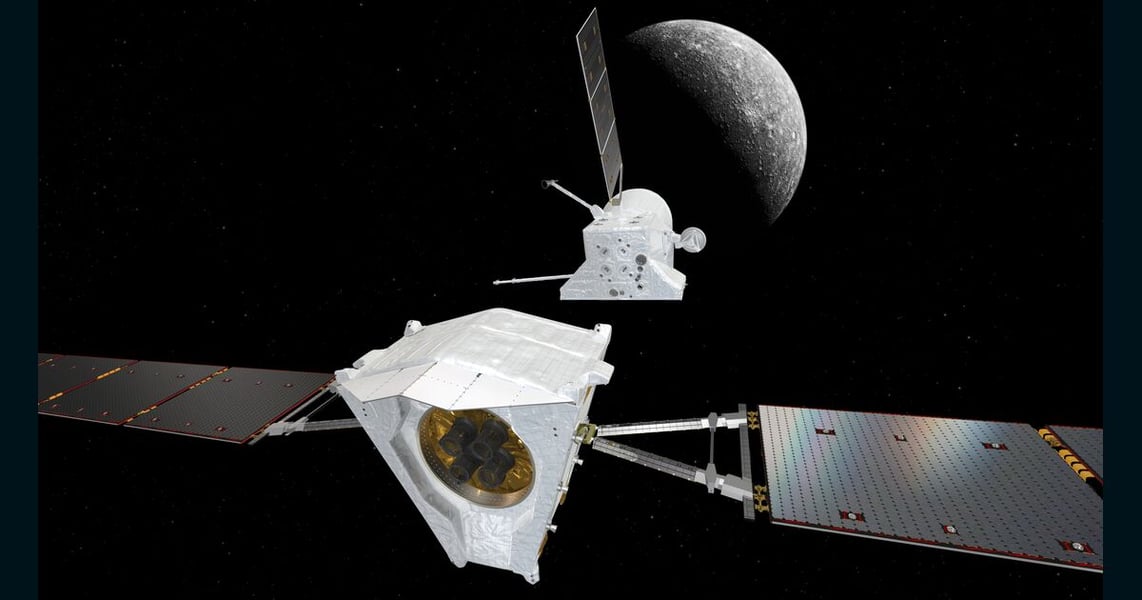
For now, the two scientific orbiters remain attached. ESA’s Mercury Planetary Orbiter, known as MPO, and the Japan Aerospace Exploration Agency’s Mercury Magnetospheric Orbiter, called Mio, are scheduled to separate on December 9–10. Their different paths around Mercury are central to the mission: one will concentrate on the planet below, while the other explores its magnetic surroundings.
BepiColombo is the second mission to enter Mercury orbit, following NASA’s MESSENGER, which studied the planet from orbit between 2011 and 2015. NASA’s Mariner 10 made three flybys in the 1970s but did not remain there. Those earlier encounters make BepiColombo the third mission to visit Mercury, not the third to orbit it, according to the report carried by ABC News.
Launched in October 2018, the mission followed a deliberately indirect route. It flew past Earth once, Venus twice and Mercury six times, using planetary encounters to shape its trajectory. By arrival, the spacecraft had travelled more than 10 billion kilometres, ABC News reported. Reaching a planet closer to the Sun did not mean taking a short, straight flight.
The final approach also required the spacecraft to shed the module that had carried them through much of the journey. The Mercury Transfer Module separated on September 3, leaving MPO’s thrusters to guide the joined scientific orbiters through the remaining approach and capture sequence, according to ESA’s arrival timeline.
ESA describes the initial capture orbit as an ellipse passing roughly 590 kilometres above Mercury at its closest point and 11,640 kilometres at its farthest. That is an arrival orbit, not the final working path for both spacecraft. The distinction matters because Saturday’s success begins another demanding operational sequence rather than ending it.
Mio will be released first into its own elongated polar orbit. MPO will then discard Mio’s protective sunshield, a step scheduled for December 16, before using further thruster firings to descend towards its lower science orbit. ESA’s published timeline places MPO’s arrival in that orbit on March 10, 2027, with the mission’s science phase beginning on April 6. The agency cautions that operational requirements can change the dates.
Once separated and checked, the orbiters will offer measurements that a single spacecraft could not collect from two locations at once. MPO will investigate Mercury and its surroundings, while Mio will focus primarily on the planet’s magnetic field and plasma environment. Their complementary observations are intended to connect what happens at the surface and within the planet with conditions in the space around it.
Mission project scientist Geraint Jones said the two spacecraft would allow researchers to compare “unprecedented measurements taken by two spacecraft at the planet at the same time,” according to ABC News. Investigations will cover Mercury’s dense interior, magnetic field, impact craters, volcanic plains and mountain ridges.
Keeping the instruments working so close to the Sun is itself a substantial engineering problem. Mercury’s surface temperature can exceed 427 degrees Celsius. Jones said the spacecraft and their instruments must be kept as cool as possible, describing that requirement as a major technical challenge. The planned mission lasts at least one Earth year, equivalent to roughly four Mercury years.
The two orbiters are therefore at their destination without yet being ready to deliver the full scientific programme. Controllers must still release Mio, remove its sunshield, lower MPO’s orbit and commission both spacecraft and their instruments. ESA’s timetable leaves more than four months between capture and routine science, with the next major step being the December separation.