CEUTA — He was 25 years old, Sudanese, and had been crouching in the hills outside Fnideq for the better part of two days. Three miles away, across a fence and a customs post, lay the Spanish enclave of Ceuta, and beyond it, continental Europe. When asked why he was trying to reach it, he said: “In Ceuta, in Europe, people are better cared for. There’s no work here. There’s no money.”
Early on Saturday morning, Morocco made sure he could not get there.
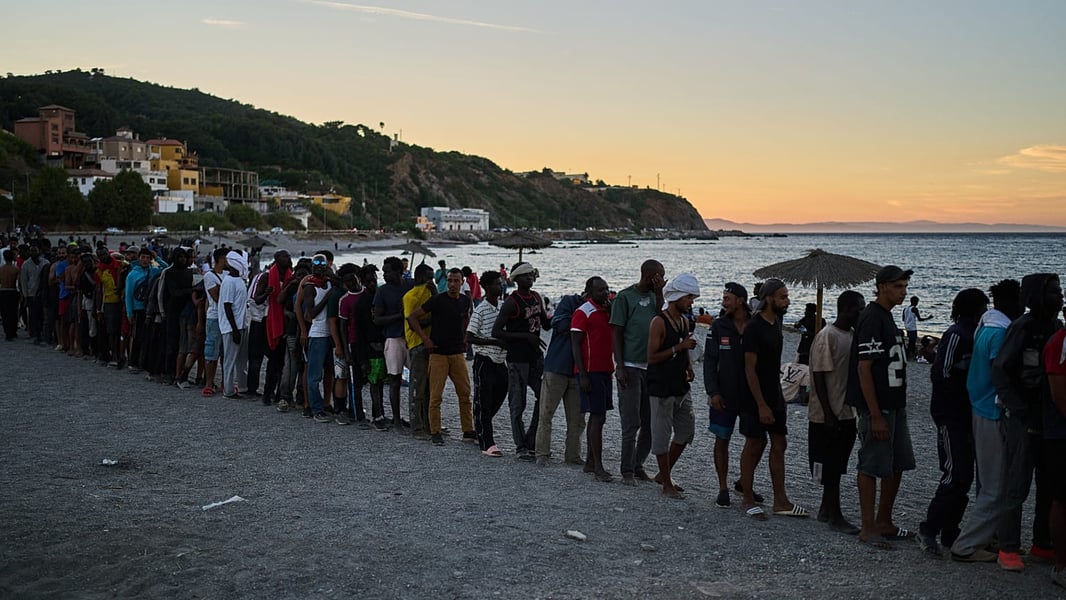
Moroccan security forces arrested 294 people who had gathered near the Castillejos area, southwest of Ceuta, ahead of a mass crossing attempt organized openly on social media. Forty-six of those arrested were Moroccan nationals; the remainder had come from sub-Saharan Africa. The operation deployed navy fast boats alongside the perimeter fence and surveillance drones above the hillsides. Road checkpoints fanned outward from Tetouan and Tangier, two cities that serve as transit hubs for those making the approach, to intercept migrants before they could reach staging areas near the fence, Euronews reported.
The timing was not coincidental. A social media post had called for a crossing specifically on Saturday, two weeks after the previous mass attempt ended with at least 141 people dead according to humanitarian organizations, the highest recorded death toll at the border in modern history.
That figure tells the scale of what has changed. On July 30 and 31, approximately 72,000 people, the majority of them Moroccan men, crossed through the perimeter fence into Ceuta in under 48 hours. It was the largest single-event crossing ever recorded at the Spain-Morocco frontier. Roughly 70,000 were subsequently returned to Morocco, but the Ceuta mass crossing and the deaths that accompanied it fundamentally shifted what officials in Madrid, Rabat, and Brussels understood to be possible at this border.
The July event was not organized on social media in advance in any systematic way. It emerged from a convergence of economic pressure, opportunity, and what appeared to be a brief collapse in Moroccan enforcement. What Saturday’s operation revealed is that the crossing has since become a template, one now being scheduled on social platforms with specific dates.
The European Commission deployed migration specialists to Ceuta in the wake of July. A Commission spokesperson framed the mandate as “reinforcing our borders and ensuring returns every day of the year.” With EU experts deployed to Ceuta to assess conditions, Brussels has been attempting to build a response that outlasts a single season of crisis, though the EU border agency Frontex operates under a mandate that limits what it can do unilaterally when the core enforcement failure is on the Moroccan side of the fence.
The July crisis triggered severe political turbulence inside the European Union. Italy briefly suspended the Schengen free-movement agreement with Spain. France activated enhanced border controls. Several governments accused Spain of having created migration pull factors through a legalization scheme for hundreds of thousands of undocumented residents, a charge Madrid rejected. The political fracture within the EU has not fully healed.
Morocco’s role in border management has always been structurally contingent. Rabat has historically used its enforcement posture as a diplomatic instrument, tightening or loosening its approach in step with its relationship with Madrid and what political benefit it calculates from being cooperative. Saturday’s arrests suggest Morocco currently has an interest in demonstrating control. What determines whether that holds is not the resources it deploys but the political calculation Rabat makes about what it gains by doing so.
Saturday’s operation did not hold completely. A 17-year-old passed through three separate checkpoints over approximately 35 kilometers overnight without being stopped, reaching the Castillejos area independently of any organized group. The gap mattered not for its scale but for what it demonstrated: even a well-resourced interdiction has limits when the motivation driving migration is structural rather than opportunistic.
What happens next at the border depends on a question nobody has yet answered: who is organizing the social media calls for mass crossings, and from where. Digital intelligence analysts found evidence of coordinated promotion across multiple accounts and platforms, but the networks behind the organizing remain opaque. Meta and TikTok activated crisis protocols around the Ceuta situation in recent weeks, collaborating with fact-checkers, though European officials acknowledged the organizing had migrated faster than platform moderation could follow.
None of Saturday’s enforcement changes the conditions that produce the pressure. Sub-Saharan African unemployment, coupled with legal pathways to Europe that are limited and slow, makes Ceuta a pressure valve that any given Saturday can test. Morocco’s navy and drones can hold the valve shut. They cannot release the pressure.
The Sudanese man outside Fnideq was not part of any network. He had heard from another migrant that Saturday was when people were going to try again. He was not arrested. He was not among the 294 who were. When last seen, he was watching the lights of Ceuta across the water.