
The James Webb Space Telescope has delivered another destabilizing glimpse into the Universe’s formative era. Astronomers have identified an ultra-faint galaxy known as LAP1-B, observed at a time when the cosmos was only about 800 million years old. That places it deep within the epoch when the first galaxies were still assembling from near-pristine hydrogen and helium gas.
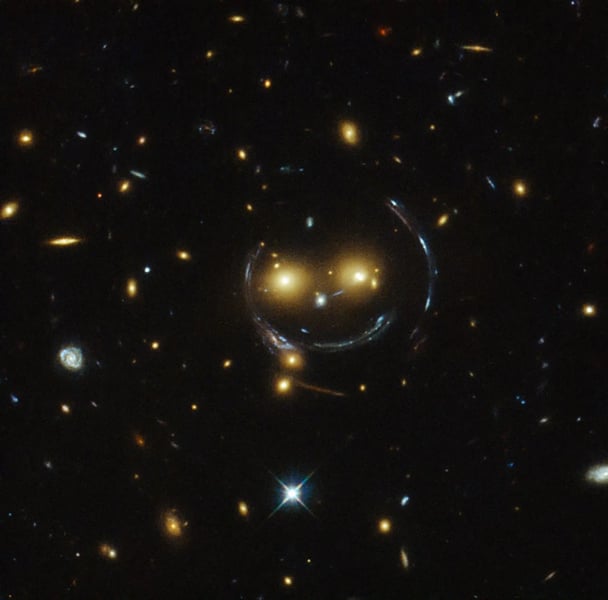
What elevates this discovery beyond routine deep-field astronomy is the mechanism of its detection. The galaxy was revealed through gravitational lensing, where a massive foreground galaxy cluster bends and amplifies light from extremely distant sources. This natural magnification effect allowed researchers to extract spectral data that would otherwise remain inaccessible, effectively turning spacetime itself into an observational instrument.
For context on how this technique works and why it has become central to modern cosmology, gravitational lensing is now one of the most important tools for probing the distant Universe. It allows astronomers to study structures formed in the earliest phases of cosmic history, when light itself is stretched across billions of years before reaching modern detectors.
More background on this phenomenon can be found through established space science frameworks such as gravitational lensing research by ESA.
LAP1-B stands out because of its extreme chemical simplicity. Spectroscopic analysis indicates an oxygen abundance at roughly 0.4 percent of the Sun’s level, placing it among the most metal-poor galaxies ever recorded. In astrophysical terms, “metals” refer to all elements heavier than hydrogen and helium. These elements are forged inside stars and dispersed through supernova explosions, meaning their scarcity signals a system that has undergone minimal stellar recycling.
This level of chemical primitiveness suggests LAP1-B is either extremely young in evolutionary terms or represents a rare survival of early galactic conditions. In either case, it provides a direct observational link to the Universe’s earliest stages of star formation and elemental synthesis.
The James Webb Space Telescope’s role in this discovery is central. Operating primarily in the infrared spectrum, JWST is designed to capture redshifted light from the distant Universe, where optical emissions from early galaxies have been stretched into longer wavelengths by cosmic expansion. The instrument’s Near-Infrared Spectrograph allowed scientists to identify faint emission lines that reveal both composition and internal motion within the galaxy.
Further technical context on the observatory’s mission and scientific goals is available via NASA’s James Webb Space Telescope program overview, which outlines its role in probing early galaxy formation and cosmic evolution.
One of the most striking aspects of LAP1-B is its radiation signature. The detection of highly ionized carbon suggests the presence of extremely energetic stellar populations. These conditions may point toward unusually hot and massive stars, potentially linked to early-generation stellar systems that differ significantly from those observed in the modern Universe.
Some researchers have raised the possibility that such environments could preserve indirect traces of Population III stars, the hypothetical first generation of stars formed from primordial gas. These stars are expected to have been massive, short-lived, and capable of producing intense ultraviolet radiation fields before ending their lives in powerful supernova explosions.
Scientific discussions around these early stellar populations remain active. Broader theoretical framing can be found in research literature such as Population III star hypothesis analyses, which examine how such objects might be indirectly detected through chemical and radiative signatures.
LAP1-B also provides insight into the role of dark matter in early galaxy formation. The measured gas dynamics indicate a compact system whose visible matter alone cannot account for its gravitational stability. This implies the presence of a substantial dark matter halo, which likely acted as a structural scaffold for gas collapse and early star formation.
Such halos are now considered essential to galaxy formation models, particularly in the early Universe, where baryonic matter required gravitational anchoring to form stable structures. LAP1-B appears to sit at the intersection of these processes, offering a rare snapshot of how small-scale systems evolved under extreme cosmological conditions.
The galaxy also falls within what cosmologists describe as the Epoch of Reionization, a transitional period when the first luminous objects ionized the neutral hydrogen that filled intergalactic space. This phase marked a fundamental transformation in the Universe’s transparency and structure.
Observational constraints on this era are still evolving, but LAP1-B contributes valuable data points to refine models of how quickly reionization progressed and how early galaxies influenced it. The system’s low metallicity and compact structure suggest it may represent one of the earliest building blocks of larger galactic assemblies.
In the broader theoretical context, LAP1-B challenges previous assumptions that early galaxies were uniformly simple and slowly evolving. Instead, JWST continues to reveal a more complex picture in which early systems may have developed rapidly, with significant variation in chemical composition and structural maturity.
This growing body of evidence is forcing revisions to galaxy formation models, particularly those governing star formation efficiency, feedback mechanisms from supernovae, and the speed of chemical enrichment across the first billion years of cosmic history.
What emerges from LAP1-B is not just a distant object, but a constraint on cosmic history itself. It is a system that sits at the edge of observational reach, preserved through gravitational lensing and decoded through infrared spectroscopy. Its existence sharpens the boundary between theoretical expectation and empirical reality.
As deeper surveys continue, astronomers expect more systems like LAP1-B to emerge. Each new detection will refine the statistical framework of early cosmic evolution and potentially reshape understanding of how the first galaxies transitioned from primordial gas clouds into structured stellar systems.
For now, LAP1-B remains one of the clearest observational links to the Universe’s earliest formative epoch, a chemically primitive structure that forces modern cosmology to confront just how quickly complexity may have emerged after the Big Bang.