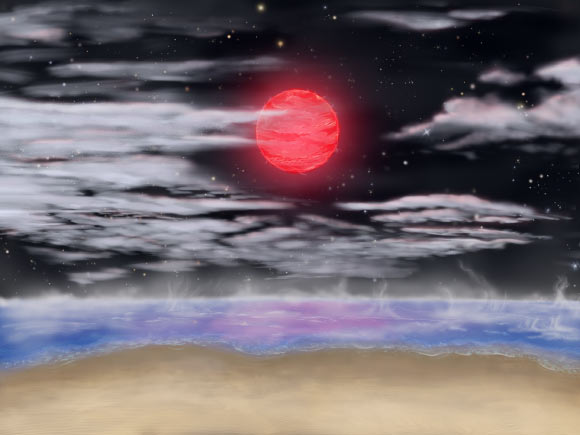

AUSTIN – The evidence that GJ 3378b might support life is thin. The evidence that it cannot is thinner still. That ambiguity, not the planet itself, is why a team from McDonald Observatory spent two years reangling its spectrometers at a dim red star 25 light-years from Earth.
The team, led by astronomer Paul Robertson, has revised the estimated mass of GJ 3378b, a super-Earth orbiting the star GJ 3378, from 5.26 Earth masses down to 2.3 Earth masses. The reduction, described in a study submitted to the preprint server arXiv in May, shifts the planet from the ambiguous territory between rocky worlds and sub-Neptune gas balls toward the range where a solid surface, and theoretically liquid water, become plausible.
The original discovery of GJ 3378b came in 2024, when a French team using the SPIRou infrared spectrometer placed the planet’s mass at more than five Earth masses and its orbital period at nearly 25 days. Those figures suggested a world at the fuzzy boundary between rocky planets and the sub-Neptune class: bloated gas-wrapped worlds that appear common in the galaxy but have little in common with Earth’s surface conditions. Robertson’s revised analysis used three additional instruments alongside SPIRou: the Habitable-zone Planet Finder on the Hobby-Eberly Telescope in the Davis Mountains of West Texas, the NEID spectrometer at Kitt Peak National Observatory in Arizona, and the CARMENES spectrometer in southern Spain. Each measures the tiny Doppler wobble the planet imparts on its star as it orbits, and the four data sets together produced a tighter result: a period of 21.45 days and a minimum mass of 2.3 Earth masses.
Minimum mass is what radial velocity surveys can establish: technically it is the planet’s mass multiplied by the sine of its orbital inclination. The true mass could be higher if the orbit tilts relative to our line of sight, but even at 2.3 Earth masses GJ 3378b falls well within the range where scientists expect rocky compositions to dominate. Sub-Neptunes typically sit above four or five Earth masses and carry thick hydrogen and helium envelopes. Below that threshold, the odds tilt toward an iron-and-silicate interior with a solid surface. GJ 3378b, at its revised size, looks more like an oversized terrestrial planet.
The revised measurements also confirm that GJ 3378b remains within the conservative habitable zone, the band of orbital distances where stellar warmth allows liquid water to theoretically persist on a planetary surface. The team’s paper places it near what they describe as the cosmic shoreline: the uncertain frontier at which planets in the habitable zones of M dwarf stars may lose their atmospheres through radiative stripping. GJ 3378, the star it orbits, is an M4V dwarf, a type of star cooler and dimmer than the Sun but capable of producing intense ultraviolet and X-ray flares, particularly during its formative years. Those bursts of radiation can ionize atmospheric particles and accelerate their escape into space faster than geological processes can replenish them.
M dwarfs represent roughly 70 percent of all stars in the galaxy. Their abundance makes them productive survey targets: the same number of telescope hours yields far more habitable-zone planet candidates around M dwarfs than around hotter, rarer stars like the Sun. But the habitability question for M dwarf planets is unsettled. The TRAPPIST-1 system, which hosts seven known planets around an ultra-cool M dwarf 40 light-years away, has drawn sustained attention from the James Webb Space Telescope; Webb has found evidence of volatile-depleted surfaces on at least two of its inner planets. Whether those results predict a universal fate for M dwarf habitable-zone planets or reflect that system’s specific history remains an open question. GJ 3378b, at 25 light-years, lies closer to Earth and represents a more accessible test case.
Measuring that test requires tools that do not yet fully exist at the required sensitivity. Webb can analyze small planetary atmospheres when they transit their star, allowing starlight to filter through whatever gases a planet carries. Whether GJ 3378b transits its star has not been established; if it does, its proximity would make it one of the most accessible targets in Webb’s range. Webb’s detection of an atmosphere on a planet orbiting a dead star this week demonstrated the instrument’s capacity to resolve fine chemical signatures even in geometrically unusual systems. A habitable-zone rocky planet at 25 light-years would push that resolution toward its practical limit. The Extremely Large Telescopes now under construction in Chile and the Canary Islands, expected to begin science operations in the early 2030s, could target GJ 3378 directly without requiring a transit.
According to NASA’s Exoplanet Exploration program, the cosmic shoreline has become a central organizing framework in habitability research: the empirical observation that planets receiving too much stellar radiation tend to lack atmospheres, while those receiving less tend to retain them. GJ 3378b sits on that line. The revised mass narrows the question but does not answer it.
What Robertson’s team cannot determine from radial velocity data alone is whether GJ 3378b has retained any atmosphere at all. The method reveals a planet’s gravitational pull on its star. It does not reveal what surrounds the planet. The composition of whatever gas may or may not persist above its surface, the pressure at any solid ground beneath, the presence of water vapor or any molecule associated with biological processes: none of that is accessible through Doppler spectroscopy. The planet’s true mass, not just its lower bound, remains unmeasured.
That gap is the honest ledger of where exoplanet science stands near the cosmic shoreline. GJ 3378b is close. It is small enough to be rocky. It holds its position in the liquid-water zone of its star. Those three conditions have rarely come together at such proximity to Earth. What happens at that shoreline, whether a world weathers its star’s early violence and keeps enough chemistry for life, is a question the revised data sharpens without yet being able to settle.