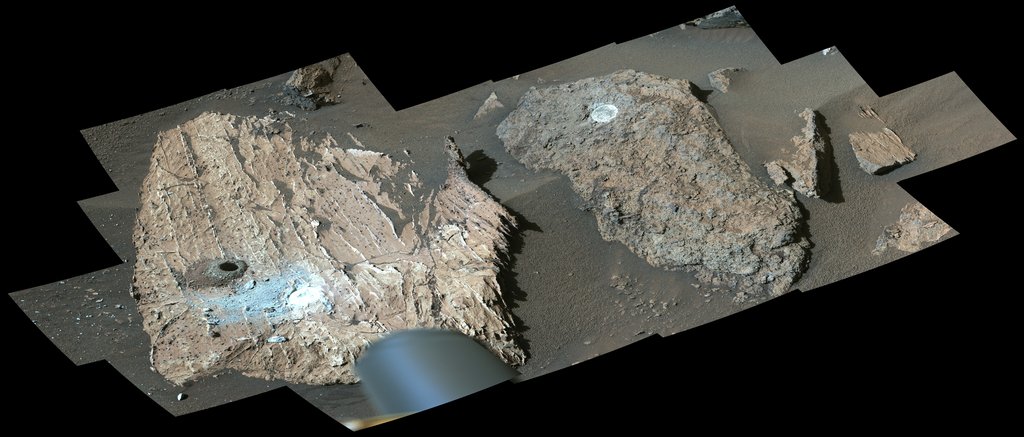

PASADENA — Two ancient mudstones at the edge of what was once a Martian river delta have forced a recalibration of what scientists know about that planet’s chemistry. The rocks, drilled by NASA’s Perseverance rover from a light-colored outcrop in Jezero Crater called Bright Angel, contain macromolecular organic carbon in concentrations and distributions that no prior instrument on Mars has matched. The question of whether that carbon was ever part of something living is one the rover cannot answer. What it can say, plainly, is that Mars had the chemistry.
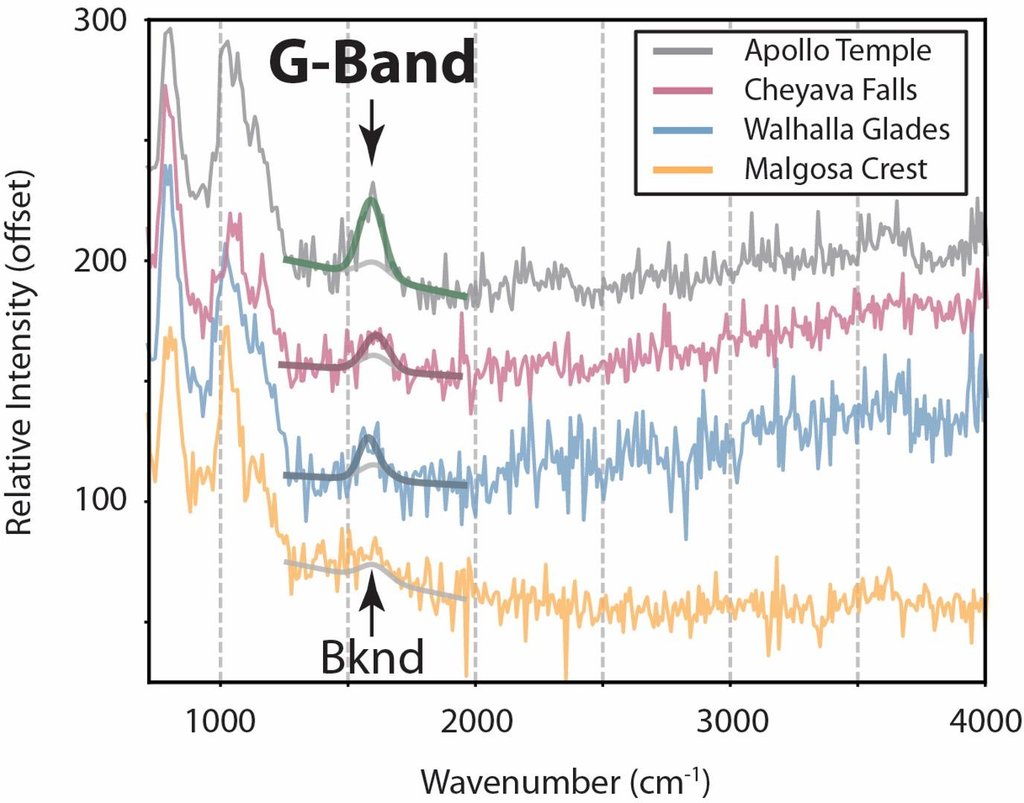
The findings appear in a study published Wednesday in Science Advances, co-led by Kyle Uckert, a research scientist at NASA’s Jet Propulsion Laboratory, and Ashley Murphy, a postdoctoral researcher at the Planetary Science Institute. Their team deployed Perseverance’s SHERLOC instrument across two mudstone samples from the Bright Angel formation, making hundreds of organic detections across both. Researchers described it, in the paper, as “the only detection of macromolecular carbon on a natural rock surface on Mars.”
SHERLOC stands for Scanning Habitable Environments with Raman and Luminescence for Organics and Chemicals. It sits on the end of Perseverance’s robotic arm and fires an ultraviolet laser at rock surfaces, then reads the light that scatters back. The pattern of frequencies in that scattered light is a fingerprint: different chemical bonds return different signatures. SHERLOC can locate organic compounds within a rock’s mineral fabric at the submillimeter scale, without drilling and without destroying the surface it reads. Its detections in the Bright Angel mudstones were both extensive and spatially distributed, spread across the rock faces rather than concentrated at one point.
What SHERLOC identified is macromolecular carbon, or MMC: large, tangled networks of carbon atoms that form in terrestrial rocks, in ancient meteorites, and across the solar system wherever carbon-bearing chemistry has had time to stabilize. On Earth, MMC accumulates in ancient sedimentary rock and is associated both with biological processes, meaning the slow compression of organic matter over geologic time, and with abiotic ones, including meteorite delivery and hydrothermal reactions. Mars has a documented history of all three. The material’s durability is part of what makes it detectable: macromolecular carbon resists the degradation that destroys simpler organic molecules.
The two mudstones carry field nicknames: Cheyava Falls and Sapphire Canyon. In the Cheyava Falls core, the organic carbon appears embedded within a silicate mineral matrix. In Sapphire Canyon, it sits within carbonate and sulfate minerals. Both samples came from the same light-toned formation in Neretva Vallis, the ancient river channel that once fed Jezero’s paleolake. The sedimentary setting matters. Mudstones form in calm water, where fine particles settle slowly, and on Earth, this kind of rock is among the most reliable archives of past biological activity. Neretva Vallis mudstones, alongside other recent analyses of ancient Martian rocks, have emerged as key archives for reconstructing the planet’s early chemistry.
Uckert noted that the selection of Jezero Crater as Perseverance’s landing site anticipated this result. “Jezero Crater was selected as a landing site due, in part, to its past evidence of aqueous activity and potential to preserve organic material,” he said. The Martian surface is a hostile environment for organics: ultraviolet radiation and chemical oxidants would break apart molecular chains on a timescale far shorter than the billions of years these rocks have sat. That the macromolecular carbon persisted suggests the surrounding minerals acted as a shield, slowing degradation over timescales that dwarf anything in recorded human history.
The Bright Angel findings do not stand alone in the record. NASA’s Curiosity rover has reported organic detections in Gale Crater, a site more than 2,000 miles from Jezero. Two ancient lake systems, separated by a continental scale, both showing preserved organic chemistry: Murphy read the pattern as a planetary signal rather than a local one. “This indicates that billions of years ago, organics may have been more than just locally present and may have been more widely available in ancient lakes and rivers on Mars,” she said. A single detection can be an anomaly. Two detections at that distance suggest a distribution.
For astrobiology, that is a meaningful shift. The habitability question has always depended partly on whether the right raw materials were in the right places at the right time. Organic carbon does not prove life was present. But if ancient Mars sustained complex organic chemistry across its lake systems, then the conditions under which life, had it emerged anywhere on the planet, might have found purchase were considerably more widespread than earlier models assumed. The planet looks less like a barren world with one wet anomaly, and more like one whose ancient chemistry worked at scale.
What SHERLOC cannot do is settle the most fundamental question the finding raises. The instrument identifies chemical bonds through the light they scatter. It cannot determine whether the macromolecular carbon it detected was laid down by living organisms, carried to Mars aboard meteorites that seed the planet with organic material from across the solar system, or produced through hydrothermal geochemical processes within the planet’s own crust. “Macromolecular carbon may be delivered to Mars via meteorites, or may have formed through hydrothermal geologic processes,” Uckert said. The instrument that could distinguish among those origins does not exist in any form compatible with surviving a rocket launch and years of Martian operational demands.
“Further constraining the origin, distribution, and alteration history of the MMC observed in the Neretva Vallis mudstones requires high-resolution and high-sensitivity analyses in terrestrial laboratories,” Murphy said. That is the case for Mars Sample Return, implicit but persistent throughout the Science Advances paper. Perseverance has been sealing rock cores since it landed in 2021. The Bright Angel mudstones are now among the candidates for eventual retrieval. The mission architecture to bring them back, including a lander, an ascent vehicle, and an Earth-return orbiter, remains under development, with no confirmed launch date.
Murphy called the Bright Angel result “one of the most exciting findings to date,” even while acknowledging that its formation mechanism remains unknown. That pairing is not unusual in planetary science. NASA’s most productive recent missions have returned results that deepen the central question rather than resolve it. The Bright Angel mudstones offer macromolecular carbon, a preserved chemistry, and a question about its origin that only an Earth laboratory can answer. The samples are waiting.