
TORONTO — A fragment of Mars sat inside a Royal Ontario Museum collection drawer for years before anyone looked closely enough to find what was hiding inside it. When Tanya Kizovski finally did, she found a mineral that, by the textbook rules of Martian geology, should not have been there at all.
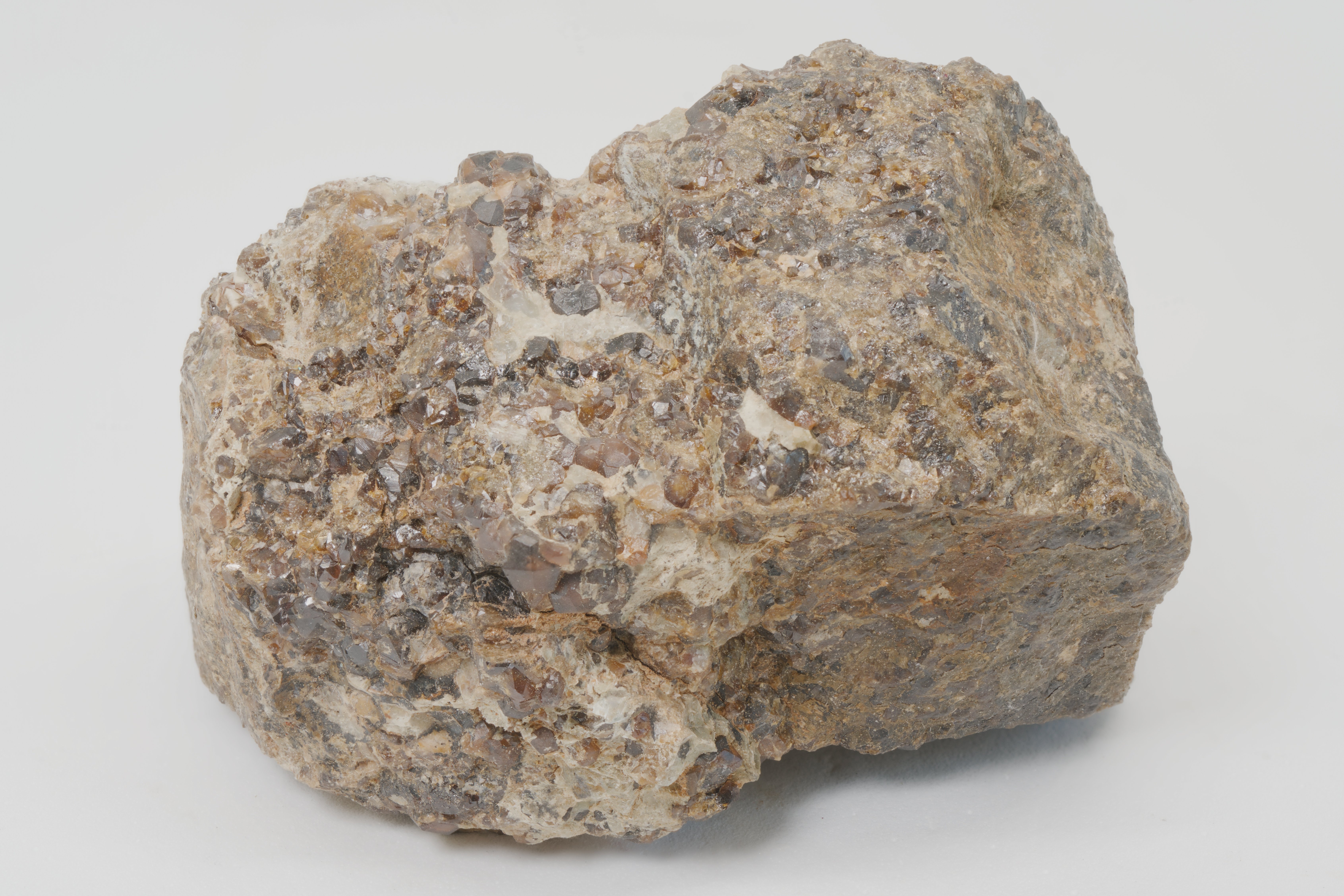
The rock is known as NWA 8171, a meteorite recovered from Northwest Africa’s Sahara Desert in 2013 and classified as a Martian polymict regolith breccia, a jumble of older rock fragments fused together by ancient impacts on the planet’s surface. Kizovski, an assistant professor of earth sciences at Brock University working with the Royal Ontario Museum and an international team, used backscatter electron imaging and elemental analysis on a small clast inside the sample. The iron, calcium and magnesium signatures pointed to something specific: andradite, a species of garnet that had never before been confirmed inside Martian material.
Garnet is not an exotic mineral on Earth. Andradite in particular tends to show up in skarns, the metamorphic rock that forms where hot fluids react with limestone near an intruding magma body, and in its greenest, clearest form it has been cut into a gemstone called demantoid since the nineteenth century. What makes its presence on Mars strange is the planet’s geology. Mars has no plate tectonics, no grinding continental collisions to generate the pressure and fluid chemistry that typically produces garnet-forming metamorphism on Earth. A mineral that usually needs tectonic machinery to exist had turned up on a planet that, as far as anyone has established, never had that machinery running.
“The most exciting part is that we potentially have a new rock type on Mars,” Kizovski said of the find, detailed in the university’s own announcement and published in Geochemical Perspectives Letters on June 23. Her team lays out two competing explanations rather than settling on one. Either an unrecognized metamorphic process has been operating somewhere on Mars, doing without tectonics what tectonics does on Earth, or the garnet crystallized from a previously unseen type of igneous rock, cooling out of lava or magma in a way the planet’s known volcanic record does not obviously explain. Both possibilities would extend the known range of Martian rock chemistry beyond what decades of orbital and rover data had suggested was there.
Chris Herd, a University of Alberta professor who has spent his career studying Martian meteorites, called the breccia “probably one of the most significant discoveries in Martian meteorite research in the last 15 years.” That is a heavy claim for a fragment that has been sitting in institutional storage since before most of the researchers now studying it finished their doctorates, and it says less about the rock’s rarity than about how much of Mars remains inferred rather than observed. Almost everything scientists know about the planet’s interior comes from a small collection of meteorites, orbital spectroscopy and a handful of rover traverses across single locations. A new mineral in an old sample is a reminder of how much of that picture is still built on gaps.
The team has deliberately left the most decisive test undone. Confirming that the garnet actually formed on Mars, rather than arriving as later contamination or an artifact of the meteorite’s violent journey through the asteroid belt and Earth’s atmosphere, would require an oxygen isotope analysis precise enough to match the mineral’s chemical signature against known Martian material. That test consumes the sample it is run on. Kizovski’s team has so far chosen not to destroy any more of a fragment this rare while other lines of investigation continue, a decision that trades a faster answer for the chance to run different tests later.
The find lands inside a broader run of discoveries reshaping how planetary scientists think about where and how life-relevant chemistry, and now unexpected mineralogy, can accumulate on other worlds. NASA’s Curiosity rover has spent recent months pulling an unexpectedly diverse set of organic molecules out of Gale Crater’s ancient lakebed sediment, evidence that early Mars carried more complex chemistry than its dusty, radiation-scoured surface today would suggest. And on Earth, geologists in South Korea recently found fossilized microbial stromatolites growing inside a hydrothermal lake that an asteroid impact itself created, a reminder that violent impact events do not only destroy. They can also manufacture the exact chemical conditions something unexpected needs to form.
What NWA 8171 cannot yet say is which of its two possible origin stories is correct, or whether either one holds until a second garnet-bearing Martian sample turns up to corroborate it. For now, the fragment sits back in its Royal Ontario Museum drawer, its most important question deliberately unanswered, its mineral chemistry the only thing standing between a small addition to the periodic table of Martian rocks and a real revision of what an untectonic planet is capable of building.