SEOUL — Beneath a shallow, bowl-shaped basin in the southern Korean countryside, geologists have pulled out something that may rewrite a small but consequential chapter in the story of how life took hold on Earth. They found stromatolites, the layered fossil remnants of microbial colonies that count among the oldest signatures of life on the planet, buried under a 42,000-year-old asteroid impact crater.
The discovery, published this week in the journal Communications Earth and Environment, was led by Jaesoo Lim, a geologist at the Korea Institute of Geoscience and Mineral Resources, known as KIGAM. His team excavated the Jeokjung-Chogye Basin in Hapcheon, a feature confirmed only in 2021 as the sole large impact crater identified anywhere on the Korean Peninsula.
What they uncovered, sitting in sediment beneath the crater floor, were rounded mineral mounds between four and eight inches across. The mounds carried the unmistakable fingerprint of cyanobacteria, the photosynthetic microbes whose ancient ancestors are believed to have flooded the early atmosphere with oxygen and made the planet hospitable for complex life. Early reporting on the find, according to coverage of the study, frames the discovery as the first robust evidence that impact craters can grow stromatolites in place.
The team radiocarbon-dated one of the structures and concluded it had formed between roughly 23,400 and 14,600 years ago, long after the impact itself but well within the lifespan of a lake that the crater appears to have held for tens of millennia. Trace amounts of europium, an element that becomes far more soluble in hot fluids, told the scientists that the lake was hydrothermal, fed by heat slowly radiating from rock the asteroid had shattered and warmed.
Calcium, calcite and sulfur signatures, along with biological traces consistent with microbes that thrive in hot water, reinforced the conclusion. The crater, in effect, had spent thousands of years as a natural spa for some of the simplest organisms on the planet.
“This is the first comprehensive evidence suggesting that stromatolites could form in hydrothermal lakes created by asteroid impacts,” Lim said in a statement accompanying the research. “Such environments may have provided favorable conditions for early microbial ecosystems.”

The implication reaches far beyond a single Korean valley. Scientists have long argued that the inner solar system endured a violent stretch of asteroid bombardment around four billion years ago, an episode sometimes called the Late Heavy Bombardment, that pockmarked the young Earth with craters now mostly erased by erosion and plate tectonics. If craters routinely produced warm, mineral-rich lakes, then early Earth would have been studded with thousands of these microbial refuges, each one a candidate cradle for life.
Stromatolites themselves have a long, layered history in paleobiology. Some examples in Western Australia date back roughly 3.5 billion years, making them among the oldest direct evidence for life on the planet. Until now, the assumption has been that impact craters might preserve fossil microbes only by accident, as sediment washed in from elsewhere. The Hapcheon stromatolites appear to have grown in place, fed by heat and chemistry the strike itself supplied.
There is a second possibility raised by the work that has astrobiologists especially interested. Cyanobacteria do not only build stromatolites. They breathe out oxygen as a byproduct of photosynthesis, and earlier research has linked the rise of atmospheric oxygen, the Great Oxidation Event roughly 2.4 billion years ago, partly to their activity. If asteroid impacts seeded the early planet with thousands of small hydrothermal nurseries, those craters may have functioned as what the Korean team calls “oxygen oases,” tiny chemical factories that helped tip the atmosphere toward breathability.
The researchers are careful not to claim too much. Their data do not prove that craters drove the oxygenation of Earth. The chain of evidence is interpretive, and the conditions on the planet 23,000 years ago were not those of the Hadean and early Archean periods when life first emerged. But the Hapcheon find narrows the gap between two long-standing ideas in origin-of-life research: that bombardment played a role in shaping Earth’s chemistry, and that microbial life found its first foothold in hot, mineral-laden waters.
The work also recasts older discoveries. Microbial traces have been recovered before from inside impact basins, including signs of mats at the Chicxulub crater off the Yucatan Peninsula, the site of the asteroid strike that ended the age of the dinosaurs. Until now, scientists generally treated those traces as material swept into the basin from outside. The Korean stromatolites give that interpretation a serious rival.
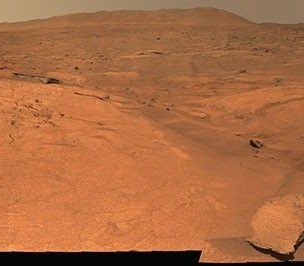
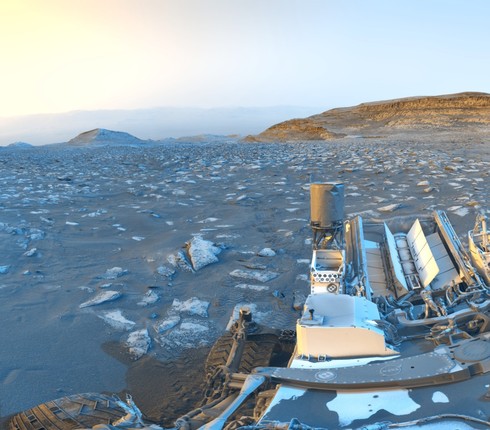
For planetary scientists, the practical payoff sits elsewhere in the solar system. Mars is covered with impact craters that once held water, and several of NASA’s rovers have already detected complex organic molecules in ancient Martian sediment, prompting a fresh round of speculation about whether the red planet ever hosted microbial life. The Curiosity rover’s most recent detection of complex organic compounds in Gale Crater has already pushed researchers to ask harder questions about what biosignatures might survive in such places.
If Lim’s team is right that craters can house living systems for tens of thousands of years, the case for digging deeper into Martian impact basins, particularly those that once held lakes, becomes stronger. The same logic could apply to icy moons in the outer solar system where subsurface impacts might still be melting brines. The published paper, available here as primary source material, appears in Communications Earth and Environment.
Closer to home, the Hapcheon result joins a broader scientific conversation about how chemistry, geology and chance combined on a young planet to produce the only known example of biology in the universe. Earlier research has implicated everything from a younger and more energetic Sun to undersea hydrothermal vents in setting the stage for life. The new study adds another, less explored possibility: that the very rocks crashing into Earth from space did more than scar it. They may have made parts of it inhabitable.
The next step, the Korean team says, is to look at other impact craters on Earth for similar signatures, and to refine the dating of the Hapcheon stromatolites with additional samples. Other researchers will be watching closely. Confirmation from a second site would lift the Hapcheon discovery from intriguing geological curiosity into a real revision of how scientists think about the chemistry of early Earth. KIGAM’s announcement, as reported in the institute’s press release, framed the work as a window into the chemistry of the early planet.
For now, a basin in southern South Korea, long known as little more than a pleasant rural depression in the landscape, has joined the small but growing list of places where the question of where we came from feels a fraction less mysterious.