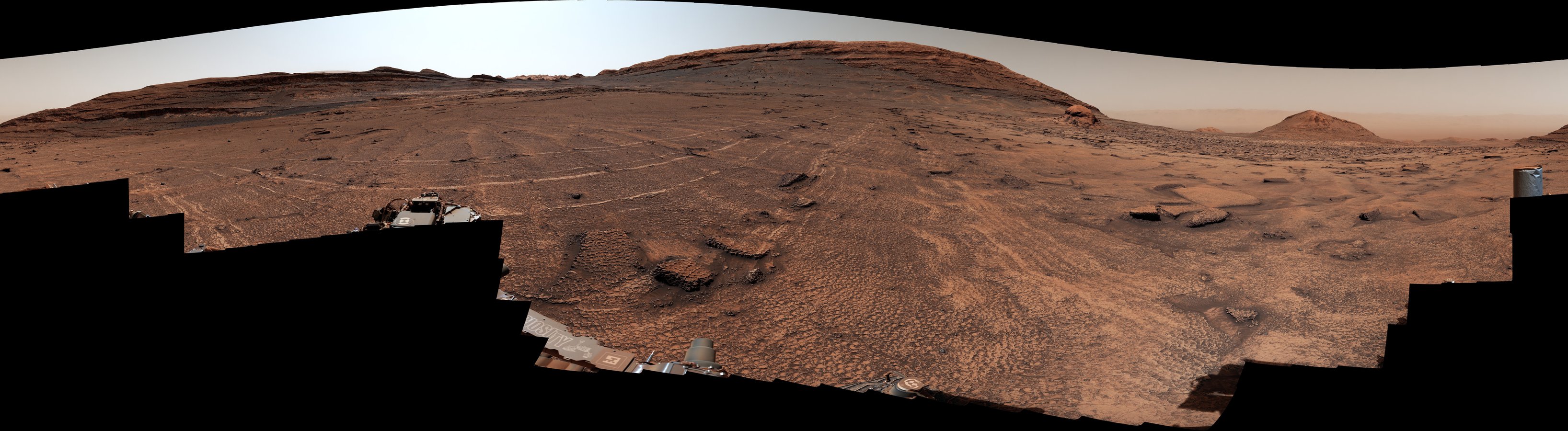

PASADENA – Ashwin Vasavada has spent more than two decades reviewing images sent back from a robot on another planet. He has seen dried riverbeds, ancient lake sediments, sulfur deposits, and dark meteorite fields. When the panorama arrived from a plateau called Valle Grande on June 20, the mission project scientist says he put everything else down.
“We’ve seen a lot of fascinating landscapes through Curiosity’s eyes,” said Vasavada, who leads the Curiosity mission at NASA’s Jet Propulsion Laboratory, “but this sea of polygons took our breath away.”
NASA released the images and accompanying analysis on Tuesday. The panorama, captured over two Martian sols on June 19 and 20, 2026, shows a terrain blanketed in geometric fractures, honeycomb-like shapes measuring approximately 1.5 to 3 inches across, extending as far as the rover’s cameras can see in every direction. At the frame’s center stands a butte the science team has nicknamed “Miraflores,” a roughly 20-foot formation capped with dark sand, the only vertical interruption in an otherwise flat geometric plain.
Curiosity landed on Mars on August 5, 2012, and has been ascending Mount Sharp since 2014, working through geological strata that preserve the history of Gale Crater’s ancient environment. The Valle Grande plateau is one stop on that 14-year climb, and the polygon field encountered there is unlike anything in the rover’s extensive catalog of Martian textures.
Scientists at JPL and Caltech, which manages the Curiosity mission for NASA’s Science Mission Directorate, have identified at least three mechanisms that could have produced what the rover photographed. Mud cracking is the most familiar candidate. When wet sediment dries and contracts, it fractures along polygonal lines, a process documented on Earth in dried lakebeds and playa deposits, and one Curiosity has observed in earlier sections of the Gale Crater traverse. Temperature cycling offers a second explanation: alternating warm and cold conditions expand and contract surface material until it fractures at regular intervals, no water required. Compression, in which buried sediment is squeezed under the weight of overlying rock, offers a third route to the same visual result.
What distinguishes the Valle Grande field from prior polygon observations is its scale and coherence. Individual fractures range from 4 to 8 centimeters across, consistent in size, evenly spaced, and wrapping continuously around the Miraflores butte rather than appearing in isolated patches. That regularity implies a single uniform process acting across a wide area at approximately the same time. Which process, and which period of Martian history it records, the team has not yet resolved.
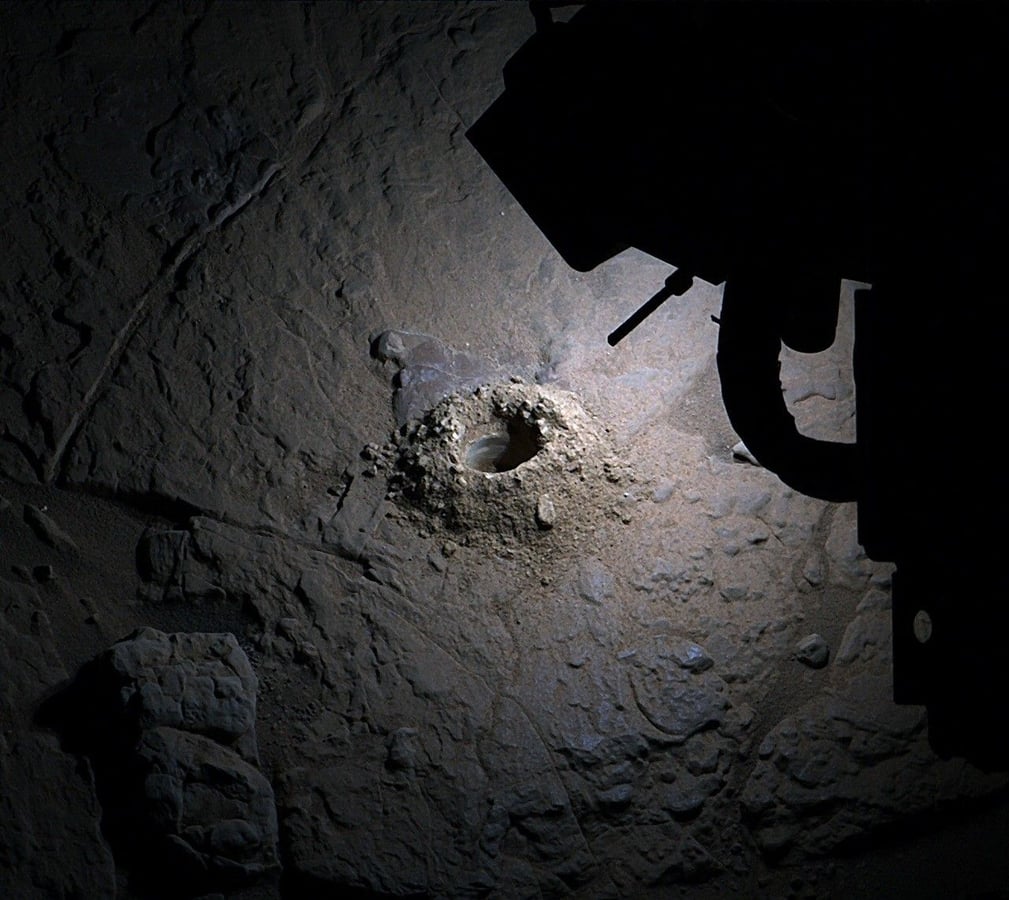
The panorama also framed, in its lower corner, Curiosity’s rear-left wheel. The image shows more than 14 broken grousers, the metal cleats that provide traction on uneven terrain. The damage is not new. Engineers began tracking wheel degradation in 2013, when the original aluminum wheels accumulated holes and cracks on sharp volcanic rock that early terrain models had not fully anticipated. Since then, route-planning software has been adjusted to steer the rover around the sharpest surfaces. Curiosity remains fully operational, its mobility unaffected.
The polygon discovery arrives as Curiosity’s sister mission, Perseverance, continues its own excavation of organic carbon chemistry deep in Jezero Crater, more than 2,000 miles to the east. The two rovers, operating in different regions of the same planet, have now each returned evidence suggesting that ancient Mars was more chemically complex than the barren, radiation-scoured surface visible today would imply.
Curiosity’s own record at Gale Crater includes detections of organic molecules in ancient lakebed sediments, compounds consistent with prebiotic chemistry. Analyses of Martian meteorites recovered on Earth have separately uncovered mineral species never before confirmed on the planet, suggesting Mars’s geological range extends further than orbital surveys alone have established. Each new discovery adds a layer to an image of early Mars that remains unresolved at its most important point: whether the right conditions for life were ever present, and for how long.
What the polygon field contributes to that image is primarily physical. Its regularity points toward a systematic process, but whether that process involved liquid water at the surface, the kind of water that could have hosted biological chemistry, is exactly what the available data cannot yet resolve. Mud cracking demands water. Temperature cycling does not. Compression depends on the fluid content of the buried sediment. Each mechanism implies a different Martian past for Valle Grande, and a different weight in the broader question of whether ancient Mars was a world where life could have taken hold.
NASA released the Valle Grande panorama as part of its standard Curiosity mission update cycle. Caltech manages the mission for NASA’s Science Mission Directorate; JPL built the rover and directs its daily operations. Higher strata on Mount Sharp, which Curiosity is expected to reach in the coming months, are believed to contain rock layers formed closer in time to when Mars lost most of its surface water. The polygon field sits below that boundary. Whether the formation process that shaped it operated before or after that transition is a question the rover has not yet climbed high enough to answer.