
SAN DIEGO – The planet was always there. Finding it required looking differently.
Astronomers led by researchers at UC San Diego and the University of Edinburgh confirmed this week that a third planet orbits Beta Pictoris, a young star 63 light-years from Earth whose surrounding debris disk has made it one of the most studied planetary systems in modern astronomy. The planet, designated Beta Pictoris d, was not detected by direct imaging. The James Webb Space Telescope found it by reading the carbon monoxide absorption lines in its atmosphere, a method that had never before been used to confirm an exoplanet’s existence from the ground up.
The distinction matters because Beta Pictoris d was hiding inside one of the brightest debris disks in the known sky. Dense clouds of cosmic dust scattered enough light to make direct imaging impossible. What JWST’s spectroscopic instruments could do was identify the planet’s chemical fingerprints without needing to resolve it as an object. “You don’t just learn that something is a planet,” said Jean-Baptiste Ruffio of UC San Diego, one of the lead authors; “you immediately begin learning about its temperature, chemistry, and motion.”
The findings were published in The Astrophysical Journals and involved three of JWST’s core instruments, the Near-Infrared Spectrograph, the Near-Infrared Camera, and the Mid-Infrared Instrument, alongside observations from the European Southern Observatory’s Very Large Telescope in Chile. Cross-validating the atmospheric signal across independent instruments was necessary to distinguish the planet’s carbon monoxide signature from the spectral noise of the surrounding disk.
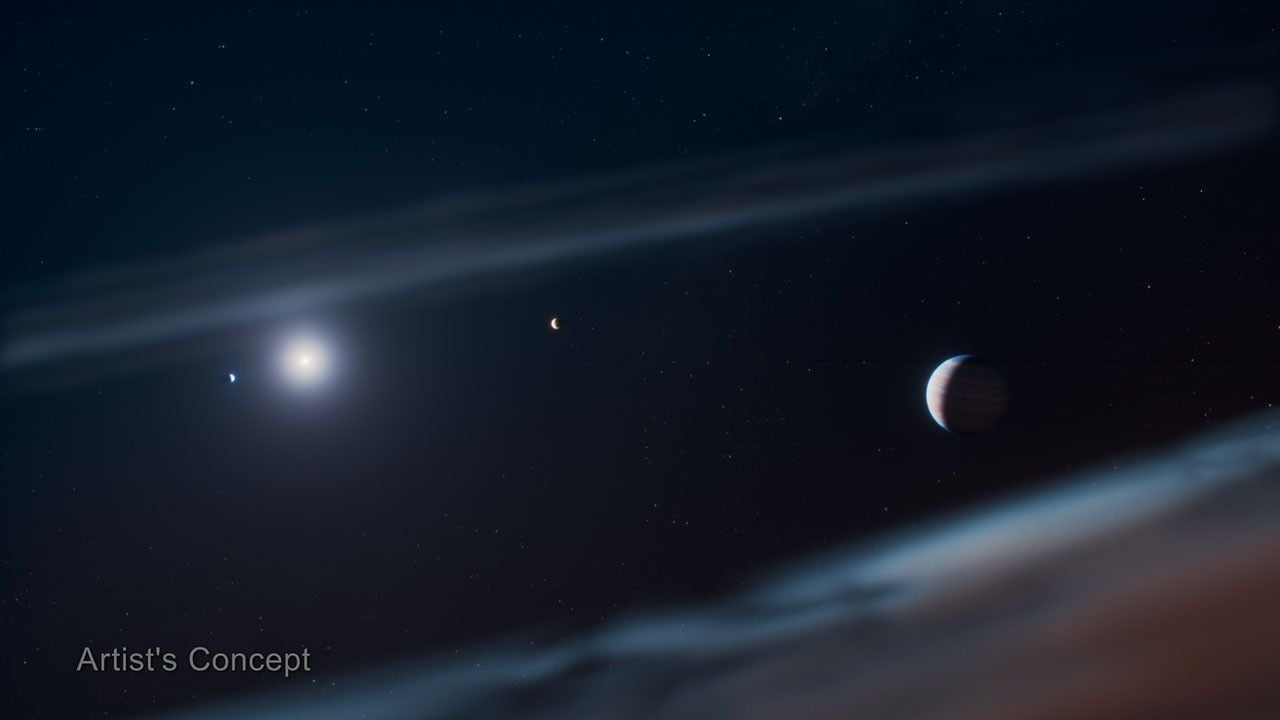
Beta Pictoris was already one of the more notable systems in the exoplanet catalog. Beta Pictoris b was confirmed in 2008; Beta Pictoris c followed in 2019. The addition of d gives the system three confirmed planets, making it only the second known planetary system with at least three directly observed worlds. Beta Pictoris d holds the widest orbit of the three, placing it farther from the star than either of its predecessors.
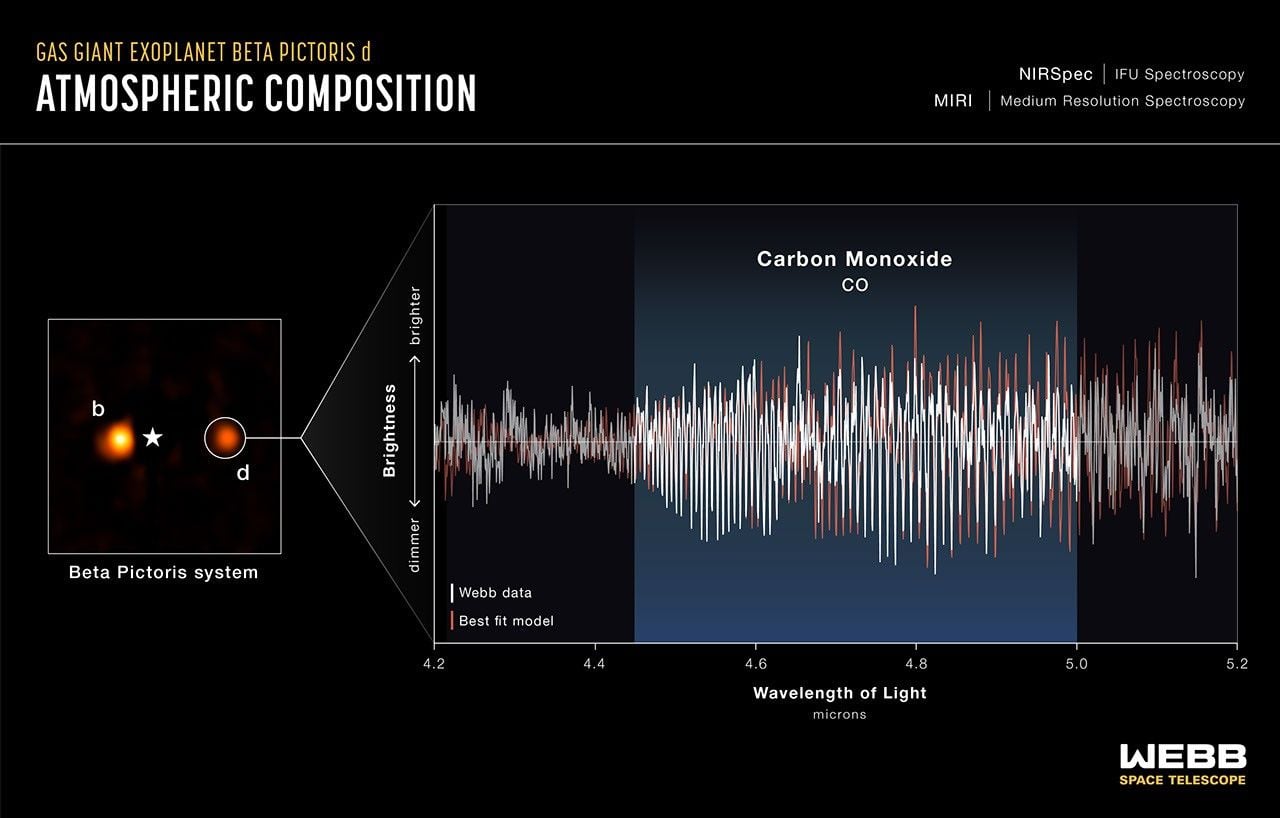
What the paper cannot yet establish is considerable. The physical size of Beta Pictoris d was not determined by this detection method. The confirmation establishes existence and provides data on atmospheric chemistry and temperature, but mass and radius require different observational approaches. Whether the planet has moons, rings, or secondary objects is untested. The researchers established what the planet is, not yet what it fully contains.
The spectroscopic approach used here is not conceptually new. Atmospheric spectroscopy has been applied to thousands of planets confirmed through transit methods, characterizing worlds whose existence was already established by other means. What is new is using it as the discovery mechanism itself, the tool that proves a planet exists before any other technique does. That shift raises a question the field has not yet had to answer: how many planets currently classified as undetected in dusty, visually obstructed systems might be found if observers looked for chemical fingerprints rather than resolved images.
Beta Pictoris has drawn attention for decades because its debris disk offered a visible laboratory for studying planetary formation. The same properties that made it scientifically valuable, the density and luminosity of the surrounding material, also made close examination difficult. Aidan Gibbs and Ben Sutlieff, co-authors from UC San Diego and Edinburgh respectively, along with Markus Bonse of the European Southern Observatory, worked to isolate the planetary signal from the disk’s own spectral emissions, a calibration challenge significant enough that the methodology warrants detailed examination in its own right.
How many other planets are currently hidden in systems like this one is a question the field cannot yet quantify. The spectroscopic method that found Beta Pictoris d does not work everywhere. It depends on geometry, atmospheric composition, and data quality. What the Beta Pictoris discovery establishes is that the method works in a demanding environment, inside one of the most visually complex, dust-dense systems on record. If it works there, the catalog of hidden planets may be substantially longer than current surveys suggest.