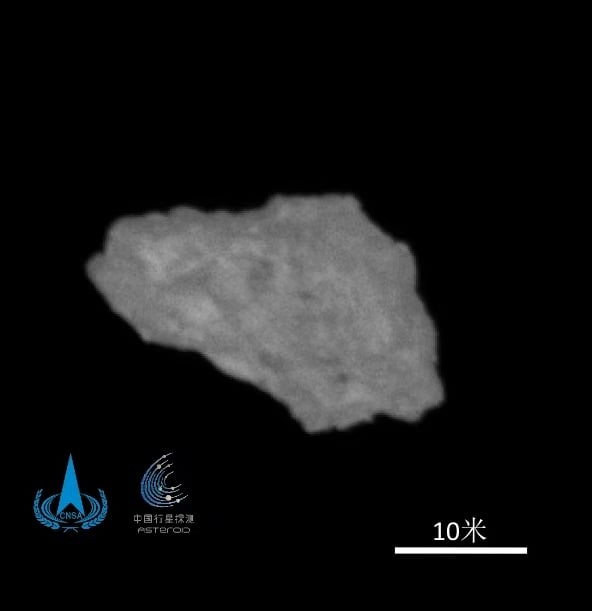

BEIJING — There is a small, elongated rock trailing Earth through space that most people have never heard of. Perhaps 20 meters across, it is older than anything humans have ever touched, and for the first time in the 4.5-billion-year history of the solar system, something assembled on Earth is close enough to examine it. China’s Tianwen-2 spacecraft arrived at near-Earth asteroid Kamoʻoalewa on July 2, completing a 400-day journey of approximately one billion kilometers, and the China National Space Administration (CNSA) released the mission’s first close-up image four days later: a gray, jagged, elongated body with a striking surface brightness that will take months of analysis to fully explain.
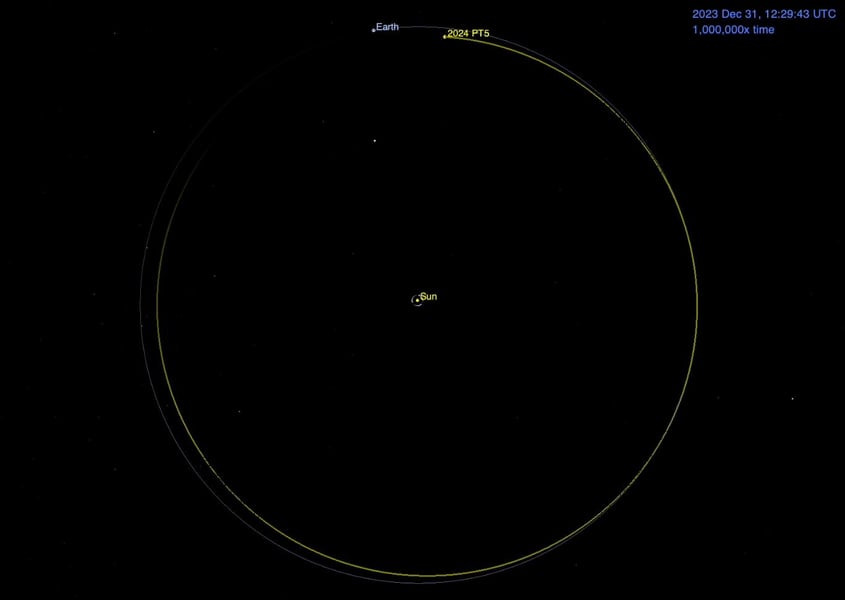
Kamoʻoalewa, formally designated 469219 and also cataloged as 2016 HO3, is not an ordinary near-Earth asteroid. It belongs to a class of objects called quasi-satellites, sometimes described informally as quasi-moons. Rather than orbiting Earth the way the Moon does, it traces a horseshoe-shaped path through space that keeps it bound to Earth’s orbital vicinity by gravitational influence while it completes its own loop around the Sun, in near-perfect step with our planet. At any given moment, Kamoʻoalewa sits between 38 and 100 times the lunar distance from Earth, drifting closer, then retreating, then looping back in a cycle stable enough to have persisted for centuries and projected to continue for centuries more. It will not stay. Eventually, it will drift away.
Understanding why this particular rock ended up in gravitational lockstep with Earth, and what it is made of, is one of the defining questions of Tianwen-2’s mission. The asteroid occupies an unusual orbital niche that raises a question scientists have not been able to settle with ground-based or orbital telescopes alone: did Kamoʻoalewa arrive in Earth’s orbital neighborhood by migrating inward from the asteroid belt, or was it thrown into its current path by a collision that once struck the Moon itself?
Mikael Granvik, an astronomer who specializes in near-Earth objects, told SpaceNews that the first close-up image from Tianwen-2 “basically confirms” the high geometric albedo the asteroid displayed in earlier observations. That surface reflectivity points toward an E-type silicate composition, placing Kamoʻoalewa in a category of asteroids thought to originate from the inner main asteroid belt rather than the lunar surface. If correct, the E-type identification would favor the migration theory over the lunar-fragment hypothesis. But Granvik noted that settling the question requires physical samples, not imaging alone. What the first image confirms is the brightness. What it cannot confirm is what lies beneath.
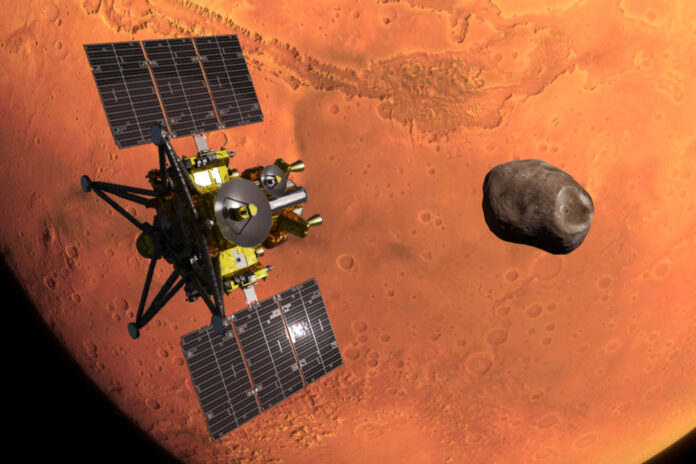
Tianwen-2 carries 11 science instruments for the mapping phase now underway: cameras, laser ranging equipment, spectrometers, ground-penetrating radar, and particle analyzers. One of those instruments, the DIANA dust analyzer, was developed by Italian researchers, a reminder that China’s national space missions increasingly draw on international scientific expertise even as they remain under CNSA operational control. The James Webb Space Telescope previously estimated Kamoʻoalewa’s diameter at approximately 18 meters; Tianwen-2’s proximity data puts it at just over 20 meters. That discrepancy will narrow as the spacecraft produces higher-resolution imagery and structural data over the coming months.
CGTN reported that CNSA said the probe will “progressively conduct more detailed scientific exploration to acquire data on the asteroid’s morphology, material composition and internal structure, laying the groundwork for subsequent sample collection operations.” Three sampling techniques are available to Tianwen-2: hovering above the surface to collect loose regolith, a touch-and-go approach similar to what Japan’s Hayabusa2 used at asteroid Ryugu, and an anchoring method for more stable surface contact. The probe’s arrival at Kamoʻoalewa marks the first time any mission from any nation has conducted a close-up investigation of an Earth quasi-satellite.
Hayabusa2’s capsule delivered material from Ryugu to Earth in December 2020, and the analysis of those samples reshaped what scientists understood about carbon-rich asteroids and the early chemical history of the solar system. NASA’s OSIRIS-REx mission returned material from the near-Earth asteroid Bennu in September 2023. Both Ryugu and Bennu were dark, carbon-rich asteroids; neither was a quasi-moon. If Kamoʻoalewa turns out to have a different composition, as Granvik’s early assessment suggests, the samples returned by Tianwen-2 would add a third data point from a chemically and orbitally distinct asteroid type, filling a gap the previous two missions could not.
The current timeline calls for Tianwen-2 to depart Kamoʻoalewa in April 2027, with a sample return capsule scheduled to reach Earth in late November 2027. What the capsule will contain cannot be known until the sampling attempts begin and the laboratory analysis follows. CNSA has not publicly specified a minimum sample mass or the criteria for a successful collection, and the surface conditions Tianwen-2 will encounter at closer range remain uncertain from the current mapping distance of 20 kilometers.
The Vera Rubin Observatory’s ongoing southern-sky survey, which began this year, is expected to identify hundreds of new near-Earth asteroid candidates over the next decade, some of them potentially in quasi-satellite relationships with Earth similar to Kamoʻoalewa’s. What Tianwen-2 returns in late 2027 may become the interpretive baseline for understanding those future objects. The science of quasi-moons is, by any reasonable measure, in its earliest phase. This week it moved from the territory of theoretical models to one being sampled, for the first time, by a spacecraft.