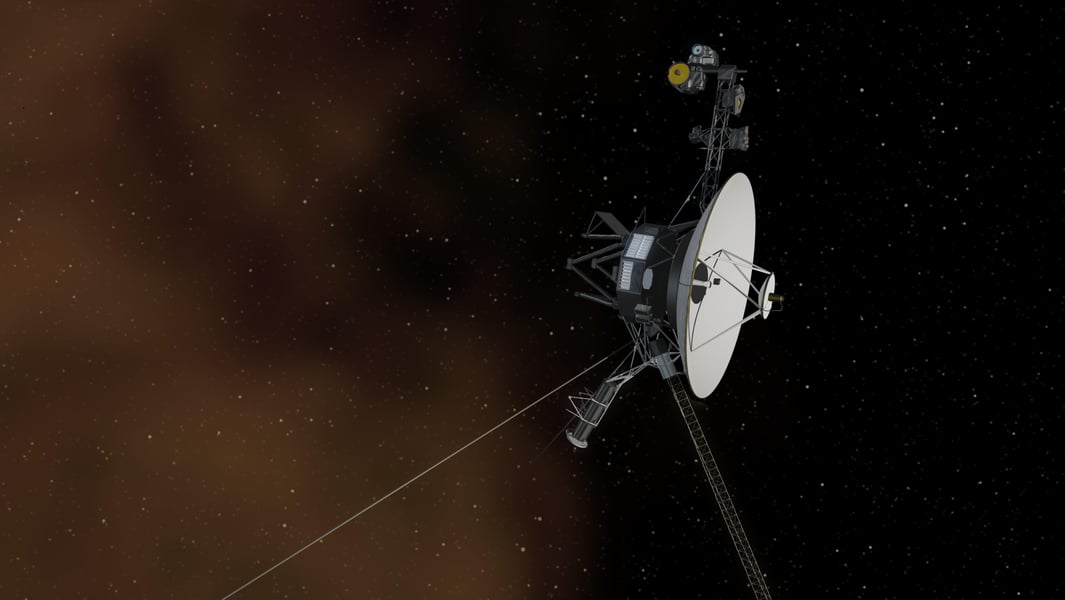

NASA is inviting people worldwide to flash Voyager’s three-letter call sign into the night sky on Tuesday, November 17, as Voyager 1 approaches a distance reached by no other human-made object: one light-day from Earth.
The spacecraft is expected to reach the milestone on Wednesday, November 18, at 5:16 a.m. EST, or 3:46 p.m. IST, according to NASA’s mission update. At that point, it will be about 16.094 billion miles, or 25.902 billion kilometres, from Earth.
How to join the Voyager celebration
The agency’s “Shine Bright for Voyager’s Light-Day” event asks participants to shine a light skyward after local sunset on November 17 and flash V-G-R in Morse code. People can use a flashlight or NASA’s automated flasher on a phone or tablet.
The sequence is three short flashes followed by one long flash for V; two long flashes followed by one short flash for G; and a short, long, short sequence for R. NASA’s participation guide recommends a pause between letters and repeating the sequence for around a minute. The automated display contains flashing light.
The activity is a symbolic greeting celebrating the mission. NASA encourages participants to photograph or film their signals and share them on social media, tagging @NASA.
What one light-day means
A light-day measures distance, not the time Voyager 1 has spent travelling. It is the distance light covers in 24 hours. The probe has taken more than 49 years to reach that separation from Earth.
The distance also explains the delay in communicating with the spacecraft. At one light-day, a radio command takes about 24 hours to reach Voyager 1, and a reply takes another 24 hours to return, NASA explains. That makes the signal’s round trip about two days.
A journey that began in 1977
Voyager 1 launched in 1977 and flew past Jupiter in 1979 and Saturn in 1980. It became the most distant human-made object in 1998, overtaking Pioneer 10, and crossed into interstellar space in August 2012.
Voyager 1 and its twin, Voyager 2, remain the only spacecraft to have operated beyond the heliosphere, the protective bubble of particles and magnetic fields generated by the Sun. Their continued observations allow scientists to study conditions beyond that boundary.
NASA will follow the public celebration with a discussion hosted by its Jet Propulsion Laboratory on Thursday, November 19, at noon EST. Mission members and agency leaders will discuss the probes’ status, their interstellar science and the difficulties of operating spacecraft across such enormous distances, according to the agency’s announcement.