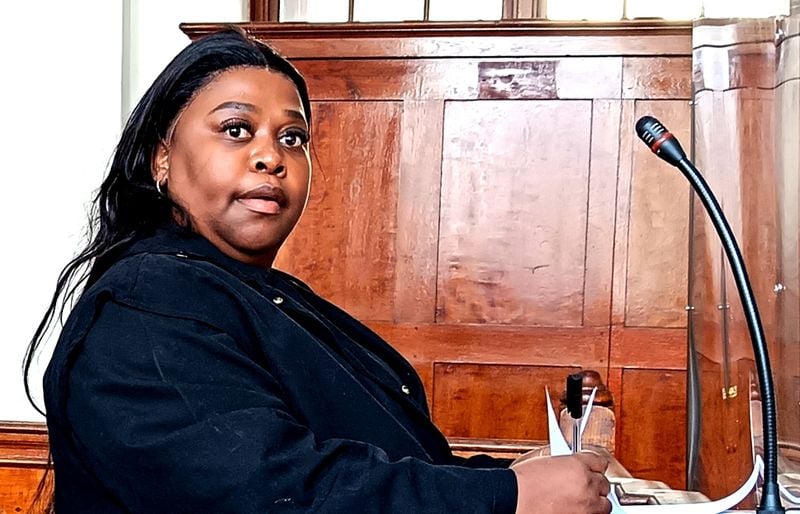
CAPE TOWN — The uMkhonto weSizwe Party suspended its National Assembly Chief Whip with immediate effect on Tuesday, formalising what had been an untenable position since Mmabatho Mokoena-Zondi walked into a Cape Town police station last week to surrender herself to the Hawks.
Four researchers — hired by Mokoena-Zondi herself between August and December 2024 — had filed complaints with the Directorate for Priority Crime Investigation. Their allegation, confirmed by Western Cape Hawks spokesperson Zinzi Hani, was specific and financially detailed: they had been instructed to remit between 50% and 60% of their monthly salaries after being recruited into the party as parliamentary researchers. The money, they were told, was for Jacob Zuma’s legal fees in his long-running arms deal trial in Pietermaritzburg. The total amount the Hawks say was extracted from the four complainants came to R233,317.99.
She had denied the claims. A Belville Commercial Crime Court appearance is set for June 18. Mokoena-Zondi was released on R30,000 bail after appearing before the Cape Town Magistrate’s Court on May 28.
The suspension Tuesday made official what the party’s removal of Mokoena-Zondi from President Cyril Ramaphosa’s Impeachment Committee had already signalled. She had been one of three MK Party MPs assigned to that committee — alongside deputy president John Hlophe and Khanyisile Litchfield-Tshabalala — examining Ramaphosa’s conduct in the Phala Phala saga. The party replaced her there with Siyabonga Gama, a former Transnet executive, and added Andile Mgxitama as an alternate member. That reshuffle happened the day of her arrest. The suspension followed days later, after what the party said was an assessment of the full circumstances surrounding the charges.
What those circumstances included, beyond the fraud charge itself, turned out to be considerable. Mokoena-Zondi, previously known as Seeng Mokoena-Brown, had faced a corruption inquiry more than a decade earlier while serving as municipal manager for what is now the Dr Nkosazana Dlamini-Zuma Municipality. A conviction for falsifying academic qualifications also emerged after her arrest, according to reporting by IOL. A senior MK Party official, speaking on condition of anonymity because he was not authorised to speak to the media, told IOL the party had been unaware of her prior record when she was elevated to chief whip in February. “We did not know that Seeng Mokoena-Brown is Mmabatho Mokoena-Zondi,” the official said.
She had been appointed only four months ago — in February 2026 — replacing Colleen Makhubele, who resigned from Parliament after being removed from the chief whip role in January. Before Makhubele, the position had already cycled through multiple occupants in less than a year. The MK Party holds the second-largest bloc of seats in Parliament and serves as the official opposition.
The case against Mokoena-Zondi is not the only legal exposure weighing on the party’s parliamentary structures. Zuma’s own arms deal trial — the corruption and fraud case that has wound through South African courts for more than two decades — recently had a date set after a KwaZulu-Natal High Court judge condemned what the court characterised as prolonged delay tactics. Former Transnet chief executive Brian Molefe, now the party’s treasurer-general, faces a multi-billion-rand corruption case related to Transnet’s locomotive procurement, postponed to July. Former Prasa CEO Lucky Montana, who left the party as an MP in late 2025, is contesting a R55 million tax evasion claim from the South African Revenue Service and faces separate allegations linking him to funds from the Swifambo locomotive scandal, according to SA People. In April 2026, MP Visvin Reddy pleaded guilty to inciting public violence after making statements threatening civil unrest ahead of the 2024 elections.
The party’s national spokesperson, Sifiso Mahlangu — himself a replacement for Nhlamulo Ndhlela, who was suspended in May after a controversy over a statement suggesting a newly formed MK Institute would assume control of the party’s leadership structures — said when the charges were first confirmed that the MK Party “reaffirms its commitment to constitutionalism and the rule of law.” The party noted that Mokoena-Zondi had voluntarily presented herself to authorities. It did not, at the time, announce any internal disciplinary action. The suspension announced Tuesday formalized that step.
What the party has not yet answered publicly is how a candidate with a prior fraud conviction and a decade-old falsified-credentials investigation was cleared for appointment to one of Parliament’s most consequential organisational roles. The question is not merely procedural. The chief whip of the official opposition manages caucus discipline, coordinates the party’s legislative strategy, and interfaces directly with the Speaker’s office. That the position was filled, and then vacated under legal duress, three times in under a year raises a governance problem the party has not yet named as such.
The MK Party is also contesting a separate high-profile legal matter involving the Independent Electoral Commission, with a vote-rigging case at the Johannesburg High Court also scheduled for June 18 — the same date as Mokoena-Zondi’s Belville Commercial Crime Court appearance. What the parallel proceedings mean for the party’s credibility ahead of the 2026 local government elections remains an open question. Party officials have framed the IEC matter as a broader test of electoral integrity. They have said considerably less about what the accumulated legal exposure of their parliamentary leadership says about the party’s internal vetting processes.
The South African Daily Maverick first reported the fraud charges on May 28. Mokoena-Zondi had not responded to requests for comment from multiple outlets by the time of her suspension. Her next court date is June 18 in Bellville.
The party also faces questions from its own former treasurer-general. According to earlier reporting, the initial complaint against Mokoena-Zondi was filed internally by former MK treasurer-general Menzi Magubane — meaning the fraud probe originated not from an outside whistleblower but from within the party’s own senior structures. That detail, unremarked upon in the party’s public statements, is perhaps the single most significant disclosure in the case so far. A party whose own former officials are filing criminal complaints against its sitting parliamentary leadership is a party experiencing something more than legal difficulty. What that something is — factional warfare, a governance vacuum, or a systemic failure of accountability — remains, as of Tuesday, unanswered.
The MK Party’s rise as South Africa’s official opposition has been accompanied at almost every stage by turbulence inside its parliamentary structures — a pattern that Tuesday’s suspension extends but does not, by any available signal, resolve.