
MOSCOW — The warning Sergei Shoigu delivered on Wednesday was not dressed up as a threat. It arrived as something colder: a withdrawal. Russia, the Security Council secretary told reporters, will not cover the costs of whatever crisis follows Armenia’s westward turn. The bill, he made clear, belongs to Yerevan and its European sponsors.
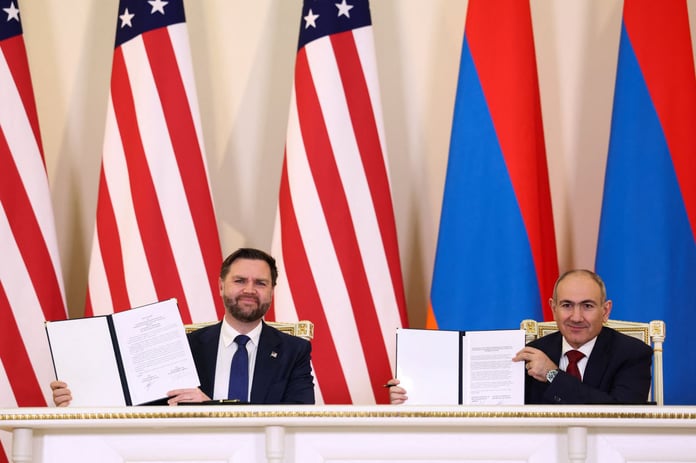
The statement, brief and precise, landed four days before Armenians vote in parliamentary elections that have become the most consequential ballot in the country’s post-Soviet history. Prime Minister Nikol Pashinyan, who is widely expected to retain power, has steered Armenia steadily toward Brussels — freezing participation in the Russian-led Collective Security Treaty Organization in 2024, passing an EU accession initiation law in 2025, and hosting a summit with French President Emmanuel Macron in Yerevan last month. Russia, which supplies Armenia with gas at subsidized prices, has watched each step with growing alarm.
“Armenia understands that without the EAEU and Russia, it will have a hard time, to put it mildly,” Shoigu said. “The Armenian authorities cannot but realize that membership in the EAEU is an obvious benefit for Armenia.” Behind the formal language was an unmistakable signal: the financial architecture that has underpinned Armenian economic stability — discounted energy, preferential trade access, remittance flows from the Armenian diaspora in Russia — is not a permanent fixture.
What made the remarks significant was less their content than their timing and their author. Shoigu, now heading the Security Council after his removal as defence minister in 2024, has become one of Moscow’s most deliberate foreign policy voices. His interventions on Armenia have escalated through the spring: in May, he accused Yerevan of “taking a series of unfriendly steps towards Russia” and reminded Armenian officials of the economic benefits they had accrued from EAEU membership. Wednesday’s statement went further, removing the implication that Moscow would absorb the consequences of Armenian policy choices.
The broader Russian campaign against Pashinyan ahead of the June 7 vote has been systematic. At the EAEU summit in Astana on May 29, Putin joined the leaders of Belarus, Kazakhstan, and Kyrgyzstan in a joint statement calling on Armenia to hold a referendum on whether to remain in the bloc or pursue EU accession. Pashinyan dismissed it as “unreasonable,” saying no referendum made sense until Armenia formally applied for EU candidate status — a step that remains years away. Two days later, Russia recalled its ambassador to Yerevan “for consultations,” a diplomatic downgrade that Euronews described as another rung in an escalating pressure campaign.
Shoigu’s Wednesday remarks introduced a new element: the explicit removal of what might be called Moscow’s insurance function. “Russia will not finance Armenia’s way out of the crisis that will follow Yerevan’s expansion of ties with the EU,” he said. Russian Deputy Prime Minister Aleksei Overchuk had earlier proposed restrictions on Armenian brandy imports, noting that Armenia could not simultaneously deepen EU integration while retaining EAEU trade advantages. Russia supplies roughly 80 percent of Armenia’s natural gas. Were that supply to shift to market pricing, Yerevan’s energy costs would rise sharply — a vulnerability Armenia’s parliament speaker, Alen Simonyan, publicly acknowledged when he warned that such a move might force Armenia to reconsider EAEU membership entirely.
The calculation Shoigu outlined also addressed the referendum question from a direction Pashinyan did not expect. “Behind this statement there is an obvious reluctance to hold this referendum,” Shoigu said, referring to Yerevan’s refusal to schedule a vote. “It may well turn out that the population will speak out against it, and the current government in Yerevan will have to have an unpleasant conversation with European sponsors.” It was, in effect, Moscow’s bet that Armenian public opinion — insulated from the diplomatic class — might not share Pashinyan’s western orientation. Whether that assessment reflects genuine intelligence about voter sentiment or Russian wishful thinking ahead of Saturday’s ballot is impossible to determine from the outside.
Pashinyan’s governing Civil Contract party leads in all major pre-election polls. His coalition has framed Saturday’s vote not as a geopolitical referendum — that framing belongs to Moscow — but as a contest over democratic governance and economic modernization. Armenia’s westward drift has been gradual and carefully managed: Yerevan has not formally applied to join the EU, has not called for the closure of Russia’s 102nd military base in Gyumri, and has continued paying its gas bills. But the expected call between European Commission President Ursula von der Leyen and Pashinyan in the days before the vote signals that Brussels reads the election as consequential enough to invest in visibly.
Russia’s escalating pre-election pressure on Armenia reflects a deeper anxiety than the referendum question itself. As U.S. Secretary of State Marco Rubio told the Senate last week, Washington has concluded that Armenia’s choices are Armenia’s to make. That statement, like Shoigu’s, was a declaration of position rather than a bid for influence. The difference is that one side is threatening to remove a financial safety net while the other is offering an alternative it has not yet fully specified. For Yerevan’s economic planners, that asymmetry is the central problem that will outlast Saturday’s election regardless of who wins.
Armenia’s exports to Russia reach near-total dependency in certain agricultural sectors. Should Moscow follow through on its warning, the consequences would fall hardest not on the political class but on Armenian farmers, producers, and workers whose livelihoods depend on access to the Russian market. That is the audience Shoigu appeared to be speaking to — not Pashinyan, whose political trajectory he has already written off, but the voters who will go to the polls on Saturday and who have not yet decided whether the western path Pashinyan is offering them carries costs they are prepared to pay.
—Inputs from RIA Novosti, Sputnik.
Related Posts