
LONDON — The pitch hadn’t changed. The cloud cover was familiar. And when Ollie Robinson walked in from the Nursery End on Thursday afternoon, with New Zealand on 13 for 3 and England still 79 runs short of a score worth defending, the equation at Lord’s was almost cartoonishly simple. Everything depended on what happened next.
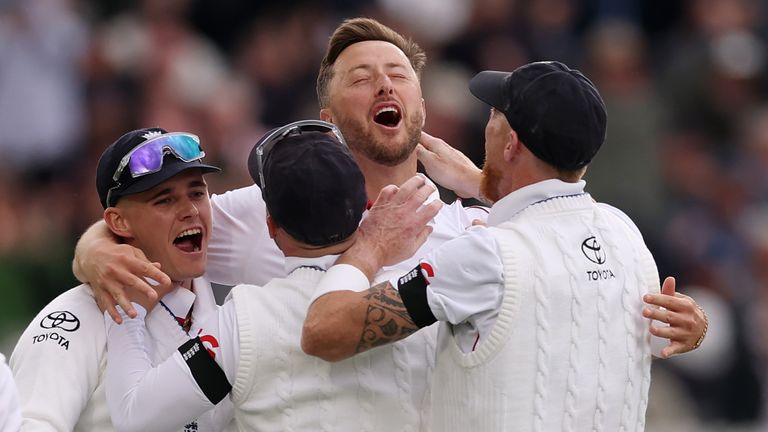
What happened next was the most arresting six-ball passage of English Test cricket since the Ashes implosion that made it necessary. Robinson, playing his first Test for England in more than two years after fitness issues and a quiet exile that he had privately accepted as permanent, delivered Conway, Williamson and Ravindra in the space of four balls — a triple-wicket maiden that reduced New Zealand to 29 for six and announced, with some force, that the post-Ashes rebuild had a cutting edge.
The context matters. England arrived at Lord’s for the first Test of a three-match Rothesay series against New Zealand carrying the weight of a 4-1 Ashes defeat in Australia over the winter. Ben Stokes had spoken in the days before the match about playing “smarter cricket.” Whether that translated into results on the first day of the 2026 Test summer was a more complicated story, but Robinson’s evening over settled the question of who controlled the atmosphere.
Kyle Jamieson had answered first. The towering New Zealand seamer, back in Test cricket himself after more than two years away, collected 5 for 62 to bundle England out for 140 in 39.4 overs. Harry Brook, at 56 from 71 balls, was the only batter to land with any authority — his counterattacking knock from 55 for 5 the kind of innings England had come to rely on even when the rest of the order disintegrated. Emilio Gay, the Durham opener making his debut in place of the dropped Zak Crawley, edged Jamieson behind for eight. Jacob Bethell and Joe Root fell cheaply. The innings ended with Shoaib Bashir and Josh Tongue adding 22 for the last wicket, a figure that spoke to the general difficulty of the surface as much as anything else.
Brendon McCullum had used the build-up to point toward a version of England that had processed its Ashes failures — the soft dismissals, the reckless shot selection in Perth and Brisbane. The first innings at Lord’s didn’t entirely answer that call. But the bowling that followed it provided something more important: the sense that England’s attack, when the conditions cooperated, could still rattle a batting line-up at pace and with precision. Those questions about England’s post-Ashes identity had been running through the English summer for months.
Robinson’s opening over was the argument made in full. Devon Conway, pinned by a nip-backer onto his pad, was lbw for one. Kane Williamson, the Black Caps’ most authoritative run-scorer in English conditions, took an inside edge at short leg off a ball that straightened, and was gone for a duck. One delivery later, Rachin Ravindra played around a late inswinger — another duck, another name in the book. Robinson had taken three wickets in four balls in his first Test over since February 2024. He said afterward he had thought at Christmas he would never play for England again.
Gus Atkinson added Tom Latham to make it 12 for four before Robinson came back to flatten Daryl Mitchell’s middle stump, shouldering arms to a delivery he had no business leaving. Josh Tongue accounted for Tom Blundell, and with bad light cutting the day short after 19.2 overs of New Zealand’s reply, the tourists closed at 61 for six — Glenn Phillips, 31 from 34 balls in the Brook mould, the only batter to treat the conditions as an opportunity rather than an ordeal.
It is worth noting what this version of Lord’s recalled. The opening day of England’s 2022 Bazball era, when Ben Stokes took the captaincy and Brendon McCullum the coaching role, ended with 17 wickets falling in a similarly compressed and dramatic session at this ground. England made 141 that day. This time it was 140. The conditions, the character of the cricket, the sense that anything might happen — all of it was recognisable. What was different was the man bowling the decisive over, and the circumstances that put him there. New Zealand’s own busy international schedule — a record 12-match India tour was confirmed just days ago — has kept the Black Caps in constant motion.
Robinson’s figures of 4 for 10 from six overs at stumps were, in isolation, freakish. The wicket was doing everything, and Williamson and Ravindra, both capable of posting large scores here, were dismissed by balls they might have handled on a less animated surface. None of which diminishes the quality of the bowling. Robinson’s height, his late movement off the pitch, his ability to repeat a length at 83 miles per hour without the need for the kind of pace that his frame has never been built to generate — these are qualities that slow pitches expose more readily than flat ones, and he used all of them.
On day two, the match remained on a knife’s edge. New Zealand resumed at 61 for six, trailing by 79, with Phillips and Nathan Smith at the crease. By the end of the morning session, the tourists had reached 70 for seven, still trailing by 70, the lower order under sustained pressure from Tongue and Robinson. Whether Phillips could extend his resistance — and whether the pitch retained its unpredictability into a second day — would determine whether England’s first innings total of 140 was a launchpad or a liability.
What was already settled was the identity of the man who had made the opening day worth watching. Robinson had not just returned to Test cricket. At Lord’s, in the summer after the Ashes, he had reminded English cricket why it had missed him. The wider Test landscape has been shifting, too — Australia made their own bold selection calls ahead of what shapes up as a heavyweight ICC Test season — but on Thursday at the Home of Cricket, the story was narrower and more immediate. Six balls. Three wickets. One over that changed everything.
The second and third Tests of the series are scheduled at The Kia Oval on June 17 and Trent Bridge on June 25.